Thank you for visiting SNEWPapers!
Sign up free
Gazette Of The United States, & Philadelphia Daily Advertiser
Philadelphia, Philadelphia County, Pennsylvania
What is this article about?
U.S. House of Representatives session on Tuesday, January 9, featured committee reports on bills for relief and pensions, petitions from soldiers, a resolution on duties on spirits, and a lengthy debate on appropriating funds to relieve Tennessee citizens dispossessed of lands by Indian treaties, ending with the committee rising and leave to sit again.
Merged-components note: The text in the second component continues the report on the House of Representatives debate from the first, forming a single news item.
Clipping
OCR Quality
Full Text
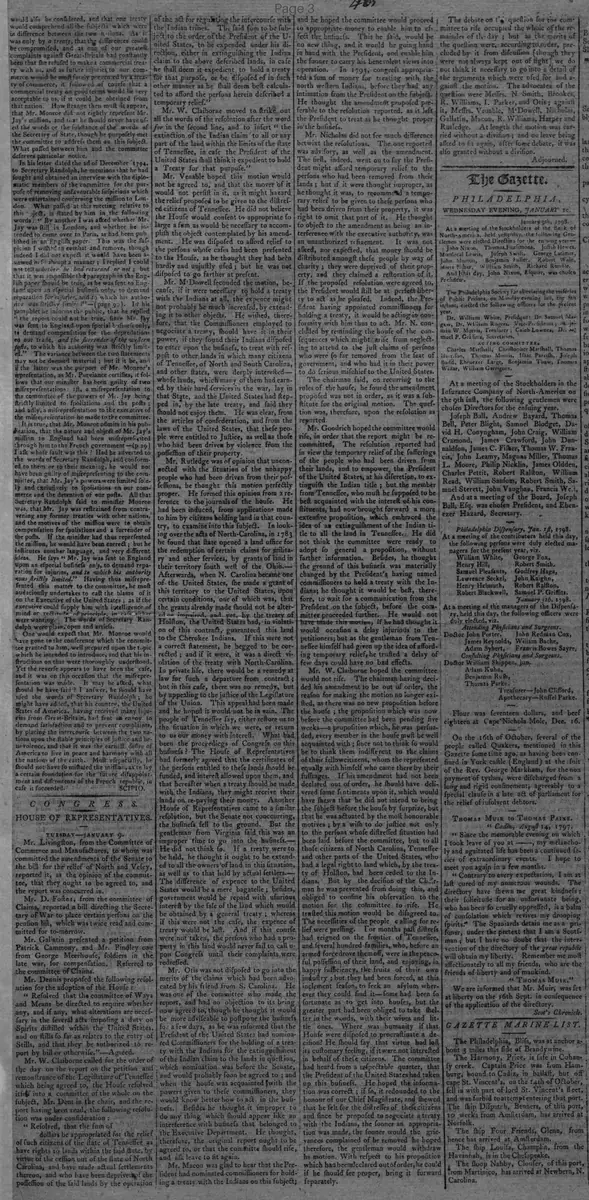
TUESDAY, JANUARY 9.
Mr. Livingston, from the Committee of Commerce and Manufactures, to whom was committed the amendments of the Senate to the bill for the relief of North and Veey, reported it, as the opinion of the committee, that they ought to be agreed to, and the report was concurred in.
Mr. D. Foster, from the committee of Claims, reported a bill directing the Secretary of War to place certain persons on the pension list, which was twice read and committed for to-morrow.
Mr. Gallatin presented a petition from Patrick Cammony, and Mr. Findley one from George Meerhouse, soldiers in the late war, for compensation. Referred to the committee of Claims.
Mr. Dennis proposed the following resolution for the adoption of the House:
"Resolved that the committee of Ways and Means be directed to inquire whether any, and if any, what alterations are necessary in the several acts imposing a duty on Spirits distilled within the United States, and on stills so far as relates to the entry of Stills, and that they be authorized to report by bill or otherwise." Agreed.
Mr. W. Claiborne called for the order of the day on the report on the petition and remonstrance of the Legislature of Tennessee which being agreed to, the House resolved itself into a committee of the whole on the subject, Mr. Dent in the chair, and the report having been read, the following resolution was under consideration:
"Resolved, that the sum of _____ dollars be appropriated for the relief of such citizens of the state of Tennessee as have rights to lands within the said state, by virtue of the cession out of the state of North Carolina, and have made actual settlements thereon, and who have been deprived of the possession of the said lands by the operation of the act for regulating the intercourse with the Indian tribes. The said sum to be subject to the order of the President of the United States, to be expended under his direction, either in extinguishing the Indian claim to the above described lands, in case he shall deem it expedient to hold a treaty for that purpose, or be disposed of in such other manner as he shall deem best calculated to afford the persons herein described a temporary relief."
Mr. W. Claiborne moved to strike out all the words of the resolution after the word for in the second line, and to insert "the extinction of the Indian claim to all or any part of the land within the limits of the state of Tennessee, in case the President of the United States shall think it expedient to hold a Treaty for that purpose."
Mr. Venable hoped this motion would not be agreed to, and that the mover of it would not persist in it, as it might hazard the relief proposed to be given to the distressed citizens of Tennessee. He did not believe the House would consent to appropriate so large a sum as would be necessary to accomplish the object contemplated by his amendment. He was disposed to afford relief to the persons whose cases had been presented to the House, as he thought they had been hardly and unjustly used; but he was not disposed to go farther at present.
Mr. M'Dowell seconded the motion, because, if it were necessary to hold a treaty with the Indians at all, the expense might not probably be much increased, by extending it to other objects. He wished, therefore, that the Commissioners employed to negotiate a treaty, should have it in their power, if they found their Indians disposed to enter upon the business, to treat with respect to other lands in which many citizens of Tennessee, of North and South Carolina, and other states, were deeply interested—who's lands, which many of them had earned by their hard services in the war, lay in that State, and the United States had stepped in, by the late treaty, and said they should not enjoy them. He was clear, from the articles of confederation, and from the laws of the United States, that these people were entitled to justice, as well as those who had been driven by violence from the possession of their property.
Mr. Rutledge was of opinion that unconnected with the situation of the unhappy people who had been driven from their possessions, he thought this motion perfectly proper. He formed this opinion from a reference to the journals of the house. He had been induced, from applications made to him by citizens holding land in that country, to examine into this subject. In looking over the acts of North-Carolina, in 1783 he found that state opened a land office for the redemption of certain claims for military and other services, by grants of land in their territory south west of the Ohio. Afterwards, when N. Carolina became one of the United States, She made a grant of this territory to the United States, upon certain conditions, one of which was, that the grants already made should not be altered or impaired, and yet, by the treaty of Holston, the United States had, in violation of this contract, guaranteed this land to the Cherokee Indians. If this were not a correct statement, he begged to be corrected: and if it were, it was a direct violation of the treaty with North-Carolina. In private life, there would be a remedy at law for such a departure from contract; but in this case, there was no remedy, but by appealing to the justice of the Legislature of the Union. This appeal had been made and he hoped it would not be in vain. The people of Tennessee say, either restore us to the situation in which we were, or return to us our money with interest. What had been the proceedings of Congress on this business? The House of Representatives had formerly agreed that the certificates of the persons entitled to these lands should be funded, and interest allowed upon them, and that hereafter when a treaty should be made with the Indians, they might receive their lands on re-paying their money. Another House of Representatives came to a similar resolution, but the Senate not concurring, the business fell to the ground. But the gentleman from Virginia said this was an improper time to go into the business. He did not think so. If a treaty were to be held, he thought it ought to be extended to all the owners of land in this situation, as well as to that held by actual settlers. The difference of expense to the United States would be a mere bagatelle; besides, government would be repaid with usurious interest by the sale of the land which would be obtained by a general treaty; whereas if this were not the case, the expense of treaty would be lost. And if this course were not taken, the persons who had a property in this land would never fail to call upon Congress until their complaints were redressed.
Mr. Otis was not disposed to go into the merits of the claims which had been advocated by his friend from S. Carolina. He was one of the committee who made the report, and had no objection to its being now agreed to, though he thought it would be more advisable to postpone the business for a few days, as he was informed that the President of the United States had nominated Commissioners for the holding of a treaty with the Indians for the extinguishment of the Indian claim to the lands in question, which nomination was before the Senate, and would probably soon be agreed to; and when the house was acquainted with the powers given to these commissioners, they would know better how to act in the business. Besides he thought it improper to do any thing which should appear like an interference with business that belonged to the Executive Department. He thought, therefore, the original report ought to be agreed to, or that the committee should rise, and ask leave to sit again.
Mr. Macon was glad to hear that the President had nominated commissioners for holding a treaty with the Indians on this subject: and he hoped the committee would proceed to appropriate money to enable him to effect the business. This he said, would be no new thing, and it would be going hand in hand with the President, and enable him the sooner to carry his benevolent views into operation. In 1793, congress appropriated a sum of money for treating with the north western Indians, before they had any intimation from the President on the subject. He thought the amendment proposed preferable to the resolution reported, as it left the President to treat as he thought proper in the business.
Mr. Nicholas did not see much difference betwixt the resolutions. The one reported was advisory, as well as the amendment. The first, indeed, went on to say the President might afford temporary relief to the persons who had been removed from their lands; but if it were thought improper, as he thought it was, to recommend a temporary relief to be given to these persons who had been driven from their property, it was right to omit that part of it. He thought to object to the amendment as being an interference with the executive authority, was an unauthorized refinement. It was not asked, nor expected, that money should be distributed amongst these people by way of charity; they were deprived of their property, and they claimed a restoration of it. If the proposed resolution were agreed to, the President would still be at perfect liberty to act as he pleased. Indeed, the President having appointed commissioners for holding a treaty, it would be acting in conformity with him thus to act. Mr. N. concluded by reminding the house of the consequences which might arise from neglecting to attend to the just claims of persons who were so far removed from the seat of government, and who had it in their power to do serious mischief to the United States.
The chairman said, on recurring to the rules of the house, he found the amendment proposed was not in order, as it was a substitute for the original motion. The question was, therefore, upon the resolution as reported.
Mr. Goodrich hoped the committee would rise, in order that the report might be recommitted. The resolution reported had in view the temporary relief of the sufferings of the people who had been driven from their lands, and to empower the President of the United States, at his discretion, to extinguish the Indian title; but the member from Tennessee, who must be supposed to be best acquainted with the interest of his constituents, had now brought forward a more extensive proposition, which embraced the idea of an extinguishment of the Indian title to all the land in Tennessee. He did not think the committee were ready to adopt so general a proposition, without farther information. Besides, he thought the ground of this business was materially changed by the President's having named commissioners to hold a treaty with the Indians; he thought it would be best, therefore, to wait for a communication from the President on the subject, before the committee proceeded further. He would not have made this motion, if he had thought it would occasion a delay injurious to the petitioners; but as the gentleman from Tennessee himself had given up the idea of affording temporary relief, he trusted a delay of few days could have no bad effects.
Mr. W. Claiborne hoped the committee would not rise. The chairman having decided his amendment to be out of order, the reason for making the motion no longer existed, as there was no new proposition before the house; the proposition which was now before the committee had been pending five weeks—a proposition which, he was persuaded, every member in the house must be well acquainted with; since not to think so would be to think them indifferent to the claims of their fellow citizens, whom they represented equally with himself who came there by their suffrages. If his amendment had not been declared out of order, he should have delivered some sentiments upon it, which would have shewn that he did not intend to bring the subject before the house by surprise, but that he was actuated by the most honourable motives; by a wish to do justice not only to the persons whose distressed situation had been laid before the committee, but to all those citizens of North Carolina, Tennessee and other parts of the United States, who had a legal right to land which, by the treaty of Holston, had been ceded to the Indians. But by the decision of the Chairman he was prevented from doing this, and obliged to confine his observation to the motion for the committee to rise. He trusted this motion would be disagreed to. The necessities of the people calling for relief were pressing. For months past distress had reigned on the frontier of Tennessee, and several hundred families, who, before an armed force drove them off, were in the peaceable possession of their land, and enjoying, in happy sufficiency, the fruits of their own industry; but they had been forced, at this inclement season, to seek an asylum wherever they could find it—some had been so fortunate as to get into houses, but the greater part had been obliged to take shelter in the woods, with their wives and little ones. Where was humanity if that House were disposed to procrastinate a decision? He should say, that virtue had lost its customary feeling, if it were not interested in behalf of these citizens. The committee had heard, from a respectable quarter, that the President of the United States had taken up this business. He hoped the information was correct; if so, it redounded to the honour of our Chief Magistrate, and shewed that he felt for the distresses of these citizens and since he proposed to negotiate a treaty with the Indians, the sooner an appropriation was made, the sooner would the grievances complained of be removed he hoped therefore, the gentleman would withdraw his motion. With respect to his proposition which has been declared out of order, he could if he should see proper, bring it forward separately.
The debate on the question for the committee to rise occupied the whole of the remainder of the day; but as the merits of the question were, according to order, precluded by it from discussion though they were not always kept out of sight, we do not think it necessary to go into a detail of the arguments which were used for and against the motion. The advocates of the question were Messrs. N. Smith, Brookes, R. Williams, J. Parker, and Otis; against it, Messrs. Venable, M'Dowell, Nicholas, Gallatin, Macon, R. Williams, Harper and Rutledge. At length the motion was carried without a division; and on leave being asked to sit again, after some debate, it was also granted without a division.
Adjourned.
What sub-type of article is it?
What keywords are associated?
What entities or persons were involved?
Domestic News Details
Event Date
Tuesday, January 9
Key Persons
Outcome
the house concurred on amendments for north and veey relief bill; pension bill committed; petitions referred; resolution on spirits duties agreed; debate on tennessee land relief resolution led to committee rising without decision, leave to sit again granted; adjourned.
Event Details
The House considered committee reports on bills for relief of North and Veey and pensions, referred petitions from soldiers Patrick Cammony and George Meerhouse, agreed to a resolution inquiring into alterations on duties on spirits and stills, and debated a resolution to appropriate funds for Tennessee citizens dispossessed of lands due to Indian intercourse act and Holston treaty, focusing on extinguishing Indian claims via treaty or providing temporary relief, with an amendment ruled out of order and motion to rise carried.