Thank you for visiting SNEWPapers!
Sign up free
Literary
March 22, 1845
New Haven Daily Herald
New Haven, New Haven County, Connecticut
What is this article about?
After financial ruin, Bob and his uncle plot for Bob to marry an heiress. At a concert, Bob learns of a wealthy Southern family from his tailor. He stages a cab accident to be injured and cared for in their home by the beautiful daughter, but discovers she is married.
Merged-components note: Continuation of the narrative story 'Introduction to Du Heffress' across adjacent columns on page 2.
Clipping
OCR Quality
98%
Excellent
Full Text
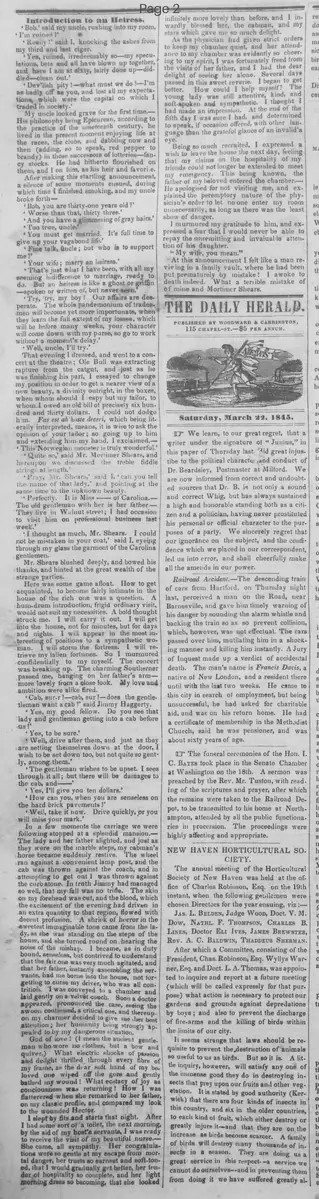
Introduction to Du Heffress:
"Bob," said my uncle, rushing into my room, "I'm ruined!"
"Really!" said I, knocking the ashes from my third and last cigar.
"Yes, ruined, irredeemably so—my speculations, bets and all have blown up together, and here I am at sixty, fairly done up—diddled clean out."
"Devilish pity! What must we do?—I'm as badly off as you, and lost all my expectations, which were the capital on which I traded in society."
My uncle looked grave for the first time.—His philosophy being Epicurean, according to the practice of the nineteenth century, he lived in the present moment enjoying life at the races, the clubs, and dabbling now and then (adding, so to speak, red pepper to brandy) in those successors of lotteries—fancy stocks. He had hitherto flourished on them, and I on him, as his heir and favorite.
After making this startling announcement, a silence of some moments ensued, during which time I finished smoking, and my uncle broke forth—
"Bob, you are thirty-one years old?"
"Worse than that, thirty-three."
"And you have a glimmering of gray hairs."
"Too true, uncle."
"You must get married. It's full time to give up your vagabond life."
"Fine talk, uncle; but who is to support me?"
"Your wife; marry an heiress."
"That's just what I have been, with all my seeming indifference to marriage, ready to do. But an heiress is like a ghost or griffin—spoken or written of, but never seen."
"Try, try, my boy! Our affairs are desperate. The whole pandemonium of tradesmen will become yet more importunate, when they learn the full extent of my losses, which will be before many weeks, your character will come down with my purse, so go to work without a moment's delay."
"Well, uncle, I'll try."
That evening I dressed, and went to a concert at the theatre; Ole Bull was extracting rapture from the catgut, and just as he was finishing his part, I essayed to change my position in order to get a nearer view of a new beauty, a divinity outright, in the boxes, when whom should I espy but my tailor, to whom I owed an old bill of precisely six hundred and thirty dollars. I could not dodge him. Fas est ab hoste doceri, which being literally interpreted, means, it is wise to ask the opinion of your tailor; so going up to him and extending him my hand, I exclaimed,—
"This Norwegian monster is truly wonderful."
"Quite so," said Mr. Mortimer Shears, and hereupon we discussed the treble fiddle strings at length.
"Pray, Mr. Shears," said I, "can you tell the name of that lady," and pointing at the same time to the unknown beauty.
"Perfectly. It is Miss — of Carolina.—The old gentleman with her is her father—Thev live in Walnut street; I had occasion to visit him on professional business last week."
"I thought as much, Mr. Shears. I could not be mistaken in your coat," said I, eyeing through my glass the garment of the Carolina gentleman.
Mr. Shears blushed deeply, and bowed his thanks, and hinted at the great wealth of the strange parties.
Here was some game afloat. How to get acquainted, to become fairly intimate in the house of the rich one was a question. A hum-drum introduction, frigid ordinary visit, would not suit my necessities. A bold thought struck me. I will carry it out. I will get into the house, not for minutes, but for days and nights. I will appear in the most interesting of positions to a sympathetic woman. I will storm the fortress. I will retrieve my fallen fortunes. So I murmured confidentially to myself. The concert was breaking up. The charming Southerner passed me, hanging on her father's arm—more lovely from a close look. My love and ambition were alike fired.
"Cab, sur-r? cab, sur?—does the gentleman want a cab?" said Jimmy Haggerty.
"Yes, my good fellow. Do you see that lady and gentleman getting into a cab before us?"
"Yes, to be sure."
"Well, drive after them, and just as they are setting themselves down at the door, I wish to be set down too, but not quite so gently, among them."
"The gentleman wishes to be upset. I sees through it all: but there will be damages to the cab, and—"
"Yes, I'll give you ten dollars."
"How can you, when you are senseless on the hard brick pavements?"
"Well, take it now. Drive quickly, or you will miss your mark."
In a few moments the carriage we were following stopped at a splendid mansion.—The lady and her father alighted, and just as they were on the marble steps, my cabman's horse became suddenly restive. The wheel ran against a convenient lamp post, and the cab was thrown against the coach, and in attempting to get out I was thrown against the curb stone. In truth Jimmy had managed so well, that my fall was no trifle. The skin on my forehead was cut, and the blood, which the excitement of the evening had driven in an extra quantity to that region, flowed with decent profusion. A shriek of horror in the sweetest imaginable tone came from the lady, as she was standing on the steps of the house, and she turned round on hearing the noise of the mishap. I became, as in duty bound, senseless, but contrived to understand that the fair one was very much agitated, and that her father, instantly assembling the servants, had me borne into the house, not forgetting to curse my driver, who was all contrition. I was conveyed to a chamber and laid gently on a velvet couch. Soon a doctor appeared, pronounced the case, seeing the swoon continued, a critical one, and thereupon my charmer decided to give me their best attention; her humanity being strongly appealed to by my dangerous situation.
God of love! (I mean the ancient gentleman who wore no clothes, but a bow and quiver.) What electric shocks of passion and delight thrilled through every fibre of my frame, as the dear soft hand of my beloved one wiped off the gore and gently bathed my wound! What ecstasy of joy as consciousness was returning! How I was flattered when she remarked to her father, on my classic profile, and compared my look to the wounded Hector!
I slept by fits and starts that night. After I had some sort of a toilet, the next morning, by the aid of my host's servants, I was ready to receive the visit of my beautiful nurse.—She came, all sympathy. Her congratulations were so gentle at my escape from mortal danger, her trusts so earnest and soft-toned, that I would gradually get better, her tender of hospitality so complete, and her light morning dress so becoming, that she looked infinitely more lovely than before, and I inwardly blessed her, the cabman, and my stars which gave me so much delight.
As the physician had given strict orders to keep my chamber quiet, and her attendance to my chamber was evidently so cheering to my spirit, I was fortunately freed from the visits of her father, and I had the dear delight of seeing her alone. Several days passed in this sweet reverie. I began to get better. How could I help myself? The young lady was still attentive, kind, and soft-spoken and sympathetic. I thought I had made an impression. At the end of the fifth day I was sure I had, and determined to speak, if occasion offered, with other language than the grateful glance of an invalid's eye.
Being so much recruited, I expressed a wish to leave the house the next day, feeling that my claims on the hospitality of my friends could not longer be extended to meet my emergency. This being known, the father of my beloved entered the chamber.—He apologised for not visiting me, and explained the peremptory nature of the physician's order to let no one enter my room unnecessarily, as long as there was the least show of danger.
I murmured my gratitude to him, and expressed a fear that I would never be able to repay the unremitting and invaluable attention of his daughter.
"My wife, you mean."
At this announcement I felt like a man reviving in a family vault, where he had been put prematurely by mistake! I awoke to death indeed. What a terrible mistake of mine and Mortimer Shears.
"Bob," said my uncle, rushing into my room, "I'm ruined!"
"Really!" said I, knocking the ashes from my third and last cigar.
"Yes, ruined, irredeemably so—my speculations, bets and all have blown up together, and here I am at sixty, fairly done up—diddled clean out."
"Devilish pity! What must we do?—I'm as badly off as you, and lost all my expectations, which were the capital on which I traded in society."
My uncle looked grave for the first time.—His philosophy being Epicurean, according to the practice of the nineteenth century, he lived in the present moment enjoying life at the races, the clubs, and dabbling now and then (adding, so to speak, red pepper to brandy) in those successors of lotteries—fancy stocks. He had hitherto flourished on them, and I on him, as his heir and favorite.
After making this startling announcement, a silence of some moments ensued, during which time I finished smoking, and my uncle broke forth—
"Bob, you are thirty-one years old?"
"Worse than that, thirty-three."
"And you have a glimmering of gray hairs."
"Too true, uncle."
"You must get married. It's full time to give up your vagabond life."
"Fine talk, uncle; but who is to support me?"
"Your wife; marry an heiress."
"That's just what I have been, with all my seeming indifference to marriage, ready to do. But an heiress is like a ghost or griffin—spoken or written of, but never seen."
"Try, try, my boy! Our affairs are desperate. The whole pandemonium of tradesmen will become yet more importunate, when they learn the full extent of my losses, which will be before many weeks, your character will come down with my purse, so go to work without a moment's delay."
"Well, uncle, I'll try."
That evening I dressed, and went to a concert at the theatre; Ole Bull was extracting rapture from the catgut, and just as he was finishing his part, I essayed to change my position in order to get a nearer view of a new beauty, a divinity outright, in the boxes, when whom should I espy but my tailor, to whom I owed an old bill of precisely six hundred and thirty dollars. I could not dodge him. Fas est ab hoste doceri, which being literally interpreted, means, it is wise to ask the opinion of your tailor; so going up to him and extending him my hand, I exclaimed,—
"This Norwegian monster is truly wonderful."
"Quite so," said Mr. Mortimer Shears, and hereupon we discussed the treble fiddle strings at length.
"Pray, Mr. Shears," said I, "can you tell the name of that lady," and pointing at the same time to the unknown beauty.
"Perfectly. It is Miss — of Carolina.—The old gentleman with her is her father—Thev live in Walnut street; I had occasion to visit him on professional business last week."
"I thought as much, Mr. Shears. I could not be mistaken in your coat," said I, eyeing through my glass the garment of the Carolina gentleman.
Mr. Shears blushed deeply, and bowed his thanks, and hinted at the great wealth of the strange parties.
Here was some game afloat. How to get acquainted, to become fairly intimate in the house of the rich one was a question. A hum-drum introduction, frigid ordinary visit, would not suit my necessities. A bold thought struck me. I will carry it out. I will get into the house, not for minutes, but for days and nights. I will appear in the most interesting of positions to a sympathetic woman. I will storm the fortress. I will retrieve my fallen fortunes. So I murmured confidentially to myself. The concert was breaking up. The charming Southerner passed me, hanging on her father's arm—more lovely from a close look. My love and ambition were alike fired.
"Cab, sur-r? cab, sur?—does the gentleman want a cab?" said Jimmy Haggerty.
"Yes, my good fellow. Do you see that lady and gentleman getting into a cab before us?"
"Yes, to be sure."
"Well, drive after them, and just as they are setting themselves down at the door, I wish to be set down too, but not quite so gently, among them."
"The gentleman wishes to be upset. I sees through it all: but there will be damages to the cab, and—"
"Yes, I'll give you ten dollars."
"How can you, when you are senseless on the hard brick pavements?"
"Well, take it now. Drive quickly, or you will miss your mark."
In a few moments the carriage we were following stopped at a splendid mansion.—The lady and her father alighted, and just as they were on the marble steps, my cabman's horse became suddenly restive. The wheel ran against a convenient lamp post, and the cab was thrown against the coach, and in attempting to get out I was thrown against the curb stone. In truth Jimmy had managed so well, that my fall was no trifle. The skin on my forehead was cut, and the blood, which the excitement of the evening had driven in an extra quantity to that region, flowed with decent profusion. A shriek of horror in the sweetest imaginable tone came from the lady, as she was standing on the steps of the house, and she turned round on hearing the noise of the mishap. I became, as in duty bound, senseless, but contrived to understand that the fair one was very much agitated, and that her father, instantly assembling the servants, had me borne into the house, not forgetting to curse my driver, who was all contrition. I was conveyed to a chamber and laid gently on a velvet couch. Soon a doctor appeared, pronounced the case, seeing the swoon continued, a critical one, and thereupon my charmer decided to give me their best attention; her humanity being strongly appealed to by my dangerous situation.
God of love! (I mean the ancient gentleman who wore no clothes, but a bow and quiver.) What electric shocks of passion and delight thrilled through every fibre of my frame, as the dear soft hand of my beloved one wiped off the gore and gently bathed my wound! What ecstasy of joy as consciousness was returning! How I was flattered when she remarked to her father, on my classic profile, and compared my look to the wounded Hector!
I slept by fits and starts that night. After I had some sort of a toilet, the next morning, by the aid of my host's servants, I was ready to receive the visit of my beautiful nurse.—She came, all sympathy. Her congratulations were so gentle at my escape from mortal danger, her trusts so earnest and soft-toned, that I would gradually get better, her tender of hospitality so complete, and her light morning dress so becoming, that she looked infinitely more lovely than before, and I inwardly blessed her, the cabman, and my stars which gave me so much delight.
As the physician had given strict orders to keep my chamber quiet, and her attendance to my chamber was evidently so cheering to my spirit, I was fortunately freed from the visits of her father, and I had the dear delight of seeing her alone. Several days passed in this sweet reverie. I began to get better. How could I help myself? The young lady was still attentive, kind, and soft-spoken and sympathetic. I thought I had made an impression. At the end of the fifth day I was sure I had, and determined to speak, if occasion offered, with other language than the grateful glance of an invalid's eye.
Being so much recruited, I expressed a wish to leave the house the next day, feeling that my claims on the hospitality of my friends could not longer be extended to meet my emergency. This being known, the father of my beloved entered the chamber.—He apologised for not visiting me, and explained the peremptory nature of the physician's order to let no one enter my room unnecessarily, as long as there was the least show of danger.
I murmured my gratitude to him, and expressed a fear that I would never be able to repay the unremitting and invaluable attention of his daughter.
"My wife, you mean."
At this announcement I felt like a man reviving in a family vault, where he had been put prematurely by mistake! I awoke to death indeed. What a terrible mistake of mine and Mortimer Shears.
What sub-type of article is it?
Prose Fiction
Satire
What themes does it cover?
Commerce Trade
Love Romance
Social Manners
What keywords are associated?
Financial Ruin
Heiress Hunt
Staged Accident
Romantic Scheme
Satirical Narrative
Marriage For Money
Literary Details
Title
Introduction To Du Heffress
Key Lines
"Your Wife; Marry An Heiress."
"This Norwegian Monster Is Truly Wonderful."
God Of Love! (I Mean The Ancient Gentleman Who Wore No Clothes, But A Bow And Quiver.) What Electric Shocks Of Passion And Delight Thrilled Through Every Fibre Of My Frame, As The Dear Soft Hand Of My Beloved One Wiped Off The Gore And Gently Bathed My Wound!
"My Wife, You Mean."
What A Terrible Mistake Of Mine And Mortimer Shears.