Thank you for visiting SNEWPapers!
Sign up free
Letter to Editor
December 16, 1803
Alexandria Daily Advertiser
Alexandria, Virginia
What is this article about?
A student at George-Town College submits a quote from Seneca describing the Corsicans, interpreting it as a prophecy of Bonaparte's rise, and provides his own liberal translation.
Clipping
OCR Quality
98%
Excellent
Full Text
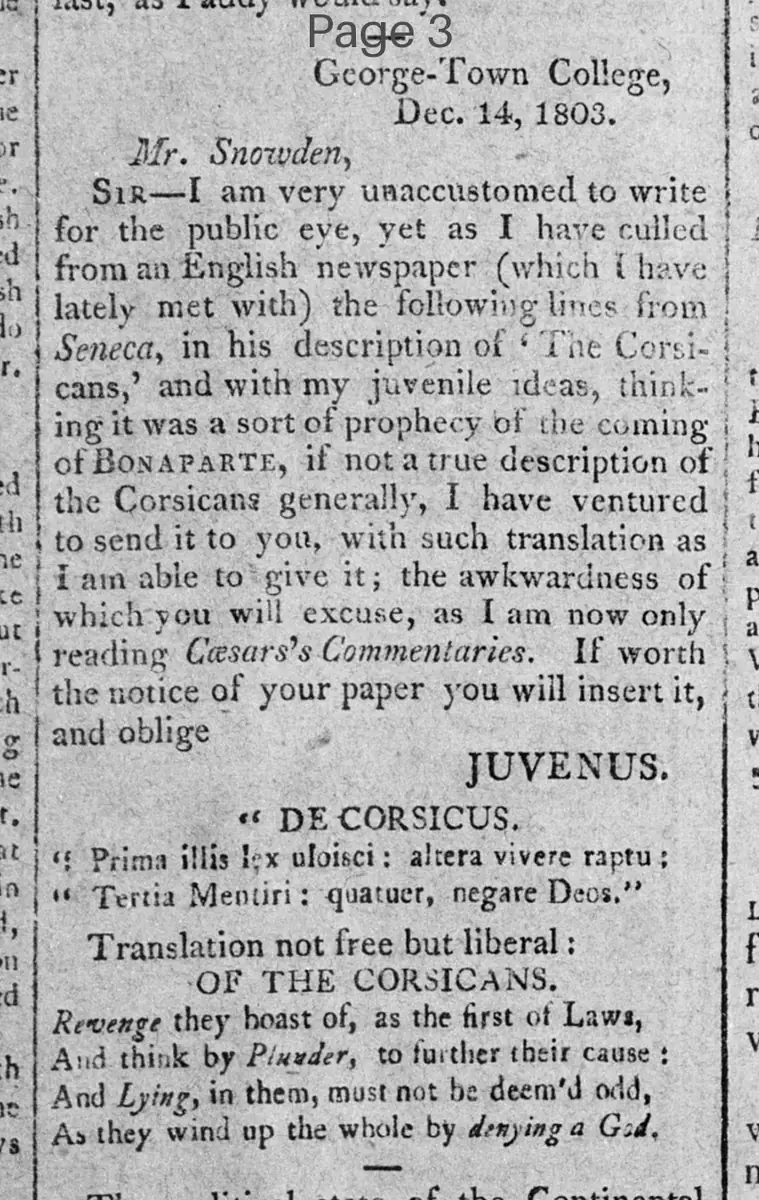
George-Town College,
Dec. 14, 1803.
Mr. Snowden,
SIR--I am very unaccustomed to write for the public eye, yet as I have culled from an English newspaper (which I have lately met with) the following lines from Seneca, in his description of 'The Corsicans,' and with my juvenile ideas, thinking it was a sort of prophecy of the coming of BONAPARTE, if not a true description of the Corsicans generally, I have ventured to send it to you, with such translation as I am able to give it; the awkwardness of which you will excuse, as I am now only reading Caesar's Commentaries. If worth the notice of your paper you will insert it, and oblige
JUVENUS.
"DE CORSICUS.
Prima illis lex est olosciri: altera vivere raptu:
Tertia Mentiri: quarta, negare Deos."
Translation not free but liberal:
OF THE CORSICANS.
Revenge they boast of, as the first of Laws,
And think by Plunder, to further their cause:
And Lying, in them, must not be deem'd odd,
As they wind up the whole by denying a God.
Dec. 14, 1803.
Mr. Snowden,
SIR--I am very unaccustomed to write for the public eye, yet as I have culled from an English newspaper (which I have lately met with) the following lines from Seneca, in his description of 'The Corsicans,' and with my juvenile ideas, thinking it was a sort of prophecy of the coming of BONAPARTE, if not a true description of the Corsicans generally, I have ventured to send it to you, with such translation as I am able to give it; the awkwardness of which you will excuse, as I am now only reading Caesar's Commentaries. If worth the notice of your paper you will insert it, and oblige
JUVENUS.
"DE CORSICUS.
Prima illis lex est olosciri: altera vivere raptu:
Tertia Mentiri: quarta, negare Deos."
Translation not free but liberal:
OF THE CORSICANS.
Revenge they boast of, as the first of Laws,
And think by Plunder, to further their cause:
And Lying, in them, must not be deem'd odd,
As they wind up the whole by denying a God.
What sub-type of article is it?
Informative
Philosophical
Reflective
What themes does it cover?
Politics
Religion
What keywords are associated?
Seneca Quote
Corsicans
Bonaparte Prophecy
Classical Translation
George Town College
What entities or persons were involved?
Juvenus
Mr. Snowden
Letter to Editor Details
Author
Juvenus
Recipient
Mr. Snowden
Main Argument
the quote from seneca on the corsicans appears to be a prophecy of bonaparte's coming or a general description of corsicans.
Notable Details
Quote From Seneca's Description Of 'The Corsicans'
Juvenile Translation Provided
Reference To Reading Caesar's Commentaries