Thank you for visiting SNEWPapers!
Sign up free
Poem
July 8, 1785
Fowle's New Hampshire Gazette And General Advertiser
Portsmouth, Rockingham County, New Hampshire
What is this article about?
A lyrical poem addressed to a dear friend, expressing how their absence causes dullness and lack of joy in the speaker's life, attributing it to the profound unity of their souls through mighty friendship.
Clipping
OCR Quality
95%
Excellent
Full Text
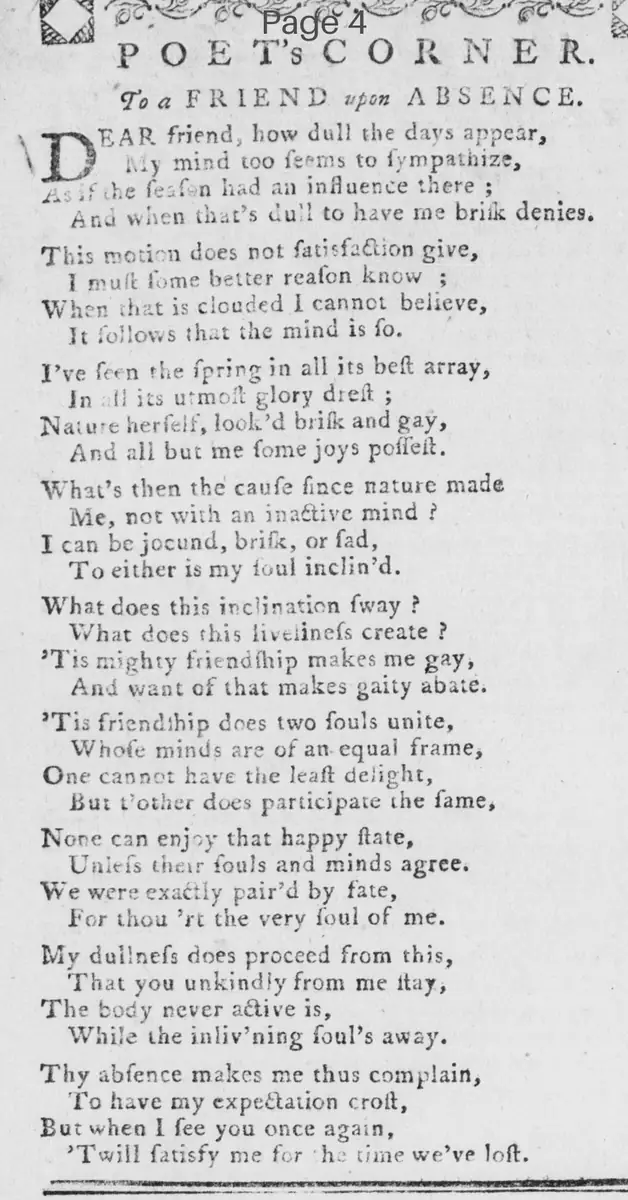
POET's CORNER.
To a FRIEND upon ABSENCE.
DEAR friend, how dull the days appear,
My mind too seems to sympathize,
As if the season had an influence there ;
And when that's dull to have me brisk denies.
This motion does not satisfaction give,
I must some better reason know ;
When that is clouded I cannot believe,
It follows that the mind is so.
I've seen the spring in all its best array,
In all its utmost glory drest :
Nature herself, look'd brisk and gay,
And all but I some joys possess.
What's then the cause since nature made
Me, not with an inactive mind ?
I can be jocund, brisk, or sad.
To either is my soul inclin'd.
What does this inclination sway ?
What does this liveliness create ?
'Tis mighty friendship makes me gay,
And want of that makes gaiety abate.
'Tis friendship does two souls unite,
Whose minds are of an-equal frame,
One cannot have the least delight,
But t'other does participate the same,
None can enjoy that happy state,
Unites their souls and minds agree.
We were exactly pair'd by fate,
For thou 'rt the very soul of me.
My dullness does proceed from this,
That you unkindly from me stay;
The body never active is,
While the enliv'ning soul's away.
Thy absence makes me thus complain,
To have my expectation crost,
But when I see you once again,
'Twill satisfy me for the time we've lost.
To a FRIEND upon ABSENCE.
DEAR friend, how dull the days appear,
My mind too seems to sympathize,
As if the season had an influence there ;
And when that's dull to have me brisk denies.
This motion does not satisfaction give,
I must some better reason know ;
When that is clouded I cannot believe,
It follows that the mind is so.
I've seen the spring in all its best array,
In all its utmost glory drest :
Nature herself, look'd brisk and gay,
And all but I some joys possess.
What's then the cause since nature made
Me, not with an inactive mind ?
I can be jocund, brisk, or sad.
To either is my soul inclin'd.
What does this inclination sway ?
What does this liveliness create ?
'Tis mighty friendship makes me gay,
And want of that makes gaiety abate.
'Tis friendship does two souls unite,
Whose minds are of an-equal frame,
One cannot have the least delight,
But t'other does participate the same,
None can enjoy that happy state,
Unites their souls and minds agree.
We were exactly pair'd by fate,
For thou 'rt the very soul of me.
My dullness does proceed from this,
That you unkindly from me stay;
The body never active is,
While the enliv'ning soul's away.
Thy absence makes me thus complain,
To have my expectation crost,
But when I see you once again,
'Twill satisfy me for the time we've lost.
What sub-type of article is it?
Verse Letter
What themes does it cover?
Friendship
What keywords are associated?
Friendship
Absence
Dullness
Souls Unite
Joy Abate
Poem Details
Title
To A Friend Upon Absence.
Subject
Upon Absence
Form / Style
Rhymed Couplets
Key Lines
Dear Friend, How Dull The Days Appear,
'Tis Mighty Friendship Makes Me Gay,
'Tis Friendship Does Two Souls Unite,
For Thou 'Rt The Very Soul Of Me.
Thy Absence Makes Me Thus Complain,