Thank you for visiting SNEWPapers!
Sign up free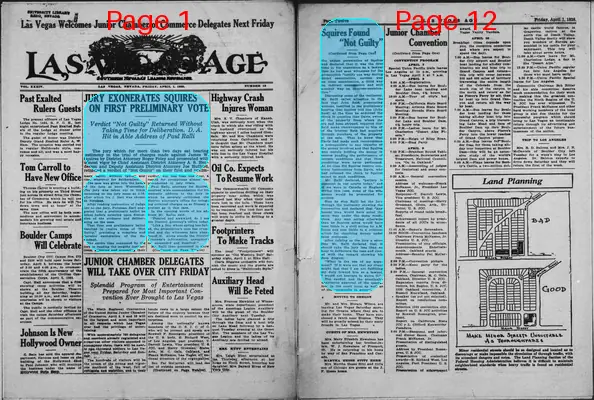
Las Vegas Age
Las Vegas, Clark County, Lincoln County, Nevada
What is this article about?
A jury in a trial against James W. Squires, prosecuted vigorously by District Attorney Roger Foley's office, returned a 'Not Guilty' verdict on their first ballot without deliberation, after a strong defense address by attorney Paul Ralli criticizing the prosecution's case.
Merged-components note: Continuation of the JURY EXONERATES SQUIRES story from page 1 to page 12.
Clippings
1 of 2
OCR Quality
Full Text
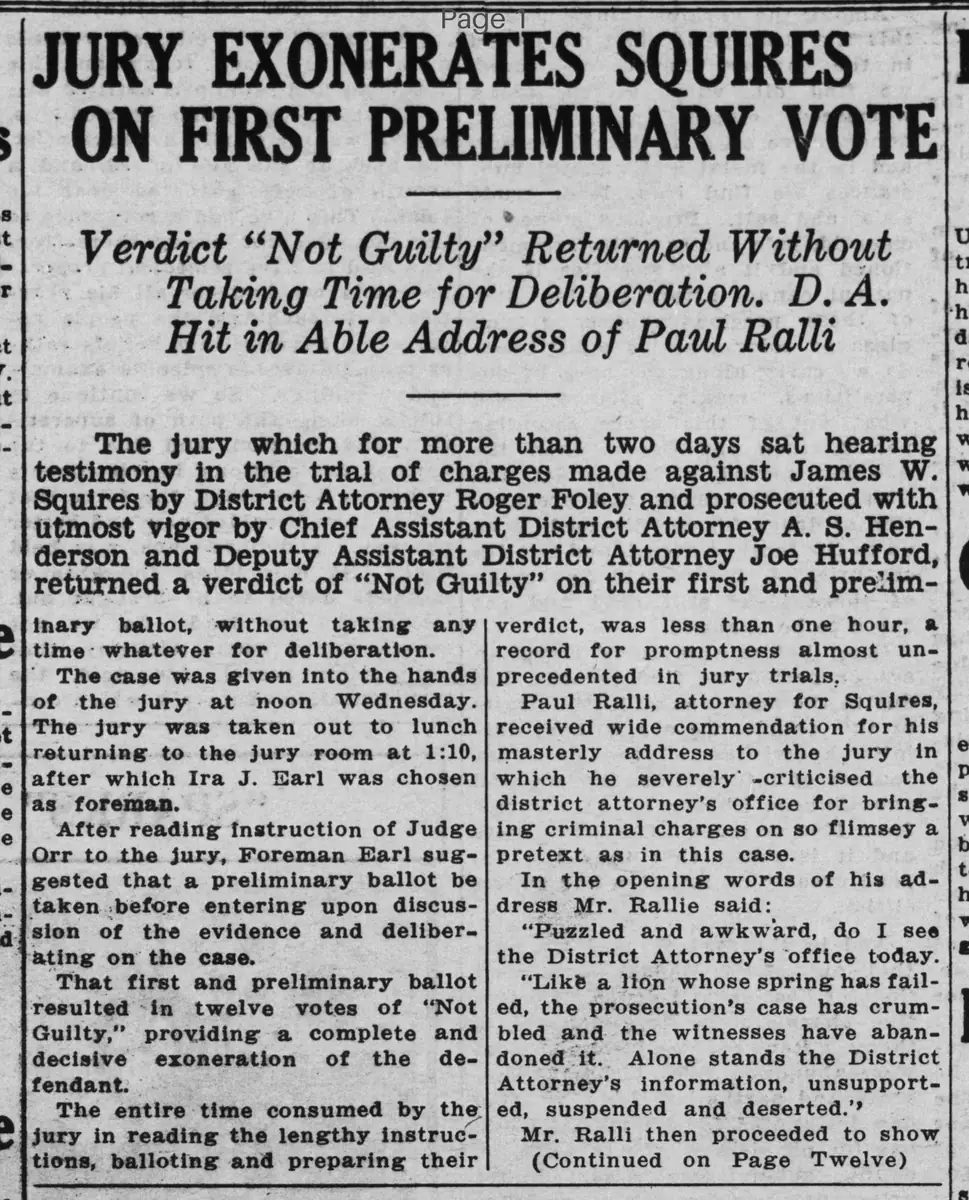
Verdict "Not Guilty" Returned Without Taking Time for Deliberation. D. A. Hit in Able Address of Paul Ralli
The jury which for more than two days sat hearing testimony in the trial of charges made against James W. Squires by District Attorney Roger Foley and prosecuted with utmost vigor by Chief Assistant District Attorney A. S. Henderson and Deputy Assistant District Attorney Joe Hufford, returned a verdict of "Not Guilty" on their first and preliminary ballot, without taking any time whatever for deliberation.
The case was given into the hands of the jury at noon Wednesday. The jury was taken out to lunch returning to the jury room at 1:10, after which Ira J. Darl was chosen as foreman.
After reading instruction of Judge Orr to the jury. Foreman Earl suggested that a preliminary ballot be taken before entering upon discussion of the evidence and deliberating on the case.
That first and preliminary ballot resulted in twelve votes of "Not Guilty," providing a complete and decisive exoneration of the defendant.
The entire time consumed by the jury in reading the lengthy instructions, balloting and preparing their verdict, was less than one hour, a record for promptness almost unprecedented in jury trials.
Paul Ralli, attorney for Squires, received wide commendation for his masterly address to the jury in which he severely criticised the district attorney's office for bringing criminal charges on so flimsy a pretext as in this case.
In the opening words of his address Mr. Ralli said:
"Puzzled and awkward, do I see the District Attorney's office today.
"Like a lion whose spring has failed, the prosecution's case has crumbled and the witnesses have abandoned it. Alone stands the District Attorney's information, unsupported, suspended and deserted."
Mr. Ralli then proceeded to show
(Continued on Page Twelve)
Page Twelve
Squires Found "Not Guilty"
(Continued from Page One)
the unjust persecution of Squires and declared that it was the first time in his experience as a lawyer that he had seen witnesses for the prosecution "testify one way during direct examination, another way on cross examination, a third way on redirect examination and still another way on re-cross-examination."
Discussing some of the testimony, Mr. Ralli called attention to the fact that John Reid, prosecuting witness, testified in the preliminary hearing that Squires told him (John Reid) at the time he endorsed the check in question that Davis, owner of the property from which the ore had been shipped, required that Reid make reconveyance to him of the interest Reid had acquired through purchase of the property at tax sale. That he knew that Davis had made such reconveyance a prerequisite to any transfer of the money involved and that Squires was merely holding the money in escrow pending the performance of certain conditions and that those conditions were never performed.
At no time did Squires receive contrary instructions from Davis, who had released the check to Squires subject to such conditions.
Mr. Ralli declared, "perjury is rampant in our courts today," and if we were in Canada or England trying this case, some of the witnesses would be prosecuted for perjury.
Step by step Ralli led the jury through the testimony showing the transaction and declared that "Any honest man would have acted the same way under the same conditions. Any man acting otherwise than as Squires acted would have been liable in a civil action by A.M. Davis and also liable to a criminal action for obtaining money under false pretenses."
After talking to the jury a short time Mr. Ralli declared that it should take the jury less than an hour to deliberate the case and closed with the remark showing his deep disgust:
"What is the use of my argument? If it were not that my client might feel that I am not fulfilling my duty toward him as a lawyer, I would not hesitate to waive it!"
The verdict met the practically unanimous approval of the spectators in the court room as well as of the community in general.
What sub-type of article is it?
What themes does it cover?
What keywords are associated?
What entities or persons were involved?
Where did it happen?
Story Details
Key Persons
Location
Court Room
Event Date
Noon Wednesday
Story Details
Jury returns 'Not Guilty' verdict for James W. Squires on first ballot after two-day trial on charges by DA Roger Foley; defense attorney Paul Ralli criticizes prosecution's flimsy case and inconsistent witnesses, highlighting escrow transaction involving ore shipment and unfulfilled conditions by John Reid and A.M. Davis.