Thank you for visiting SNEWPapers!
Sign up free
The Spirit Of The Age
Woodstock, Windsor County, Vermont
What is this article about?
Editorial criticizing the 1833 Tariff Compromise's duties on paper and iron, arguing they burden consumers, harm education and industry, and benefit manufacturers at the expense of the public and workers. References data on employment, capital, imports, and economic impacts in the US.
Clipping
OCR Quality
Full Text
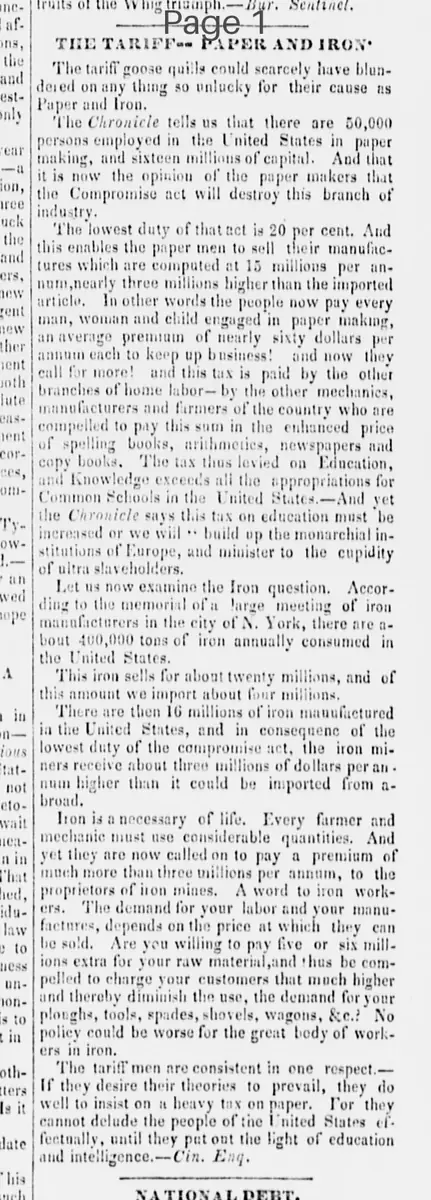
The tariff goose quills could scarcely have blundered on anything so unlucky for their cause as Paper and Iron.
The Chronicle tells us that there are 50,000 persons employed in the United States in paper making, and sixteen millions of capital. And that it is now the opinion of the paper makers that the Compromise act will destroy this branch of industry.
The lowest duty of that act is 20 per cent. And this enables the paper men to sell their manufactures which are computed at 15 millions per annum, nearly three millions higher than the imported article. In other words the people now pay every man, woman and child engaged in paper making, an average premium of nearly sixty dollars per annum each to keep up business! and now they call for more! and this tax is paid by the other branches of home labor—by the other mechanics, manufacturers and farmers of the country who are compelled to pay this sum in the enhanced price of spelling books, arithmetics, newspapers and copy books. The tax thus levied on Education, and Knowledge exceeds all the appropriations for Common Schools in the United States.—And yet the Chronicle says this tax on education must be increased or we will build up the monarchical institutions of Europe, and minister to the cupidity of ultra slaveholders.
Let us now examine the Iron question. According to the memorial of a large meeting of iron manufacturers in the city of N. York, there are about 400,000 tons of iron annually consumed in the United States.
This iron sells for about twenty millions, and of this amount we import about four millions.
There are then 16 millions of iron manufactured in the United States, and in consequence of the lowest duty of the compromise act, the iron miners receive about three millions of dollars per annum higher than it could be imported from abroad.
Iron is a necessary of life. Every farmer and mechanic must use considerable quantities. And yet they are now called on to pay a premium of much more than three millions per annum, to the proprietors of iron mines. A word to iron workers. The demand for your labor and your manufactures, depends on the price at which they can be sold. Are you willing to pay five or six millions extra for your raw material, and thus be compelled to charge your customers that much higher and thereby diminish the use, the demand for your ploughs, tools, spades, shovels, wagons, &c.? No policy could be worse for the great body of workers in iron.
The tariff men are consistent in one respect.—If they desire their theories to prevail, they do well to insist on a heavy tax on paper. For they cannot delude the people of the United States effectually, until they put out the light of education and intelligence.—Cin. Enq.
What sub-type of article is it?
What themes does it cover?
What keywords are associated?
Where did it happen?
Story Details
Location
United States, City Of N. York
Story Details
Critique of the Compromise Act's 20% duty on paper, enabling domestic sellers to charge $3M more annually than imports, burdening consumers with $60 premium per worker and taxing education via higher book prices; similar analysis for iron, where duties add $3M premium, harming farmers, mechanics, and iron workers by raising costs and reducing demand.