Thank you for visiting SNEWPapers!
Sign up free
St. Paul Recorder
Saint Paul, Ramsey County, Minnesota
What is this article about?
Louis Lautier discusses the potential for the second session of the 80th Congress, starting January 6, to advance civil rights by addressing discriminatory practices. Highlights pending bills on anti-lynching, poll tax, fair employment, and desegregation, while criticizing Senate filibusters and proposing cloture rule changes to facilitate passage.
Clipping
OCR Quality
Full Text
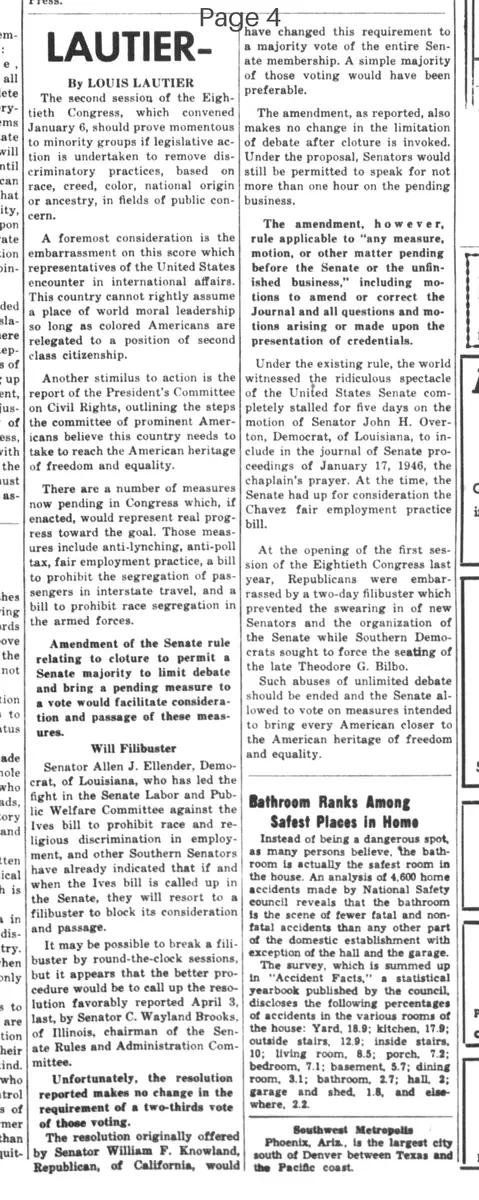
The second session of the Eightieth Congress, which convened January 6, should prove momentous to minority groups if legislative action is undertaken to remove discriminatory practices, based on race, creed, color, national origin or ancestry, in fields of public concern.
A foremost consideration is the embarrassment on this score which representatives of the United States encounter in international affairs. This country cannot rightly assume a place of world moral leadership so long as colored Americans are relegated to a position of second class citizenship.
Another stimulus to action is the report of the President's Committee on Civil Rights, outlining the steps the committee of prominent Americans believe this country needs to take to reach the American heritage of freedom and equality.
There are a number of measures now pending in Congress which, if enacted, would represent real progress toward the goal. Those measures include anti-lynching, anti-poll tax, fair employment practice, a bill to prohibit the segregation of passengers in interstate travel, and a bill to prohibit race segregation in the armed forces.
Amendment of the Senate rule relating to cloture to permit a Senate majority to limit debate and bring a pending measure to a vote would facilitate consideration and passage of these measures.
Senator Allen J. Ellender, Democrat, of Louisiana, who has led the fight in the Senate Labor and Public Welfare Committee against the Ives bill to prohibit race and religious discrimination in employment, and other Southern Senators have already indicated that if and when the Ives bill is called up in the Senate, they will resort to a filibuster to block its consideration and passage.
It may be possible to break a filibuster by round-the-clock sessions, but it appears that the better procedure would be to call up the resolution favorably reported April 3, last, by Senator C. Wayland Brooks, of Illinois, chairman of the Senate Rules and Administration Committee.
Unfortunately, the resolution reported makes no change in the requirement of a two-thirds vote of those voting.
The resolution originally offered by Senator William F. Knowland, Republican, of California, would have changed this requirement to a majority vote of the entire Senate membership. A simple majority of those voting would have been preferable.
The amendment, as reported, also makes no change in the limitation of debate after cloture is invoked. Under the proposal, Senators would still be permitted to speak for not more than one hour on the pending business.
The amendment, however, does change the rule applicable to "any measure, motion, or other matter pending before the Senate or the unfinished business," including motions to amend or correct the Journal and all questions and motions arising or made upon the presentation of credentials.
Under the existing rule, the world witnessed the ridiculous spectacle of the United States Senate completely stalled for five days on the motion of Senator John H. Overton, Democrat, of Louisiana, to include in the journal of Senate proceedings of January 17, 1946, the chaplain's prayer. At the time, the Senate had up for consideration the Chavez fair employment practice bill.
At the opening of the first session of the Eightieth Congress last year, Republicans were embarrassed by a two-day filibuster which prevented the swearing in of new Senators and the organization of the Senate while Southern Democrats sought to force the seating of the late Theodore G. Bilbo.
Such abuses of unlimited debate should be ended and the Senate allowed to vote on measures intended to bring every American closer to the American heritage of freedom and equality.
What sub-type of article is it?
What keywords are associated?
What entities or persons were involved?
Where did it happen?
Domestic News Details
Primary Location
Washington, D.C.
Event Date
January 6
Key Persons
Event Details
Opinion piece advocating for civil rights legislation in the second session of the Eightieth Congress, including anti-lynching, anti-poll tax, fair employment, and desegregation bills, while addressing Senate filibuster tactics and proposing changes to the cloture rule to enable passage.