Thank you for visiting SNEWPapers!
Sign up free
Story
February 6, 1901
Edgefield Advertiser
Edgefield, Edgefield County, South Carolina
What is this article about?
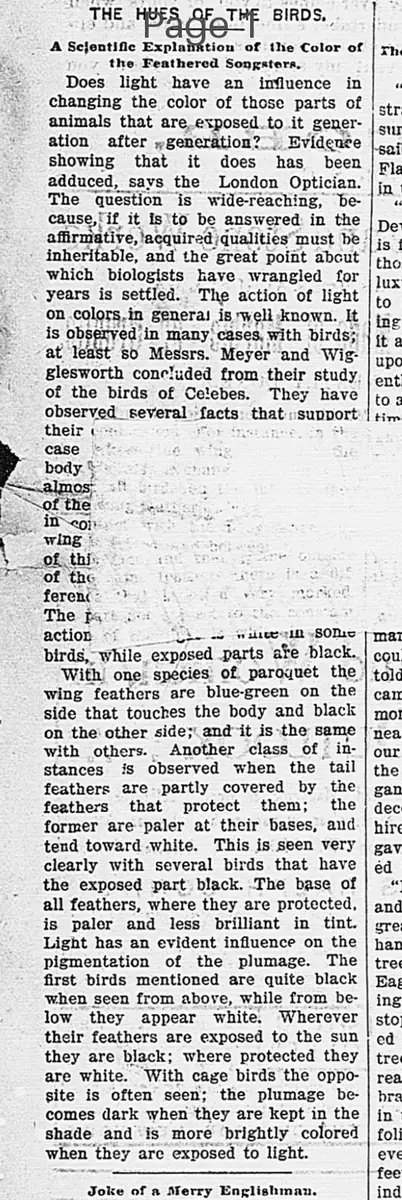
Scientific explanation of how light exposure affects bird feather colors over generations, with evidence from Celebes birds by Meyer and Winglesworth indicating inheritance of acquired pigmentation changes.
Clipping
OCR Quality
75%
Good
Full Text
A Scientific Explanation of the Color of
the Feathered Songster.
Does light have an influence in
changing the color of those parts of
animals that are exposed to it generation
after generation? Evidence
showing that it does has been
adduced, says the London Optician.
The question is wide-reaching, because, if it is to be answered in the
affirmative, acquired qualities must be
inheritable, and the great point about
which biologists have wrangled for
years is settled. The action of light
on colors in general is well known. It
is observed in many cases with birds;
at least so Messrs. Meyer and Winglesworth concluded from their study
of the birds of Celebes. They have
observed several facts that support
their case. In consequence of the
difference in the action, while in some
birds the exposed parts are black.
With one species of paroquet the
wing feathers are blue-green on the
side that touches the body and black
on the other side; and it is the same
with others. Another class of in-
stances is observed when the tail
feathers are partly covered by the
feathers
that
protect them; the
former are paler at their bases, and
tend toward white. This is seen very
clearly with several birds that have
the exposed part black. The base of
all feathers, where they are protected,
is paler and less brilliant in tint.
Light has an evident influence on the
pigmentation of the plumage. The
first birds mentioned are quite black
when seen from above, while from be-
low they appear
white. Wherever
their feathers are exposed to the sun
they are black; where protected they
are white. With cage birds the oppo-
site is often seen; the plumage be-
comes dark when they are kept in the
shade and is more brightly colored
when they are exposed to light.
the Feathered Songster.
Does light have an influence in
changing the color of those parts of
animals that are exposed to it generation
after generation? Evidence
showing that it does has been
adduced, says the London Optician.
The question is wide-reaching, because, if it is to be answered in the
affirmative, acquired qualities must be
inheritable, and the great point about
which biologists have wrangled for
years is settled. The action of light
on colors in general is well known. It
is observed in many cases with birds;
at least so Messrs. Meyer and Winglesworth concluded from their study
of the birds of Celebes. They have
observed several facts that support
their case. In consequence of the
difference in the action, while in some
birds the exposed parts are black.
With one species of paroquet the
wing feathers are blue-green on the
side that touches the body and black
on the other side; and it is the same
with others. Another class of in-
stances is observed when the tail
feathers are partly covered by the
feathers
that
protect them; the
former are paler at their bases, and
tend toward white. This is seen very
clearly with several birds that have
the exposed part black. The base of
all feathers, where they are protected,
is paler and less brilliant in tint.
Light has an evident influence on the
pigmentation of the plumage. The
first birds mentioned are quite black
when seen from above, while from be-
low they appear
white. Wherever
their feathers are exposed to the sun
they are black; where protected they
are white. With cage birds the oppo-
site is often seen; the plumage be-
comes dark when they are kept in the
shade and is more brightly colored
when they are exposed to light.
What sub-type of article is it?
Curiosity
What themes does it cover?
Nature
What keywords are associated?
Bird Coloration
Light Exposure
Feather Pigmentation
Inherited Traits
Celebes Birds
What entities or persons were involved?
Meyer
Winglesworth
Where did it happen?
Celebes
Story Details
Key Persons
Meyer
Winglesworth
Location
Celebes
Story Details
Messrs. Meyer and Winglesworth conclude from studying birds of Celebes that light influences feather coloration, darkening exposed parts while protected areas remain pale, suggesting inheritance of acquired traits.