Thank you for visiting SNEWPapers!
Sign up free
Story
September 8, 1866
The Wheeling Daily Register
Wheeling, Ohio County, West Virginia
What is this article about?
Report on the Southern Loyalist Convention in Philadelphia, highlighting the procession featuring radical leaders like Parson Brownlow, General Butler, P.T. Barnum, and Frederick Douglass. The event affirmed the radicals' stance on negro equality by including black delegates in the march, drawing mixed reactions from the crowd.
Clipping
OCR Quality
96%
Excellent
Full Text
Radical Leaders at the Philadelphia Convention-Douglass, Boranm, Brownlow and Butler.
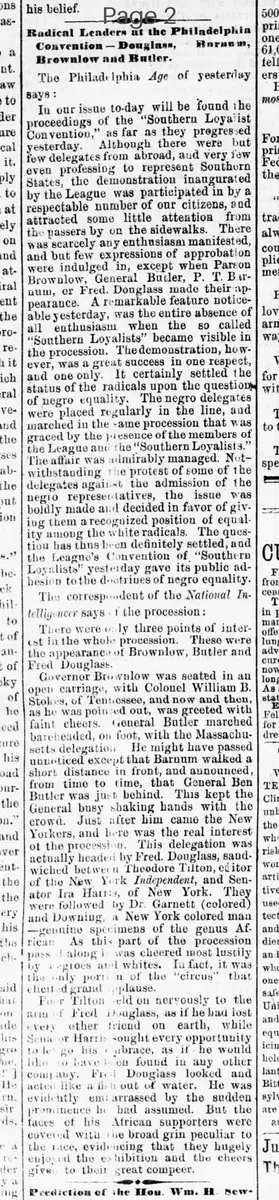
The Philadelphia Age of yesterday says: In our issue to-day will be found the proceedings of the 'Southern Loyalist Convention,' as far as they progressed yesterday. Although there were but few delegates from abroad, and very few even professing to represent Southern States, the demonstration inaugurated by the League was participated in by a respectable number of our citizens, and attracted some little attention from the passers by on the sidewalks. There was scarcely any enthusiasm manifested, and but few expressions of approbation were indulged in, except when Parson Brownlow, General Butler, P. T. Barnum, or Fred. Douglass made their appearance. A remarkable feature noticeable yesterday, was the entire absence of all enthusiasm when the so called 'Southern Loyalists' became visible in the procession. The demonstration, however, was a great success in one respect, and one only. It certainly settled the status of the radicals upon the question of negro equality. The negro delegates were placed regularly in the line, and marched in the same procession that was graced by the presence of the members of the League and the 'Southern Loyalists.' The affair was admirably managed. Notwithstanding the protest of some of the delegates against the admission of the negro representatives, the issue was boldly made and decided in favor of giving them a recognized position of equality among the white radicals. The question has thus been definitely settled, and the League's Convention of 'Southern Loyalists' yesterday gave its public adhesion to the doctrines of negro equality.
The correspondent of the National Intelligencer says: in the procession: There were only three points of interest in the whole procession. These were the appearances of Brownlow, Butler and Fred Douglass. Governor Brownlow was seated in an open carriage, with Colonel William B. Stokes, of Tennessee, and now and then, as he was pointed out, was greeted with faint cheers. General Butler marched bareheaded, on foot, with the Massachusetts delegation. He might have passed unnoticed except that Barnum walked a short distance in front, and announced from time to time, that General Ben Butler was just behind. This kept the crowd shaking hands with the General busy. Just after him came the New Yorkers, and by the interest of the procession actually headed by Fred. Douglass, and Theodore Tilton, editor of the New York Independent, and Senator Ira Harris, of New York. They were followed by Dr. Garnett (colored) a New York colored man and specimens of the genus African. That part of the procession was cheered most lustily by the whites. In fact, it was the only portion of the 'circus' that received applause. Fred Douglass held on nervously to the arm of Tilton, as if he had lost his only friend on earth, while Tilton sought every opportunity to embrace, as if he would suffocate him. Douglass looked and acted like a fish out of water. He was embarrassed by the sudden promotion he had assumed. But the African supporters were in ecstasies, their faces covered with the broad grin peculiar to the race, evincing that they hugely enjoyed the exhibition and the cheers given to their great compeer.
The Philadelphia Age of yesterday says: In our issue to-day will be found the proceedings of the 'Southern Loyalist Convention,' as far as they progressed yesterday. Although there were but few delegates from abroad, and very few even professing to represent Southern States, the demonstration inaugurated by the League was participated in by a respectable number of our citizens, and attracted some little attention from the passers by on the sidewalks. There was scarcely any enthusiasm manifested, and but few expressions of approbation were indulged in, except when Parson Brownlow, General Butler, P. T. Barnum, or Fred. Douglass made their appearance. A remarkable feature noticeable yesterday, was the entire absence of all enthusiasm when the so called 'Southern Loyalists' became visible in the procession. The demonstration, however, was a great success in one respect, and one only. It certainly settled the status of the radicals upon the question of negro equality. The negro delegates were placed regularly in the line, and marched in the same procession that was graced by the presence of the members of the League and the 'Southern Loyalists.' The affair was admirably managed. Notwithstanding the protest of some of the delegates against the admission of the negro representatives, the issue was boldly made and decided in favor of giving them a recognized position of equality among the white radicals. The question has thus been definitely settled, and the League's Convention of 'Southern Loyalists' yesterday gave its public adhesion to the doctrines of negro equality.
The correspondent of the National Intelligencer says: in the procession: There were only three points of interest in the whole procession. These were the appearances of Brownlow, Butler and Fred Douglass. Governor Brownlow was seated in an open carriage, with Colonel William B. Stokes, of Tennessee, and now and then, as he was pointed out, was greeted with faint cheers. General Butler marched bareheaded, on foot, with the Massachusetts delegation. He might have passed unnoticed except that Barnum walked a short distance in front, and announced from time to time, that General Ben Butler was just behind. This kept the crowd shaking hands with the General busy. Just after him came the New Yorkers, and by the interest of the procession actually headed by Fred. Douglass, and Theodore Tilton, editor of the New York Independent, and Senator Ira Harris, of New York. They were followed by Dr. Garnett (colored) a New York colored man and specimens of the genus African. That part of the procession was cheered most lustily by the whites. In fact, it was the only portion of the 'circus' that received applause. Fred Douglass held on nervously to the arm of Tilton, as if he had lost his only friend on earth, while Tilton sought every opportunity to embrace, as if he would suffocate him. Douglass looked and acted like a fish out of water. He was embarrassed by the sudden promotion he had assumed. But the African supporters were in ecstasies, their faces covered with the broad grin peculiar to the race, evincing that they hugely enjoyed the exhibition and the cheers given to their great compeer.
What sub-type of article is it?
Historical Event
What themes does it cover?
Social Manners
What keywords are associated?
Southern Loyalist Convention
Negro Equality
Philadelphia Procession
Radical Leaders
Fred Douglass
General Butler
What entities or persons were involved?
Fred Douglass
P. T. Barnum
Parson Brownlow
General Butler
Colonel William B. Stokes
Theodore Tilton
Senator Ira Harris
Dr. Garnett
Where did it happen?
Philadelphia
Story Details
Key Persons
Fred Douglass
P. T. Barnum
Parson Brownlow
General Butler
Colonel William B. Stokes
Theodore Tilton
Senator Ira Harris
Dr. Garnett
Location
Philadelphia
Event Date
Yesterday
Story Details
The Southern Loyalist Convention procession in Philadelphia featured radical leaders and included negro delegates, affirming the radicals' support for negro equality despite protests; the crowd showed enthusiasm only for figures like Brownlow, Butler, and Douglass.