Thank you for visiting SNEWPapers!
Sign up free
Domestic News
February 12, 1931
Vashon Island News Record
Vashon, King County, Washington
What is this article about?
U.S. fire losses rose to $463 million in 1930 from $422 million in 1929, despite depression; attributed to carelessness, urging national fire prevention efforts.
Clipping
OCR Quality
98%
Excellent
Full Text
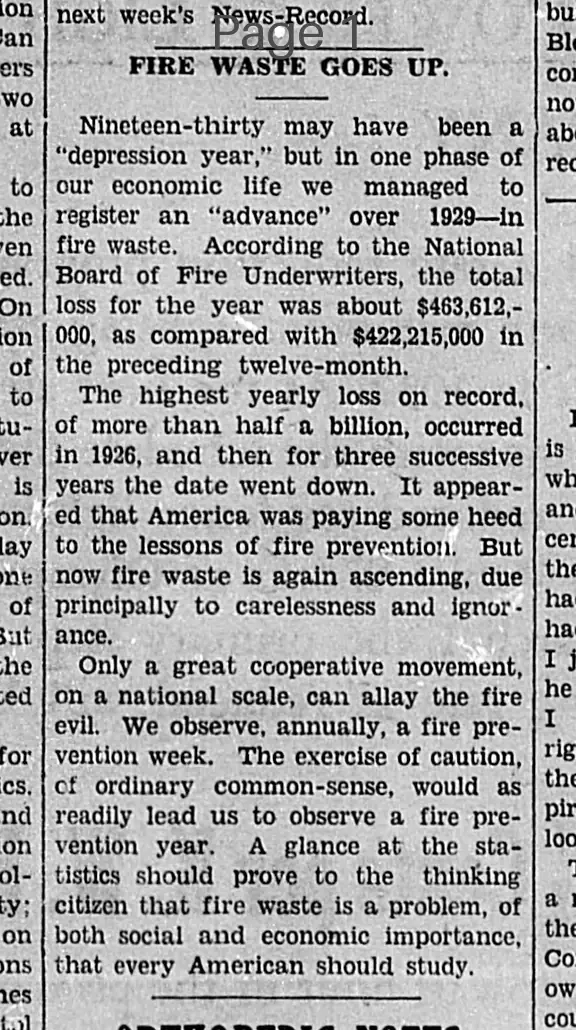
FIRE WASTE GOES UP.
Nineteen-thirty may have been a "depression year," but in one phase of our economic life we managed to register an "advance" over 1929 - in fire waste. According to the National Board of Fire Underwriters, the total loss for the year was about $463,612,000, as compared with $422,215,000 in the preceding twelve-month.
The highest yearly loss on record of more than half-a billion, occurred in 1926, and then for three successive years the rate went down. It appeared that America was paying some heed to the lessons of fire prevention. But now fire waste is again ascending, due principally to carelessness and ignorance.
Only a great cooperative movement, on a national scale, can allay the fire evil. We observe, annually, a fire prevention week. The exercise of caution, of ordinary common-sense, would as readily lead us to observe a fire prevention year. A glance at the statistics should prove to the thinking citizen that fire waste is a problem, of both social and economic importance, that every American should study.
Nineteen-thirty may have been a "depression year," but in one phase of our economic life we managed to register an "advance" over 1929 - in fire waste. According to the National Board of Fire Underwriters, the total loss for the year was about $463,612,000, as compared with $422,215,000 in the preceding twelve-month.
The highest yearly loss on record of more than half-a billion, occurred in 1926, and then for three successive years the rate went down. It appeared that America was paying some heed to the lessons of fire prevention. But now fire waste is again ascending, due principally to carelessness and ignorance.
Only a great cooperative movement, on a national scale, can allay the fire evil. We observe, annually, a fire prevention week. The exercise of caution, of ordinary common-sense, would as readily lead us to observe a fire prevention year. A glance at the statistics should prove to the thinking citizen that fire waste is a problem, of both social and economic importance, that every American should study.
What sub-type of article is it?
Fire
Economic
What keywords are associated?
Fire Waste
National Board Of Fire Underwriters
Fire Prevention
Economic Loss
Depression Year
Where did it happen?
America
Domestic News Details
Primary Location
America
Event Date
1930
Outcome
total fire loss $463,612,000 in 1930 compared to $422,215,000 in 1929; highest record over half-a billion in 1926
Event Details
Fire waste increased in 1930 despite depression, due to carelessness and ignorance; calls for national cooperative movement and year-round fire prevention