Thank you for visiting SNEWPapers!
Sign up free
Constitutional Whig
Richmond, Virginia
What is this article about?
Article from The Constitutional Whig praises Edward Livingston's proposed penal code for Louisiana, highlighting its humane approach to punishments, protection of press freedom, jury trials, and critiques capital punishment's efficacy compared to England, contrasting with European trends.
Clipping
OCR Quality
Full Text
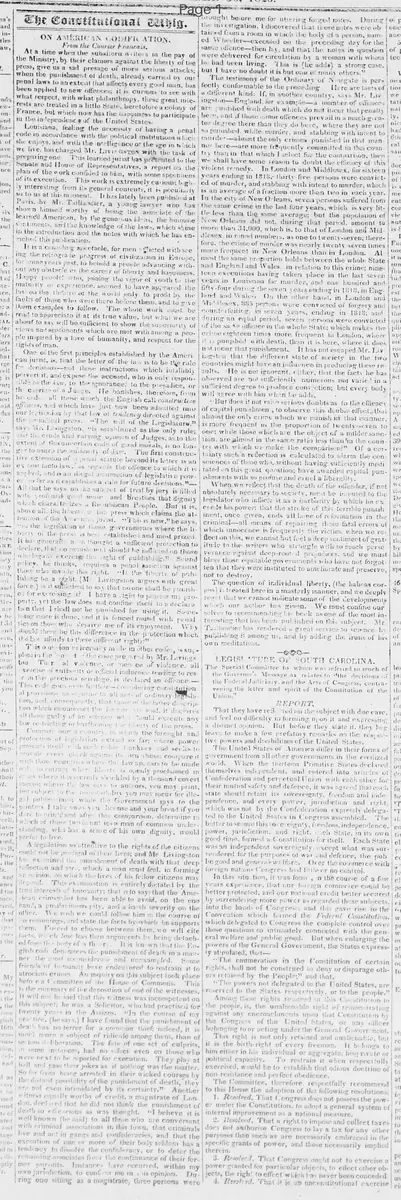
ON AMERICAN CODIFICATION.
From the Courier Francais.
At a time when the subaltern writers in the pay of the Ministry, by their clamors against the liberty of the press, give us a sad presage of more serious attacks; when the punishment of death, already carried by our penal laws to an extent that affects every good man, has been applied to new offences; it is curious to see with what respect, with what philanthropy, these great interests are treated in a little State, heretofore a colony of France, but which now has the happiness to participate in the independence of the United States.
Louisiana, feeling the necessity of having a penal code in accordance with the political institutions which she enjoys, and with the intelligence of the age in which we live, has charged Mr. Livingston with the task of preparing one. This learned jurist has presented to the Senate and House of Representatives, a report on the plan of the work confided to him, with some specimens of its execution. This work is extremely curious; highly interesting from its general contents, it is peculiarly so to us at this moment. It has lately been published at Paris, by Mr. Taillandier, a young lawyer who has shown himself worthy of being the associate of the learned American, by the generous ideas, the humane sentiments, and the knowledge of the laws, which shine in the introduction and the notes with which he has enriched this publication.
It is a consoling spectacle, for men afflicted with seeing the retrograde progress of civilization in Europe, for some years past, to behold a people advancing without any obstacle in the career of liberty and happiness. Happy people! who, joining the vigor of youth to the maturity of experience, seemed to have appeared the last on the theatre of the world only to profit by the faults of those who were there before them, and to give them examples to follow. The whole work must be read to appreciate it at its true value, but what we are about to say will be sufficient to show the superiority of views and sentiments which are met with among a people inspired by a love of humanity, and respect for the rights of man.
One of the first principles established by the American jurist, is, that the letter of the law is to be the rule of decisions—not those instructions which infallibly pervert it, and expose the accused, who is only responsible to the law, to the ignorance, to the prejudice, or to the caprice of a Judge. He banishes, therefore, from his code, all those which the English constructive offences, and which have just now been admitted into our legislation by that law of tendency directed against the periodical press. "The will of the Legislature," says Mr. Livingston, "is established as the only rule; no crude and varying opinion of Judges, as to the extent of this uncertain code of good morals, is longer to usurp the authority of law. The first constructive extension of a penal statute beyond its letter is an ex post facto law, as regards the offence to which it is annexed, and is an illegal assumption of legislative power so far as it establishes a rule for future decisions."
All that he says on the subject of trial by jury is filled with good sense and breathes that dignity which characterizes a Republican People. But it is, above all, the liberty of the press which claims the attention of the American. "This is new," he says, "... the legislation of those governments where the liberty of the press is best established and most prized. It has generally been thought a sufficient protection to declare, that no punishment should be inflicted on those who legally exercise the right of publishing." Sound policy, he thinks, requires a penal sanction against those who invade this right. "If the liberty of publishing be a right, (Mr. Livingston argues with great force) is it sufficient to say that no one shall be punished for exercising it? I have a right to possess my property, yet the law does not confine itself to a declaration that I shall not be punished for using it. Something more is done, and it is fenced round with penalties on those who deprive me of its enjoyment. Why should there be this difference in the protection which the law affords to these different rights?"
It is an opinion universally received in another code, applicable to the case prepared by Mr. Livingston, "that threat of violence, or menace of violence," all exercise of authority or official influence tending to restrain in the precious privilege, is defined an offence—
The code declares guilty of an offence all those who would execute any law restricting the liberty of the press.
Compare, now a country where the foresight and protection of legislation extend so far; where power, possessing such number of checks and balances as to receive every check against its own abuse: compare with those countries where the Law appears to be made only to entrap; where liberty is openly proclaimed in codes wherein it is secretly shackled by a thousand covert means; where the law says to authors, you may print, but subject to the resentment still you may incur for illegality; while the Government says to the printers I take away your license and your bread if you dare to onward; after this comparison, determine in which of those countries a man of common understanding, who has a sense of his own dignity, would prefer to live.
A legislation so attentive to the rights of the citizens could not be prodigal of their lives; and Mr. Livingston has examined the punishment of death with that deep reflection and awe, which a man must feel, in forming an opinion which the lives of his fellow citizens may depend. This examination is entirely dictated by the true interests of humanity; that is to say: that the American criminalist has been able to avoid, on the one hand, a pusillanimous pity, and a harsh severity on the other. We wish we could follow him in the course of his reasonings, and state the facts by which he supports them. Forced to choose between them, we will cite facts, which lose less than arguments by being detached from the body of a treatise. It is known that the English code denounces the punishment of death in a manner the most inconsiderate and unexampled. Some friends of humanity have endeavored to restrain it to atrocious crimes. An inquiry on this subject took place before a committee of the House of Commons. This is the summary of the deposition of one of the witnesses. It will not be said that this witness was incompetent on this subject: he was a Solicitor, who had practised for twenty years in the Assizes. "In the course of my practice, (he says,) I have found that the punishment of death has no terror for a common thief; indeed, it is much more a subject of ridicule among them, than of serious deliberation. The fate of one set of culprits, in some instances, had no effect even on those who were next to be reported for execution. They play at ball and pass their jokes as if nothing was the matter. So far from being arrested in their wicked courses by the danger of the punishment of death, they are not even intimidated by its certainty." Another witness equally worthy of credit, a magistrate of London, declared that he did not think the punishment of death so effectual as was thought. "I believe it is well known (he said) to all those who are conversant with criminal associations in this town, that criminals live and act in gangs and confederacies, and that the execution of one or more of their body seldom has a tendency to dissolve the confederacy, or to deter the remaining associates from the continuance of their former pursuits. Instances have occurred, within my own jurisdiction, to confirm me in this opinion. During one sitting as a magistrate, three persons were brought before me for uttering forged notes. During the investigation, I discovered that those notes were obtained from a room in which the body of a person, named Wheeler—executed on the preceding day for the same offence—then lay, and that the notes in question were delivered for circulation by a woman with whom he had been living. This is (he adds) a strong case, but I have no doubt it is but one of many others."
The testimony of the Ordinary of Newgate is perfectly conformable to the preceding. Here are facts of a different kind: If, in another country, says Mr. Livingston—England, for example—a number of offences are punished with death which do not incur that penalty here, and if those minor offences prevail in a much greater degree there than they do here, where they are not so punished, while murder, and stabbing with intent to murder—almost the only crimes punished in that manner here—are more frequently committed in this country than in that which I select for the comparison, then we shall have some reason to doubt the efficacy of this violent remedy. In London and Middlesex, for sixteen years ending in 1818, thirty-five persons were convicted of murder, and stabbing with intent to murder, which is an average of a fraction more than two in each year. In the city of New-Orleans, seven persons suffered from the same crime in the last four years, which is very little less than the same average; but the population of New-Orleans did not, during that period, amount to more than 34,000, which is, to that of London and Middlesex in round numbers, as one to twenty-seven, therefore, the crime of murder was nearly twenty-seven times more frequent in New Orleans than in London. Almost the same proportion holds between the whole State and England and Wales in relation to this crime; nineteen executions having taken place in the last seven years in Louisiana for murder, and one hundred and fifty-four during the seven years ending in 1818, in England and Wales. On the other hand, in London and Middlesex, 585 persons were convicted of forgery and counterfeiting, in seven years, ending in 1818: and during an equal period, seven persons were convicted of the same offence in the whole State: which makes the crime eighteen times more frequent in London, where it is punished with death, than it is here, where it does not incur that punishment. It has not escaped Mr. Livingston that the different state of society in the two countries might have an influence in producing these results.—He is not ignorant, either, that the facts he has observed are not sufficiently numerous nor varied in a sufficient degree to produce conviction; but every body will agree with him when he adds,
"...But does it not raise serious doubts as to the efficacy of capital punishment, to observe this double effect, that almost the only crime which we punish in that manner, is more frequent in the proportion of twenty-seven to one; while those which are the object of a milder sanction, are almost in the same ratio less than in the country with which we make the comparison?" Of a certainty such a reflection is calculated to alarm the consciences of those who, without having sufficiently meditated on this great question, have awarded capital punishments with so profuse and cruel a liberality.
When we reflect that the death of the offender, if not absolutely necessary to society, must be imputed to the Legislator who inflicts it as a barbarity by which he exercises his power; that the stroke of this terrible punishment, once given, ends all hope of reformation in the criminal—all means of repairing those fatal errors of which innocence is frequently the victim, when we reflect on this, we cannot but feel a deep sentiment of gratitude to the writers who struggle with so much perseverance against deep-rooted prejudices, and we must bless those equitable governments who have not forgotten that they were instituted to ameliorate and preserve, not to destroy.
The question of individual liberty, (the habeas corpus) treated herein a masterly manner, and we deeply regret that we cannot imitate some of the developments which our author has given.
We must confine ourselves to recommending the book as one of the most interesting that has been published on this subject. Mr. Taillandier has rendered a great service to science by publishing it among us, and by adding the fruits of his own meditations.
What sub-type of article is it?
What themes does it cover?
What keywords are associated?
What entities or persons were involved?
Where did it happen?
Story Details
Key Persons
Location
Louisiana, New Orleans, England, France
Event Date
Around 1818 1820s
Story Details
Edward Livingston's proposed penal code for Louisiana emphasizes strict adherence to the letter of the law, protects liberty of the press with penalties for interference, promotes jury trials, and critiques capital punishment's ineffectiveness using comparisons of crime rates in Louisiana versus England.