Thank you for visiting SNEWPapers!
Sign up free
Poem
July 3, 1835
Richmond Enquirer
Richmond, Richmond County, Virginia
What is this article about?
Satirical apostrophe to an approaching comet predicted visible in late August 1832, mocking astronomical reports from Edinburgh Review and Herschel, while weaving in political jabs at figures like Durham, Hume, O'Connell, and parties, ending in feigned despair.
Clipping
OCR Quality
95%
Excellent
Full Text
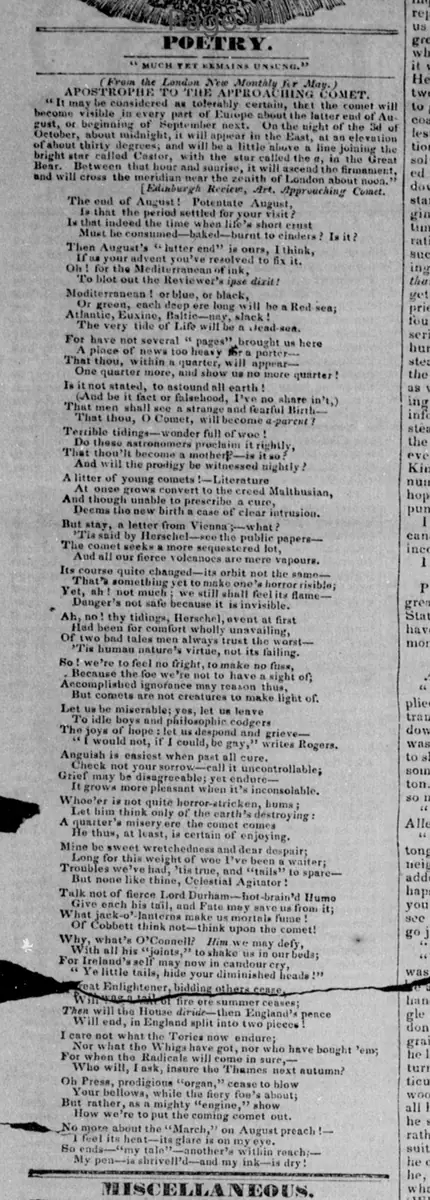
POETRY.
"Such that no man can know."
(From the London New Monthly for May.)
APOSTROPHE TO THE APPROACHING COMET.
"It may be considered as tolerably certain, that the comet will become visible in every part of Europe about the latter end of August, or beginning of September next. On the night of the 3d of October, about midnight, it will appear in the East, at an elevation of about thirty degrees; and will be a little above a line joining the bright star called Castor, with the star called the α, in the Great Bear. Between that hour and sunrise, it will ascend the firmament, and will cross the meridian near the zenith of London about noon."
Edinburgh Review, Art. Approaching Comet.
The end of August! Potentate August,
Is that the period settled for your visit?
Is that indeed the time when life's short crust
Must be consumed—baked—burnt to cinders? Is it?
Then August's "latter end" is ours, I think,
If as your advent you've resolved to fix it.
Oh! for the Mediterranean of ink,
To blot out the Reviewer's ipse dixit!
Mediterranean! or blue, or black,
Or green, each deep ere long will be a Red Sea;
Atlantic, Euxine, Baltic—nay, slack!
The very tide of Life will be a Dead Sea.
For have not several "pages" brought us here
A piece of news too heavy for a porter—
That thou, within a quarter, will appear—
One quarter more, and show us no more quarter!
Is it not stated, to astound all earth!
(And be it fact or falsehood, I've no share in't,)
That men shall see a strange and fearful Birth—
That thou, O Comet, will become a parent?
Terrible tidings—wonder full of woe!
Do these astronomers proclaim it rightly,
That thou'lt become a mother?—is it so?
And will the prodigy be witnessed nightly?
A litter of young comets!—Literature
At once grows convert to the creed Malthusian,
And though unable to prescribe a cure,
Deems the new birth a case of clear intrusion.
But stay, a letter from Vienna—what?
'Tis said by Herschel—see the public papers—
The comet seeks a more sequestered lot,
And all our fierce volcanoes are mere vapours.
Its course quite changed—its orbit not the same—
That something yet to make one's horror risible;
Yet, ah! not much; we still shall feel its flame—
Danger's not safe because it is invisible.
Ah, no! thy tidings, Herschel, over at first
Had been for comfort wholly unavailing,
Of two bad tales men always trust the worst—
'Tis human nature's virtue, not its failing.
So! we're to feel no fright, to make no fuss,
Because the foe we're not to have a sight of;
Accomplished ignorance may reason thus,
But comets are not creatures to make light of.
Let us be miserable; yes, let us leave
To idle boys and philosophic codgers
The joys of hope: let us despond and grieve—
"I would not, if I could, be gay," writes Rogers.
Anguish is easiest when past all cure.
Check not your sorrow—call it uncontrollable;
Grief may be disagreeable; yet endure—
It grows more pleasant when it's inconsolable.
Whoe'er is not quite horror-stricken, hums;
Let him think only of the earth's destroying:
A quarter's misery ere the comet comes
He thus, at least, is certain of enjoying.
Mine be sweet wretchedness and dear despair;
Long for this weight of woe I've been a waiter;
Troubles we've had, 'tis true, and "tails" to spare
But none like thine, Celestial Agitator:
Talk not of fierce Lord Durham—hot-brained Hume
Give each his tail, and Fate may save us from it;
What jack-o'-lanterns make us mortals fume!
Of Cobbett think not—think upon the comet!
Why, what's O'Connell? Him we may defy,
With all his "joints," to shake us in our beds;
For Ireland's self may now in candour cry,
"Ye little tails, hide your diminished heads!"
Great Enlightener, bidding others cease,
When a jailor fire ere summer ceases;
Then will the House divide—then England's peace
Will end, in England split into two pieces
I care not what the Tories now endure;
Nor what the Whigs have got, nor who have bought 'em;
For when the Radicals will come in sure,—
Who will, I ask, insure the Thames next autumn?
Oh Press, prodigious "organ," cease to blow
Your bellows, while the fiery foe's about;
But rather, as a mighty "engine," show
How we're to put the coming comet out.
No more about the "March," on August preach!—
I feel its heat—its glare is on my eye.
So ends—"my tale"—another's within reach;—
My pen is shrivelled—and my ink is dry.
"Such that no man can know."
(From the London New Monthly for May.)
APOSTROPHE TO THE APPROACHING COMET.
"It may be considered as tolerably certain, that the comet will become visible in every part of Europe about the latter end of August, or beginning of September next. On the night of the 3d of October, about midnight, it will appear in the East, at an elevation of about thirty degrees; and will be a little above a line joining the bright star called Castor, with the star called the α, in the Great Bear. Between that hour and sunrise, it will ascend the firmament, and will cross the meridian near the zenith of London about noon."
Edinburgh Review, Art. Approaching Comet.
The end of August! Potentate August,
Is that the period settled for your visit?
Is that indeed the time when life's short crust
Must be consumed—baked—burnt to cinders? Is it?
Then August's "latter end" is ours, I think,
If as your advent you've resolved to fix it.
Oh! for the Mediterranean of ink,
To blot out the Reviewer's ipse dixit!
Mediterranean! or blue, or black,
Or green, each deep ere long will be a Red Sea;
Atlantic, Euxine, Baltic—nay, slack!
The very tide of Life will be a Dead Sea.
For have not several "pages" brought us here
A piece of news too heavy for a porter—
That thou, within a quarter, will appear—
One quarter more, and show us no more quarter!
Is it not stated, to astound all earth!
(And be it fact or falsehood, I've no share in't,)
That men shall see a strange and fearful Birth—
That thou, O Comet, will become a parent?
Terrible tidings—wonder full of woe!
Do these astronomers proclaim it rightly,
That thou'lt become a mother?—is it so?
And will the prodigy be witnessed nightly?
A litter of young comets!—Literature
At once grows convert to the creed Malthusian,
And though unable to prescribe a cure,
Deems the new birth a case of clear intrusion.
But stay, a letter from Vienna—what?
'Tis said by Herschel—see the public papers—
The comet seeks a more sequestered lot,
And all our fierce volcanoes are mere vapours.
Its course quite changed—its orbit not the same—
That something yet to make one's horror risible;
Yet, ah! not much; we still shall feel its flame—
Danger's not safe because it is invisible.
Ah, no! thy tidings, Herschel, over at first
Had been for comfort wholly unavailing,
Of two bad tales men always trust the worst—
'Tis human nature's virtue, not its failing.
So! we're to feel no fright, to make no fuss,
Because the foe we're not to have a sight of;
Accomplished ignorance may reason thus,
But comets are not creatures to make light of.
Let us be miserable; yes, let us leave
To idle boys and philosophic codgers
The joys of hope: let us despond and grieve—
"I would not, if I could, be gay," writes Rogers.
Anguish is easiest when past all cure.
Check not your sorrow—call it uncontrollable;
Grief may be disagreeable; yet endure—
It grows more pleasant when it's inconsolable.
Whoe'er is not quite horror-stricken, hums;
Let him think only of the earth's destroying:
A quarter's misery ere the comet comes
He thus, at least, is certain of enjoying.
Mine be sweet wretchedness and dear despair;
Long for this weight of woe I've been a waiter;
Troubles we've had, 'tis true, and "tails" to spare
But none like thine, Celestial Agitator:
Talk not of fierce Lord Durham—hot-brained Hume
Give each his tail, and Fate may save us from it;
What jack-o'-lanterns make us mortals fume!
Of Cobbett think not—think upon the comet!
Why, what's O'Connell? Him we may defy,
With all his "joints," to shake us in our beds;
For Ireland's self may now in candour cry,
"Ye little tails, hide your diminished heads!"
Great Enlightener, bidding others cease,
When a jailor fire ere summer ceases;
Then will the House divide—then England's peace
Will end, in England split into two pieces
I care not what the Tories now endure;
Nor what the Whigs have got, nor who have bought 'em;
For when the Radicals will come in sure,—
Who will, I ask, insure the Thames next autumn?
Oh Press, prodigious "organ," cease to blow
Your bellows, while the fiery foe's about;
But rather, as a mighty "engine," show
How we're to put the coming comet out.
No more about the "March," on August preach!—
I feel its heat—its glare is on my eye.
So ends—"my tale"—another's within reach;—
My pen is shrivelled—and my ink is dry.
What sub-type of article is it?
Satire
Ode
What themes does it cover?
Political
Science Progress
Satire Society
What keywords are associated?
Comet
Astronomy
Satire
Politics
August
Herschel
Malthusian
Reform
Whigs
Tories
Poem Details
Title
Apostrophe To The Approaching Comet.
Subject
Approaching Comet As Per Edinburgh Review
Form / Style
Rhymed Couplets
Key Lines
The End Of August! Potentate August,
Is That The Period Settled For Your Visit?
Is That Indeed The Time When Life's Short Crust
Must Be Consumed—Baked—Burnt To Cinders? Is It?
A Litter Of Young Comets!—Literature
At Once Grows Convert To The Creed Malthusian,
And Though Unable To Prescribe A Cure,
Deems The New Birth A Case Of Clear Intrusion.
Talk Not Of Fierce Lord Durham—Hot Brained Hume
Give Each His Tail, And Fate May Save Us From It;
What Jack O' Lanterns Make Us Mortals Fume!
Of Cobbett Think Not—Think Upon The Comet!
Oh Press, Prodigious "Organ," Cease To Blow
Your Bellows, While The Fiery Foe's About;
But Rather, As A Mighty "Engine," Show
How We're To Put The Coming Comet Out.
No More About The "March," On August Preach!—
I Feel Its Heat—Its Glare Is On My Eye.
So Ends—"My Tale"—Another's Within Reach;—
My Pen Is Shrivelled—And My Ink Is Dry.