Thank you for visiting SNEWPapers!
Sign up free
Story
July 15, 1885
The Indiana State Sentinel
Indianapolis, Marion County, Indiana
What is this article about?
Article from Philadelphia Record details methods to restore fertility to worn-out farmland using lime, green manuring with rye, oats, peas, buckwheat, and sheep pasturing, emphasizing long-term benefits over immediate cropping.
Clipping
OCR Quality
98%
Excellent
Full Text
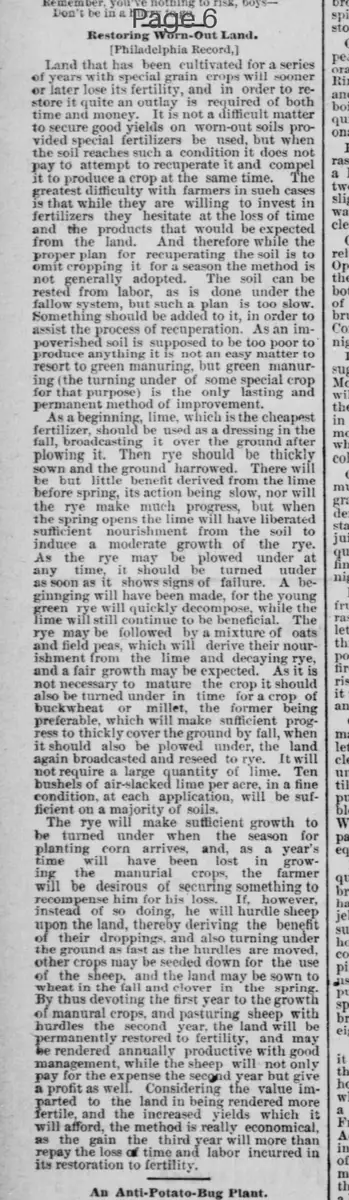
Restoring Worn-Out Land.
[Philadelphia Record.]
Land that has been cultivated for a series of years with special grain crops will sooner or later lose its fertility, and in order to restore it quite an outlay is required of both time and money. It is not a difficult matter to secure good yields on worn-out soils provided special fertilizers be used, but when the soil reaches such a condition it does not pay to attempt to recuperate it and compel it to produce a crop at the same time. The greatest difficulty with farmers in such cases is that while they are willing to invest in fertilizers they hesitate at the loss of time and the products that would be expected from the land. And therefore while the proper plan for recuperating the soil is to omit cropping it for a season the method is not generally adopted. The soil can be rested from labor, as is done under the fallow system, but such a plan is too slow. Something should be added to it, in order to assist the process of recuperation. As an impoverished soil is supposed to be too poor to produce anything it is not an easy matter to resort to green manuring, but green manuring (the turning under of some special crop for that purpose) is the only lasting and permanent method of improvement.
As a beginning, lime, which is the cheapest fertilizer, should be used as a dressing in the fall, broadcasting it over the ground after plowing it. Then rye should be thickly sown and the ground harrowed. There will be but little benefit derived from the lime before spring, its action being slow, nor will the rye make much progress, but when the spring opens the lime will have liberated sufficient nourishment from the soil to induce a moderate growth of the rye. As the rye may be plowed under at any time, it should be turned under as soon as it shows signs of failure. A beginning will have been made, for the young green rye will quickly decompose, while the lime will still continue to be beneficial. The rye may be followed by a mixture of oats and field peas, which will derive their nourishment from the lime and decaying rye, and a fair growth may be expected. As it is not necessary to mature the crop it should also be turned under in time for a crop of buckwheat or millet, the former being preferable, which will make sufficient progress to thickly cover the ground by fall, when it should also be plowed under, the land again broadcasted and reseeded to rye. It will not require a large quantity of lime. Ten bushels of air-slacked lime per acre, in a fine condition, at each application, will be sufficient on a majority of soils.
The rye will make sufficient growth to be turned under when the season for planting corn arrives, and, as a year's time will have been lost in growing the manurial crops, the farmer will be desirous of securing something to recompense him for his loss. If, however, instead of so doing, he will hurdle sheep upon the land, thereby deriving the benefit of their droppings, and also turning under the ground as fast as the hurdles are moved, other crops may be seeded down for the use of the sheep, and the land may be sown to wheat in the fall and clover in the spring. By thus devoting the first year to the growth of manurial crops, and pasturing sheep with hurdles the second year, the land will be permanently restored to fertility, and may be rendered annually productive with good management, while the sheep will not only pay for the expense the second year but give a profit as well. Considering the value imparted to the land in being rendered more fertile, and the increased yields which it will afford, the method is really economical, as the gain the third year will more than repay the loss of time and labor incurred in its restoration to fertility.
[Philadelphia Record.]
Land that has been cultivated for a series of years with special grain crops will sooner or later lose its fertility, and in order to restore it quite an outlay is required of both time and money. It is not a difficult matter to secure good yields on worn-out soils provided special fertilizers be used, but when the soil reaches such a condition it does not pay to attempt to recuperate it and compel it to produce a crop at the same time. The greatest difficulty with farmers in such cases is that while they are willing to invest in fertilizers they hesitate at the loss of time and the products that would be expected from the land. And therefore while the proper plan for recuperating the soil is to omit cropping it for a season the method is not generally adopted. The soil can be rested from labor, as is done under the fallow system, but such a plan is too slow. Something should be added to it, in order to assist the process of recuperation. As an impoverished soil is supposed to be too poor to produce anything it is not an easy matter to resort to green manuring, but green manuring (the turning under of some special crop for that purpose) is the only lasting and permanent method of improvement.
As a beginning, lime, which is the cheapest fertilizer, should be used as a dressing in the fall, broadcasting it over the ground after plowing it. Then rye should be thickly sown and the ground harrowed. There will be but little benefit derived from the lime before spring, its action being slow, nor will the rye make much progress, but when the spring opens the lime will have liberated sufficient nourishment from the soil to induce a moderate growth of the rye. As the rye may be plowed under at any time, it should be turned under as soon as it shows signs of failure. A beginning will have been made, for the young green rye will quickly decompose, while the lime will still continue to be beneficial. The rye may be followed by a mixture of oats and field peas, which will derive their nourishment from the lime and decaying rye, and a fair growth may be expected. As it is not necessary to mature the crop it should also be turned under in time for a crop of buckwheat or millet, the former being preferable, which will make sufficient progress to thickly cover the ground by fall, when it should also be plowed under, the land again broadcasted and reseeded to rye. It will not require a large quantity of lime. Ten bushels of air-slacked lime per acre, in a fine condition, at each application, will be sufficient on a majority of soils.
The rye will make sufficient growth to be turned under when the season for planting corn arrives, and, as a year's time will have been lost in growing the manurial crops, the farmer will be desirous of securing something to recompense him for his loss. If, however, instead of so doing, he will hurdle sheep upon the land, thereby deriving the benefit of their droppings, and also turning under the ground as fast as the hurdles are moved, other crops may be seeded down for the use of the sheep, and the land may be sown to wheat in the fall and clover in the spring. By thus devoting the first year to the growth of manurial crops, and pasturing sheep with hurdles the second year, the land will be permanently restored to fertility, and may be rendered annually productive with good management, while the sheep will not only pay for the expense the second year but give a profit as well. Considering the value imparted to the land in being rendered more fertile, and the increased yields which it will afford, the method is really economical, as the gain the third year will more than repay the loss of time and labor incurred in its restoration to fertility.
What sub-type of article is it?
Agricultural Advice
What themes does it cover?
Recovery
What keywords are associated?
Soil Restoration
Green Manuring
Lime Fertilizer
Rye Crop
Sheep Pasturing
Story Details
Story Details
Method for restoring worn-out soil: apply lime in fall, sow rye, plow under in spring; follow with oats and peas, then buckwheat; reseed rye; second year pasture sheep with hurdles, sow wheat and clover for permanent fertility.