Thank you for visiting SNEWPapers!
Sign up free
Editorial
November 24, 1847
The Daily Union
Washington, District Of Columbia
What is this article about?
Editorial from Washington, D.C., November 24, 1847, critiques Henry Clay's Lexington speech as the Whig manifesto, accusing him of factual misrepresentations on the Mexican War's origins, unclear war objectives, and opposition to indemnity, while defending U.S. policy.
Clipping
OCR Quality
98%
Excellent
Full Text
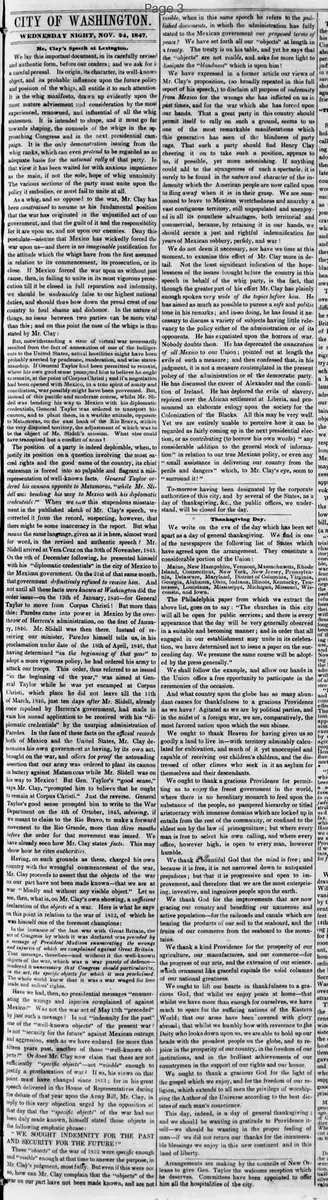
CITY OF WASHINGTON.
WEDNESDAY NIGHT, NOV. 24, 1847.
Mr. Clay's Speech at Lexington.
We lay this important document, in its carefully revised and authentic form, before our readers; and we ask for it a careful perusal. Its origin, its character, its well-known object, and its probable influence upon the future policy and position of the whigs, all entitle it to such attention. It is the whig manifesto, drawn up evidently upon the most mature advisement and consideration by the most experienced, renowned, and influential of all the whig statesmen. It is intended to shape, and it must go far towards shaping, the counsels of the whigs in the approaching Congress and in the next presidential campaign. It is the only demonstration issuing from the whig ranks, which can even pretend to be regarded as an adequate basis for the national rally of that party. In that view it has been waited for with anxious impatience as the main, if not the sole, hope of whig unanimity. The various sections of the party must unite upon the policy it embodies, or must fail to unite at all.
As a whig, and so opposed to the war, Mr. Clay has been constrained to assume as his fundamental position that the war has originated in the unjustified act of our government, and that the guilt of it and the responsibility for it are upon us, and not upon our enemies. Deny this postulate-assume that Mexico has wickedly forced the war upon us-and there is no imaginable justification for the attitude which the whigs have from the first assumed in relation to its commencement, its prosecution, or its close. If Mexico forced the war upon us without just cause, then, in failing to unite in its most vigorous prosecution till it be closed in full reparation and indemnity, we should be undeniably false to our highest national duties, and should thus bow down the proud crest of our country to foul shame and dishonor. In the nature of things, no issue between two parties can be more vital than this; and on this point the case of the whigs is thus stated by Mr. Clay:
But, notwithstanding a state of virtual war necessarily resulted from the fact of annexation of one of the belligerents to the United States, actual hostilities might have been probably averted by prudence, moderation, and wise statesmanship. If General Taylor had been permitted to remain, where his own good sense prompted him to believe he ought to remain, at the point of Corpus Christi; and if a negotiation had been opened with Mexico, in a true spirit of amity and conciliation, war possibly might have been prevented. But, instead of this pacific and moderate course, whilst Mr. Slidell was bending his way to Mexico with his diplomatic credentials, General Taylor was ordered to transport his cannon, and to plant them, in a warlike attitude, opposite to Matamoras, on the east bank of the Rio Bravo, within the very disputed territory, the adjustment of which was to be the object of Mr. Slidell's mission. What else could have transpired but a conflict of arms?
The position of a party is indeed deplorable, when, to justify its position on a question involving the most sacred rights and the good name of the country, its chief statesman is forced into so palpable and flagrant a misrepresentation of well-known facts. General Taylor ordered his cannon opposite to Matamoras, "while Mr. Slidell was bending his way to Mexico with his diplomatic credentials!" When we saw this stupendous misstatement in the published sketch of Mr. Clay's speech, we corrected it from the record, suspecting, however, that there might be some inaccuracy in the report. But what means the same language, given as it is here, almost word for word, in the revised and authentic speech? Mr. Slidell arrived at Vera Cruz on the 30th of November, 1845. On the 5th of December following, he presented himself with his "diplomatic credentials" in the city of Mexico to the Mexican government. On the 21st of that same month, that government definitively refused to receive him. And not until all these facts were known at Washington did the order issue--on the 13th of January, 1846--for General Taylor to move from Corpus Christi! But more than this: Paredes came into power in Mexico by the overthrow of Herrera's administration, on the first of January, 1846. Mr. Slidell was then there. Instead of receiving our minister, Paredes himself tells us, in his proclamation under date of the 15th of April, 1846, that having determined "in the beginning of that year" to adopt a more vigorous policy, he had ordered his army to attack our troops. This order, thus referred to as issued "in the beginning of the year," was aimed at General Taylor while he was yet encamped at Corpus Christi, which place he did not leave till the 11th of March, 1846, just ten days after Mr. Slidell, already once repulsed by Herrera's government, had made in vain his second application to be received with his "diplomatic credentials" by the usurping administration of Paredes. In the face of these facts on the official records both of Mexico and the United States, Mr. Clay denounces his own government as having, by its own act, brought on the war, and offers for proof the astounding assertion that our army was ordered to plant its cannon in battery against Matamoras while Mr. Slidell was on his way to Mexico! But Gen. Taylor's "good sense," says Mr. Clay, "prompted him to believe that he ought to remain at Corpus Christi." Just the reverse. General Taylor's good sense prompted him to write to the War Department on the 4th of October, 1845, advising, if we meant to claim to the Rio Bravo, to make a forward movement to the Rio Grande, more than three months before the order for that movement was issued. We have already seen how Mr. Clay states facts. This may show how he cites authorities.
Having, on such grounds as these, charged his own country with the wrongful commencement of the war, Mr. Clay proceeds to assert that the objects of the war on our part have not been made known-that we are at war "blindly and without any visible object." Let us see, then, what is, on Mr. Clay's own showing, a sufficient declaration of the objects of a war. Here is what he says on this point in relation to the war of 1812, of which he was himself one of the foremost champions:
In the instance of the last war with Great Britain, the act of Congress by which it was declared was preceded by a message of President Madison enumerating the wrongs and injuries of which we complained against Great Britain. That message, therefore—and without it the well-known objects of the war, which was a war purely of defence—rendered it unnecessary that Congress should particularize, in the act, the specific objects for which it was proclaimed. The whole world knew that it was a war waged for free trade and sailors' rights.
Have we had, then, no presidential messages "enumerating the wrongs and injuries complained of against Mexico?" Was not the war act of May 13th "preceded" by just such a message? Is not "indemnity for the past" one of the "well-known objects" of the present war? Is not "security for the future" against Mexican outrage and aggression, such as we have endured for more than fifteen years past, another of those "well-known objects?" Or does Mr. Clay now claim that these are not sufficiently "specific objects"—not "visible" enough to justify a proclamation of war? If so, his views on that point must have changed since 1813; for in his great speech delivered in the House of Representatives during the debate of that year upon the Army Bill, Mr. Clay, in reply to this very objection urged by the opposition of that day that the "specific objects" of the war had not been duly made known, himself stated those objects in the following emphatic phrase:
WE SOUGHT INDEMNITY FOR THE PAST AND SECURITY FOR THE FUTURE!
These "objects" of the war of 1812 were specific enough and "visible" enough at that time to answer the purpose, in Mr. Clay's judgment, most fully. But even if this were not so, how can Mr. Clay complain that the "objects" of the war on our part have not been made known, and are not visible, when in this same speech he refers to the published documents, in which the administration has fully stated to the Mexican government our proposed terms of peace? We have set forth all our "objects" at length in a treaty. The treaty is on his table, and yet he says that the "objects" are not visible, and asks for more light to dissipate the "blindness" which is upon him!
We have expressed in a former article our views of Mr. Clay's proposition, (so broadly repeated in this full report of his speech,) to disclaim all purpose of indemnity from Mexico for the wrongs she has inflicted on us in past times, and for the war which she has forced upon our hands. That a great party in this country should permit itself to rally on such a ground, seems to us one of the most remarkable manifestations which this generation has seen of the blindness of party rage. That such a party should find Henry Clay cheering it on to take such a position, appears to us, if possible, yet more astonishing. If anything could add to the strangeness of such a spectacle, it is surely to be found in the nature and character of the indemnity which the American people are now called upon to fling away when it is in their grasp. We are summoned to leave to Mexican wretchedness and anarchy a vast contiguous territory, still unpopulated and unenjoyed in all its countless advantages, both territorial and commercial, because, by retaining it in our hands, we should secure a just and rightful indemnification for years of Mexican robbery, perfidy, and war!
We do not deem it necessary, nor have we time at this moment, to examine this effort of Mr. Clay more in detail. Not the least significant indication of the hopelessness of the issues brought before the country in this speech in behalf of the whig party, is the fact, that through the greater part of his effort Mr. Clay has plainly enough spoken very wide of the topics before him. He has aimed as much as possible to pursue a safe and politic tone in his remarks; and in so doing, he has found it necessary to discuss a variety of subjects having little relevancy to the policy either of the administration or of its opponents. He has expatiated upon the horrors of war. Nobody doubts them. He has deprecated the annexation of all Mexico to our Union; pointed out at length the evils of such a measure; and then confessed that, in his judgment, it is not a measure contemplated in the present policy of the administration or of the democratic party. He has discussed the career of Alexander and the condition of Ireland. He has deplored the evils of slavery; rejoiced over the African settlement at Liberia, and pronounced an elaborate eulogy upon the society for the Colonization of the Blacks. All this may be very well. Yet we are entirely unable to perceive how it can be regarded as fairly coming up in the next presidential election, or as contributing (to borrow his own words) "any considerable addition to the general stock of information" in relation to our true Mexican policy, or even any "small assistance in delivering our country from the perils and dangers" which, to Mr. Clay's eye, seem to "surround it!"
WEDNESDAY NIGHT, NOV. 24, 1847.
Mr. Clay's Speech at Lexington.
We lay this important document, in its carefully revised and authentic form, before our readers; and we ask for it a careful perusal. Its origin, its character, its well-known object, and its probable influence upon the future policy and position of the whigs, all entitle it to such attention. It is the whig manifesto, drawn up evidently upon the most mature advisement and consideration by the most experienced, renowned, and influential of all the whig statesmen. It is intended to shape, and it must go far towards shaping, the counsels of the whigs in the approaching Congress and in the next presidential campaign. It is the only demonstration issuing from the whig ranks, which can even pretend to be regarded as an adequate basis for the national rally of that party. In that view it has been waited for with anxious impatience as the main, if not the sole, hope of whig unanimity. The various sections of the party must unite upon the policy it embodies, or must fail to unite at all.
As a whig, and so opposed to the war, Mr. Clay has been constrained to assume as his fundamental position that the war has originated in the unjustified act of our government, and that the guilt of it and the responsibility for it are upon us, and not upon our enemies. Deny this postulate-assume that Mexico has wickedly forced the war upon us-and there is no imaginable justification for the attitude which the whigs have from the first assumed in relation to its commencement, its prosecution, or its close. If Mexico forced the war upon us without just cause, then, in failing to unite in its most vigorous prosecution till it be closed in full reparation and indemnity, we should be undeniably false to our highest national duties, and should thus bow down the proud crest of our country to foul shame and dishonor. In the nature of things, no issue between two parties can be more vital than this; and on this point the case of the whigs is thus stated by Mr. Clay:
But, notwithstanding a state of virtual war necessarily resulted from the fact of annexation of one of the belligerents to the United States, actual hostilities might have been probably averted by prudence, moderation, and wise statesmanship. If General Taylor had been permitted to remain, where his own good sense prompted him to believe he ought to remain, at the point of Corpus Christi; and if a negotiation had been opened with Mexico, in a true spirit of amity and conciliation, war possibly might have been prevented. But, instead of this pacific and moderate course, whilst Mr. Slidell was bending his way to Mexico with his diplomatic credentials, General Taylor was ordered to transport his cannon, and to plant them, in a warlike attitude, opposite to Matamoras, on the east bank of the Rio Bravo, within the very disputed territory, the adjustment of which was to be the object of Mr. Slidell's mission. What else could have transpired but a conflict of arms?
The position of a party is indeed deplorable, when, to justify its position on a question involving the most sacred rights and the good name of the country, its chief statesman is forced into so palpable and flagrant a misrepresentation of well-known facts. General Taylor ordered his cannon opposite to Matamoras, "while Mr. Slidell was bending his way to Mexico with his diplomatic credentials!" When we saw this stupendous misstatement in the published sketch of Mr. Clay's speech, we corrected it from the record, suspecting, however, that there might be some inaccuracy in the report. But what means the same language, given as it is here, almost word for word, in the revised and authentic speech? Mr. Slidell arrived at Vera Cruz on the 30th of November, 1845. On the 5th of December following, he presented himself with his "diplomatic credentials" in the city of Mexico to the Mexican government. On the 21st of that same month, that government definitively refused to receive him. And not until all these facts were known at Washington did the order issue--on the 13th of January, 1846--for General Taylor to move from Corpus Christi! But more than this: Paredes came into power in Mexico by the overthrow of Herrera's administration, on the first of January, 1846. Mr. Slidell was then there. Instead of receiving our minister, Paredes himself tells us, in his proclamation under date of the 15th of April, 1846, that having determined "in the beginning of that year" to adopt a more vigorous policy, he had ordered his army to attack our troops. This order, thus referred to as issued "in the beginning of the year," was aimed at General Taylor while he was yet encamped at Corpus Christi, which place he did not leave till the 11th of March, 1846, just ten days after Mr. Slidell, already once repulsed by Herrera's government, had made in vain his second application to be received with his "diplomatic credentials" by the usurping administration of Paredes. In the face of these facts on the official records both of Mexico and the United States, Mr. Clay denounces his own government as having, by its own act, brought on the war, and offers for proof the astounding assertion that our army was ordered to plant its cannon in battery against Matamoras while Mr. Slidell was on his way to Mexico! But Gen. Taylor's "good sense," says Mr. Clay, "prompted him to believe that he ought to remain at Corpus Christi." Just the reverse. General Taylor's good sense prompted him to write to the War Department on the 4th of October, 1845, advising, if we meant to claim to the Rio Bravo, to make a forward movement to the Rio Grande, more than three months before the order for that movement was issued. We have already seen how Mr. Clay states facts. This may show how he cites authorities.
Having, on such grounds as these, charged his own country with the wrongful commencement of the war, Mr. Clay proceeds to assert that the objects of the war on our part have not been made known-that we are at war "blindly and without any visible object." Let us see, then, what is, on Mr. Clay's own showing, a sufficient declaration of the objects of a war. Here is what he says on this point in relation to the war of 1812, of which he was himself one of the foremost champions:
In the instance of the last war with Great Britain, the act of Congress by which it was declared was preceded by a message of President Madison enumerating the wrongs and injuries of which we complained against Great Britain. That message, therefore—and without it the well-known objects of the war, which was a war purely of defence—rendered it unnecessary that Congress should particularize, in the act, the specific objects for which it was proclaimed. The whole world knew that it was a war waged for free trade and sailors' rights.
Have we had, then, no presidential messages "enumerating the wrongs and injuries complained of against Mexico?" Was not the war act of May 13th "preceded" by just such a message? Is not "indemnity for the past" one of the "well-known objects" of the present war? Is not "security for the future" against Mexican outrage and aggression, such as we have endured for more than fifteen years past, another of those "well-known objects?" Or does Mr. Clay now claim that these are not sufficiently "specific objects"—not "visible" enough to justify a proclamation of war? If so, his views on that point must have changed since 1813; for in his great speech delivered in the House of Representatives during the debate of that year upon the Army Bill, Mr. Clay, in reply to this very objection urged by the opposition of that day that the "specific objects" of the war had not been duly made known, himself stated those objects in the following emphatic phrase:
WE SOUGHT INDEMNITY FOR THE PAST AND SECURITY FOR THE FUTURE!
These "objects" of the war of 1812 were specific enough and "visible" enough at that time to answer the purpose, in Mr. Clay's judgment, most fully. But even if this were not so, how can Mr. Clay complain that the "objects" of the war on our part have not been made known, and are not visible, when in this same speech he refers to the published documents, in which the administration has fully stated to the Mexican government our proposed terms of peace? We have set forth all our "objects" at length in a treaty. The treaty is on his table, and yet he says that the "objects" are not visible, and asks for more light to dissipate the "blindness" which is upon him!
We have expressed in a former article our views of Mr. Clay's proposition, (so broadly repeated in this full report of his speech,) to disclaim all purpose of indemnity from Mexico for the wrongs she has inflicted on us in past times, and for the war which she has forced upon our hands. That a great party in this country should permit itself to rally on such a ground, seems to us one of the most remarkable manifestations which this generation has seen of the blindness of party rage. That such a party should find Henry Clay cheering it on to take such a position, appears to us, if possible, yet more astonishing. If anything could add to the strangeness of such a spectacle, it is surely to be found in the nature and character of the indemnity which the American people are now called upon to fling away when it is in their grasp. We are summoned to leave to Mexican wretchedness and anarchy a vast contiguous territory, still unpopulated and unenjoyed in all its countless advantages, both territorial and commercial, because, by retaining it in our hands, we should secure a just and rightful indemnification for years of Mexican robbery, perfidy, and war!
We do not deem it necessary, nor have we time at this moment, to examine this effort of Mr. Clay more in detail. Not the least significant indication of the hopelessness of the issues brought before the country in this speech in behalf of the whig party, is the fact, that through the greater part of his effort Mr. Clay has plainly enough spoken very wide of the topics before him. He has aimed as much as possible to pursue a safe and politic tone in his remarks; and in so doing, he has found it necessary to discuss a variety of subjects having little relevancy to the policy either of the administration or of its opponents. He has expatiated upon the horrors of war. Nobody doubts them. He has deprecated the annexation of all Mexico to our Union; pointed out at length the evils of such a measure; and then confessed that, in his judgment, it is not a measure contemplated in the present policy of the administration or of the democratic party. He has discussed the career of Alexander and the condition of Ireland. He has deplored the evils of slavery; rejoiced over the African settlement at Liberia, and pronounced an elaborate eulogy upon the society for the Colonization of the Blacks. All this may be very well. Yet we are entirely unable to perceive how it can be regarded as fairly coming up in the next presidential election, or as contributing (to borrow his own words) "any considerable addition to the general stock of information" in relation to our true Mexican policy, or even any "small assistance in delivering our country from the perils and dangers" which, to Mr. Clay's eye, seem to "surround it!"
What sub-type of article is it?
War Or Peace
Partisan Politics
What keywords are associated?
Mexican War
Henry Clay Speech
Whig Manifesto
War Origins
Indemnity
General Taylor
Mr Slidell
What entities or persons were involved?
Henry Clay
Whig Party
General Taylor
Mr. Slidell
Paredes
President Madison
Editorial Details
Primary Topic
Critique Of Henry Clay's Speech On The Mexican War
Stance / Tone
Strongly Pro Administration Critique Of Whig Position
Key Figures
Henry Clay
Whig Party
General Taylor
Mr. Slidell
Paredes
President Madison
Key Arguments
Clay Misrepresents Timeline Of Slidell's Mission And Taylor's Movements To Blame U.S. For Starting War
War Objects Are Clearly Stated In Presidential Messages And Treaty Proposals
Clay's Opposition To Indemnity Ignores Past Mexican Wrongs
Clay's Speech Deviates From Relevant Topics To Safer Subjects