Thank you for visiting SNEWPapers!
Sign up free
Alexandria Gazette, Commercial And Political
Alexandria, Virginia
What is this article about?
Napoleon returns from Elba on March 1, 1815, landing at Gulf Juan and marching to Paris without resistance by March 20. He issues decrees in Lyons abolishing nobility, sequestering Bourbon assets, and dismissing certain officers. Bourbons flee; enthusiasm greets his arrival. Commentary on Vienna Congress secrecy included.
Merged-components note: These components form a continuous article on late foreign intelligence regarding Napoleon's return from Elba and related events.
Clippings
1 of 2
OCR Quality
Full Text
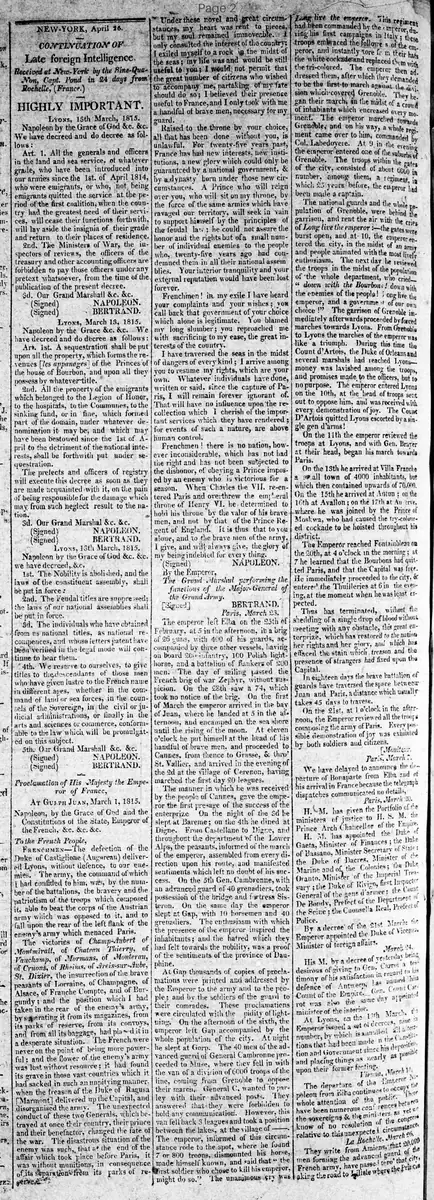
CONTINUATION OF
Late foreign Intelligence
Received at New-York by the Sine-Qua-Non, Capt. Pond in 24 days from Rochelie, (France.)
HIGHLY IMPORTANT.
Lyons, 15th March, 1815.
Napoleon by the Grace of God &c. &c.
We have decreed and do decree as follows:
Art. 1. All the generals and officers in the land and sea service. of whatever grade, who have been introduced into our armies since the 1st. of April 1814. who were emigrants, or who, not being emigrants quitted the service at the period of the first coalition, when the country had the greatest need of their services, will cease their functions forthwith. will lay aside the insignia of their grade and return to their places of residence.
2nd. The Ministers of War. the inspectors of reviews, the officers of the treasury and other accounting officers are forbidden to pay those officers under any pretext whatsoever, from the time of the publication of the present decree.
Sd. Our Grand Marshall &c. &c.
(Signed)
NAPOLEON.
(Signed)
BERTRAND.
Lyons. March 13, 1815.
Napoleon by the Grace &c. &c. We have decreed and do decree as follows:
Art. 1st. A sequestration shall be put upon all the property, which forms the revenues [les appanages] of the Princes of the house of Bourbon, and upon all they possess by whatever title.
2nd. All the property of the emigrants which belonged to the Legion of Honor, to the hospitals, to the Communes, to the sinking fund, or in fine, which formed part of the domain, under whatever denomination it may be, and which may have been bestowed since the 1st of April to the detriment of the national interests, shall be forthwith put under sequestration.
The prefects and officers of registry will execute this decree as soon as they are made acquainted with it, on the pain of being responsible for the damage which may from such neglect result to the nation.
Sd. Our Grand Marshal &c. &c.
(Signed)
NAPOLEON.
(Signed)
BERTRAND.
Lyons, 13th March, 1815.
Napoleon by the Grace of God &c. &c. we have decreed. &c.
1st. The Nobility is abolished. and the laws of the constituent assembly, shall be put in force :
2nd. The Feudal titles are suppressed: the laws of our national assemblies shall be put in force.
3d. The individuals who have obtained from us national titles. as national recompenses, and whose letters patent have been verified in the legal mode will continue to bear them.
4th. We reserve to ourselves. to give titles to the descendants of those men who have given lustre to the French name in different ages, whether in the command of land or sea forces, in the counsels of the Sovereign, in the civil or judicial administrations, or finally in the arts and sciences or commerce, conformable to the law which will be promulgated on this subject.
5th. Our Grand Marshall &c. &c.
(Signed)
NAPOLEON.
(Signed)
BERTRAND.
Proclamation of His Majesty the Emperor of France,
At Gulf Juan, March 1, 1815.
Napoleon, by the Grace of God and the Constitutions of the State, Emperor of the French, &c. &c. &c.
To the French People,
FRENCHMEN--The defection of the Duke of Castiglione (Augereau) delivered Lyons, without defence, to our enemies. The army, the command of which I had confided to him, was, by the number of the battalions, the bravery and the patriotism of the troops which composed it, able to beat the corps of the Austrian enemy fall upon the rear of the left flank of the army which was opposed to it, and to enemy’s army which menaced Paris.
The victories of Champ-Aubert of Montmirall, of Chatean Thiierry, of Vauchamp, of Mormans, of Montereau of Craonne, of Rheims, of Arcis-sur-Aube, St. Dizier. the insurrection of the brave peasants of Lorraine, of Champagne, of Alsace, of Franche Comte, and of Burgundy; and the position which I had by separating it from its magazines, from its parks of reserve, from its convoys. and from all its baggage, had placed it in a desperate situation. The French were never on the point of being more powerful; and the flower of the enemy's army was lost without resource; it had found its grave in those vast countries which it had sacked in such an unpitying manner. when the treason of the Duke of Ragusa (Marmont) delivered up the Capital, and disorganised the army. The unexpected conduct of these two Generals, which betrayed at once their country, their prince and their benefactor, changed the fate of the war. The disastrous situation of the enemy was such, that at the end of the affair which took place before Paris, it was without munitions. in consequence of its separation from its parks of reserve.
Under these novel and great circumstances, my heart was rent to pieces. but my soul remained immoveable. I only consulted the interest of the country: I exiled myself to a rock in the midst of the seas; my life was and would be still useful to you I would not permit that the great number of citizens who wished to accompany me, partaking of my fate should do so; I believed their presence useful to France, and I only took with me a handful of brave men, necessary for my guard.
Raised to the throne by your choice. all that has been done without you, is unlawful.* For twenty-five years past, France has had new interests. new institutions, a new glory which could only be guaranteed by a national government, & by a dynasty born under those new circumstances. A Prince who will reign over you, who will sit on my throne, by the force of the same armies which have ravaged our territory, will seek in vain to support himself by the principles of the feudal law ; he could not assure the honor and the rights but of a small number of individual enemies to the people who, twenty-five years ago had condemned them in all their national assemblies. Your interior tranquility and your external reputation would have been lost forever.
Frenchmen! in my exile I have heard your complaints and your wishes; you call back that government of your choice which alone is legitimate, You blamed my long slumber; you reproached me with sacrificing to my ease, the great interests of the country.
I have traversed the seas in the midst of dangers of every kind ; I arrive among you to resume my rights, which are yours. Whatever individuals have done, written or said, since the capture of Paris. I will remain forever ignorant of. That will have no influence upon the recollection which I cherish of the important services which they have rendered; for events of such a nature, are above human control.
Frenchmen ! there is no nation, however inconsiderable, which has not had the right and has not been subjected to the dishonor, of obeying a Prince imposed by an enemy who is victorious for a season. When Charles the VII. re-entered Paris and overthrew the English throne of Henry VI. he determined to hold his throne by the valor of his brave men, and not by that of the Prince Regent of England. It is thus that to you alone, and to the brave men of the army. I give, and will always give, the glory of my being indebted for every thing.
(Signed)
NAPOLEON.
By the Emperor.
The Grand Marshal performing the functions of the Major-General of the Grand Army.
(Signed)
BERTRAND.
Paris. March 23.
The emperor left Elba on the 25th of February, at 5 in the afternoon, in a brig of 26 guns, with 400 of his guards, accompanied by three other vessels, having on board 200 infantry, 100 Polish light-horse. and a battalion of flankers of 200 men. The day of sailing passed the French brig of war Zephyr. without suspicion. On the 28th saw a 74, which took no notice of the brig. On the first of March the emperor arrived in the bay of Juan, where he landed at 5 in the afternoon, and encamped on the sea shore until the rising of the moon. At eleven o'clock he put himself at the head of his handful of brave men. and proceeded to Cannes. from thence to Grasse, & thro St. Vallier. and arrived in the evening of the 2d at the village of Cerenon, having marched the first day 20 leagues.
The manner in which he was received by the people of Cannes. gave the emperor the first presage of the success of the enterprize On the night of the 3d he slept at Bareme: on the 4th he dined at Digne. From Castellane to Digne, and throughout the department of the Lower Alps, the peasants, informed of the march of the emperor, assembled from every direction upon his route. and manifested sentiments which left no doubt of his success. On the 5th Gen. Cambronne, with an advanced guard of 40 grenadiers, took possession of the bridge and fortress Sisteron. On the same day the emperor slept at Gap, with 10 horsemen and 40 grenadiers. The enthusiasm with which the presence of the emperor inspired the inhabitants; and the hatred which they had felt towards the nobility, was a proof of the sentiments of the province of Dauphine.
At Gap thousands of copies of proclamations were printed and addressed by the Emperor to the army and to the people; and by the soldiers of the guard to their comrades. These proclamations were circulated with the rapidity of lightning. On the afternoon of the sixth, the emperor left Gap accompanied by the whole population of the city. At night he slept at Gorp. The 40 men of the advanced guard of General Cambronne proceeded to Muse, where they fell in with the van of a division of 6000 troops of the line, coming from Grenoble to oppose their march. General C. wanted to parley with their advanced posts. They answered that they were forbidden to hold any communication. However, this van fell back 3 leagues and took a position between the lakes, at the village of --. The emperor, informed of this circumstance rode to the spot, where he found 7 or 800 troops. dismounted his horse, made himself known, and said that " the first soldier who chose to kill his emperor, might do so." The unanimous cry was
Long live the emperor. This regiment had been commanded by the emperor, during his first campaigns in Italy; these troops embraced the followers of the emperor, and instantly tore from their hats the white cockade and replaced them with the tri-colored. The emperor then addressed them, after which they demanded to be the first to march against the division which covered Grenoble. They began their march, in the midst of a crowd of inhabitants which increased every moment. The emperor marched towards Grenoble; and on his way, a whole regiment came over to him, commanded by Col. Labedoyere. At 9 in the evening the emperor entered one of the suburbs of Grenoble. The troops within the gates of the city, consisted of about 6000 in number, among them, a regiment, in which 25 years before, the emperor had been made a captain. The national guards and the whole population of Grenoble, were behind the garrison, and rent the air with the cries of Long live the emperor:--the gates were burst open, and at 10, the emperor entered the city, in the midst of an army and people animated with the most lively enthusiasm. The next day he reviewed the troops in the midst of the population of the whole department, who cried-- " down with the Bourbons! down with the enemies of the people! long live the emperor, and a government of our own choice !"
The garrison of Grenoble immediately afterwards proceeded by forced marches towards Lyons. From Grenoble to Lyons the march of the emperor was like a triumph. During this time the Count d'Artois, the Duke of Orleans and several marshals had reached Lyons-- money was lavished among the troops, and promises made to the officers, but to no purpose. The emperor entered Lyons on the 10th, at the head of troops sent out to oppose him, and was received with every demonstration of joy. The Count D'Artois quitted Lyons escorted by a single gen d'arms!
On the 11th the emperor reviewed the troops at Lyons, and with Gen. Ney at their head, began his march towards Paris.
On the 18th he arrived at Villa Franca a small town of 4000 inhabitants. but which then contained upwards of 70,000. On the 15th he arrived at Autun : on the 16th at Avallon ; on the 17th at Auxerre. where. he was joined by the Prince of Moskwa, who had caused the tri-coloured cockade to be hoisted throughout his district.
The Emperor reached Fontainebleau on the 20th, at 4 o'clock in the morning : at 7 he learned that the Bourbons had quitted Paris, and that the Capital was free. He immediately proceeded to the city. & entered the Thuilleries at 6 in the evening. at the moment when he was least expected.
Thus has terminated. without the shedding of a single drop of blood without meeting with any obstacle. this great enterprize, which has restored to the nation her rights and her glory. and which has effaced the stain which treason and the presence of strangers had fixed upon the Capital.
In eighteen days the brave battalion of guards have traversed the space between Juan and Paris. a distance which usually takes 45 days to traverse
On the 21st. at 1 o'clock in the afternoon, the Emperor reviewed all the troops composing the army of Paris. Every possible demonstration of joy was exhibited by both soldiers and citizens.
[Moniteur.
Paris. March 27.
his arrival in France because the telegraph parture of Bonaparte from Elba and of dispatches communicated no details.
We have delayed to announce the de-
Paris. March 20.
H.M. has given the Portfolio of the ministers of justice to H. S. M. the Prince Arch Chancellor of the Empire.
H.M. has appointed the Duke of Gaeta, Minister of Finances ; the Duke of Bassano, Minister Secretary of State : the Duke of Decres. Minister of the Marine and of the Colonies; the Duke Oranto, Minister of the Imperial Treasury ; the Duke of Rivoli, first Inspector General of the gens d'arme: the Count De Bondy, Prefect of the Department of the Seine ; the Count Real, Prefect of Police.
Emperor appointed the Duke of Vicenza, By a decree of the 31st March: the Minister of Foreign affairs.
March 24.
His M. by a decree of yesterday being desirous of giving to Gen. Carnot a testimony of his satisfaction in regard to his defence of Antwerp, has named him Count of the Empire.
Gen. Count Carnot rot was also the same day appointed minister of the interior.
At Lyons, on the 13th March, the Emperor issued a series of decrees, nine in number, by which is annulled all alterations that had been made in the Constitution and Government since his deposition. and placing things as nearly as possible upon their former footing.
The departure of the Emperor Napoleon from Elba continues to occupy the poleon from Elba cantinues to occupy the whole attention of the public. There have been numerous conferences between the sovereigns & the ministers. as yet we know of no resolution of the congress relative to this unexpected circumstance.
They write from Amiens, that 20,000 men forming the advanced guard of the French army. have passed through that city taking the road to Lisle where the Prince
La Rochelle. March 26.
of the House of Bourbon have retired, It exposes itself to a siege. It is further said, that it is believed that that city will not expose the king has embarked for England at the session of Belgium where the Emperor that our troops will take immediate possession Ambleteause, near Calais. It is believed partisans. It is estimated that he has will find great resources and many have been given to raise new levies of troops. Orders
command the English troops in Belgium I is said that Lord Wellington will and that a Prussian corps of troops is advancing and that a general war is likely to take towards frontiers France Italy said being state insurrection. Austria is sending a large army into that country.
Piedmont and Genoa are rising and are disposed to declare in favor of France. Bordeaux and Toulouse are for the king, long, The Bordeaux people endeavored to take possession of the post of Blanges, but it is believed they will not hold out but they did not succeed. The duke of Angouleme has his head quarters at Toulouse; he has sent for troops, and they are national guards. June. 16 at union, and 6 at Rochefort ; The French have in Brest, 44 sail of the returned from British prisons, are devoted all the French seamen, especially those It is said by letters from Paris. that ed to Napoleon. moderately disposed, it appears that he since the return of Napoleon, he appears the mediation of Maria Louisa, that in had made propositions to Austria through favor, or would offer her mediation and re- casa that power would declare in his fa- main neutral, peace would soon be re- established, at least on the continent of Europe.
Paris. March 1.
The proceedings of a Congress at Vienna having been kept such a profound secret, until they had come to a decision respecting the partition of Poland and Saxony, and the people of Europe having been merely informed of the result of their deliberations, without reason which influenced them; in fact millions of human beings having changed masters, with out being told why! it becomes highly important that an enquiry should be made after the grand cause, which could produce such extraordinary effects. If a power is invested in any number of men, why incorporate themselves into one body. (let them be denominated a Congress or any thing else, it matters not.) and they proceed to arrange definitely & professedly upon just principles; the deranged affairs of the unsettled states of Europe, according to the laws of nations and the rights of sovereigns : it behoves them to make their proceedings public. that the different nations interested in the result. may judge how justly they have been condemned or acquitted. But we dare say some enlightened politician will here interrupt us, and say, " The Ministers who are sent to guard the interests of their respective countries, do they not know. are they not acquainted with the secret springs of this great political Cabinet ? "We reply—yes. but they agree to what we don't know and keep secret we don't know what! it is this sly way of doing business, this secrecy—" there's the rub." Therefore, where the proceedings are just. the actions ought to be open. We do not mean to say the proceedings of the Congress have been otherwise than just, by no means ; but we are not furnished with any clue which we can form an opinion at all : we have only heard their will; and that has been absolute definite, law !!! Europe contains upwards of 150,000,000 of inhabitants. existing on a space of 2,749,246 square miles, and the greatest part of these have been nearly interested in the discussions of the Congress: therefore is it fair that only two or three individuals of this immense multitude should be acquainted with the proceedings! Russia. with 40,000,000 of inhabitants, however contented they may appear to be, would no doubt gladly be acquainted with what passes. France with upwards of 25,000,000. is equally eager to know. not merely the result that alone cannot be sufficiently satisfactory. but the reasons which led to such conclusion. The inhabitants of G. Britain, estimated at 16,000,000 are quite exasperated at the impenetrable secrecy under which every proceeding has been covered: indeed. if we may judge by their public prints, and their debates in the House of Commons, they are almost clamorous, & nothing but the speedy solution of the enigma by Lord Castlereagh, can quell the turbulent, members of the opposition. It is said we all know that the public will in due time become fully masters of the subject, when every thing is decided ; now the petty affairs of Germany may very possibly occupy the attention of the ministers interested in it six months longer, and then of what use will be an explanation ? In the mean time, each party, as his territory is assigned him, takes immediate possession of it, right or wrong. and when the congress is broken up we should like to know what now could interfere were the latter found to be the case. Perhaps it may be said we. do not treat the congress with the respect it deserves—we deny it—we treat it with every possible respect for we never saw or heard of such a number of respectable personages in such respectable situations before; and we here seriously assert that we think they have acted in the most respectable manner—and we think—we do not know—that. as we said before, it is invisible to decuple ripsu, This congress
What sub-type of article is it?
What keywords are associated?
What entities or persons were involved?
Where did it happen?
Foreign News Details
Primary Location
France
Event Date
March 1 To March 27, 1815
Key Persons
Outcome
no bloodshed; napoleon enters paris unopposed on march 20; bourbons flee; new ministers appointed; decrees annul changes since deposition; potential war with allies; enthusiasm among troops and people.
Event Details
Napoleon leaves Elba on February 25, 1815, lands at Gulf Juan on March 1, marches through France with growing support from troops and populace, enters Lyons on March 10, Paris on March 20. Issues decrees in Lyons on March 13-15 abolishing nobility, sequestering Bourbon and emigrant properties, dismissing certain officers. Proclamation justifies return, blames traitors. Appoints ministers and officials. Reports of royalist holdouts in Bordeaux, Toulouse; allied reactions and Vienna Congress secrecy criticized.