Thank you for visiting SNEWPapers!
Sign up free
The Virginia Gazette
Richmond, Williamsburg, Richmond County, Virginia
What is this article about?
In Dublin on Nov. 1, public agitation over free trade and a short-duration money bill led to riots targeting officials like Attorney General John Scott. Crowds surrounded Parliament House, forcing oaths from members, but were dispersed by volunteer lawyers' intervention without major violence.
Clipping
OCR Quality
Full Text
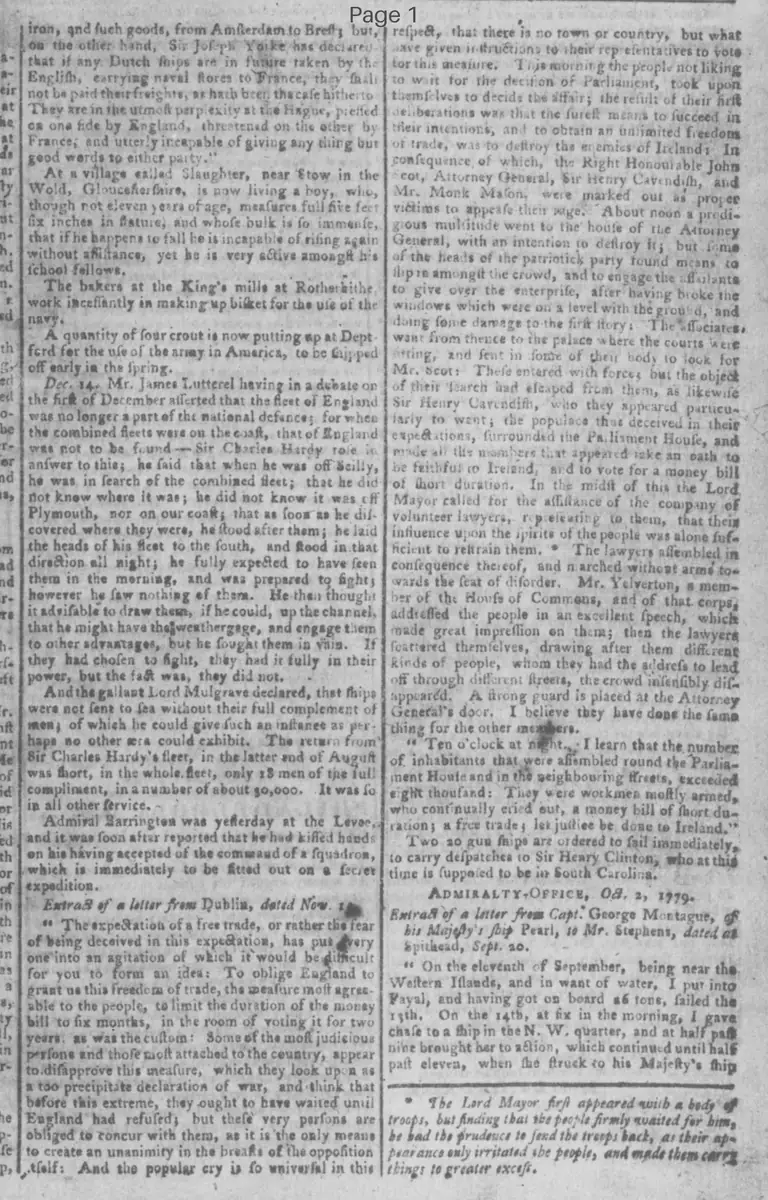
The expectation of a free trade, or rather the fear of being deceived in this expectation, has put every one into an agitation of which it would be difficult for you to form an idea: To oblige England to grant us this freedom of trade, the measure most agreeable to the people, to limit the duration of the money bill to six months, in the room of voting it for two years, as was the custom: Some of the most judicious persons and those not attached to the country, appear to disapprove this measure, which they look upon as a too precipitate declaration of war, and think that before this extreme, they ought to have waited until England had refused; but these very persons are obliged to concur with them, as it is the only means to create an unanimity in the breast of the opposition.
And the popular cry is so universal in this respect, that there is no town or country, but have given instructions to their representatives to vote for this measure. This morning the people not liking to wait for the election of Parliament, took upon themselves to decide the affair; the result of their first deliberations was that the surest means to succeed in their intentions, and to obtain an unlimited freedom of trade, was to destroy the enemies of Ireland. In consequence of which, the Right Honourable John Scott, Attorney General, Sir Henry Cavendish, and Mr. Monk Mason, were marked out as proper victims to appease their rage. About noon a prodigious multitude went to the house of the Attorney General, with an intention to destroy it; but most of the heads of the patriotick party found means to slip in amongst the crowd, and to engage the assailants to give over the enterprize, after having broke the windows which were on a level with the ground, and doing some damage to the first story: The rioters went from thence to the palace where the courts were sitting, and sent in some of their body to look for Mr. Scott: These entered with force but the object of their search had escaped from them, as likewise Sir Henry Cavendish, who they appeared particularly to want; the populace thus deceived in their expectations, surrounded the Parliament House, and made all the members that appeared take an oath to be faithful to Ireland, and to vote for a money bill of short duration. In the midst of this the Lord Mayor called for the assistance of the company of volunteer lawyers, representing to them, that their influence upon the spirits of the people was alone sufficient to restrain them. The lawyers assembled in consequence thereof, and marched without arms towards the seat of disorder, Mr. Yelverton, member of the House of Commons, and of that corps, addressed the people in an excellent speech, which made great impression on them; then the lawyers scattered themselves, drawing after them different kinds of people, whom they had the address to lead off through different streets, the crowd insensibly disappeared. A strong guard is placed at the Attorney General's door. I believe they have done the same for the other members.
Ten o'clock at night: I learn that the number of inhabitants that were assembled round the Parliament House and in the neighbouring streets, exceeded eight thousand: They were workmen mostly armed, who continually cried out, a money bill of short duration; a free trade; let justice be done to Ireland.
The Lord Mayor first appeared with a body of troops, but finding that the people firmly resisted for him, he had the prudence to send the troops back, as their appearance only irritated the people, and made them carry things to greater excess.
What sub-type of article is it?
What keywords are associated?
What entities or persons were involved?
Where did it happen?
Foreign News Details
Primary Location
Dublin
Event Date
Nov. 1
Key Persons
Outcome
crowd dispersed peacefully after intervention by volunteer lawyers; minor damage to attorney general's house; guards placed at officials' doors; no major casualties reported.
Event Details
Public agitation in Dublin over demands for free trade with England and a six-month money bill led to crowds targeting officials, attempting to destroy the Attorney General's house, searching for targets in courts, and surrounding Parliament House to extract oaths from members. Volunteer lawyers, led by Mr. Yelverton, dispersed the crowd of over 8,000 armed workmen without arms or troops.