Thank you for visiting SNEWPapers!
Sign up free
Letter to Editor
January 22, 1822
Edwardsville Spectator
Edwardsville, Madison County, Illinois
What is this article about?
Criticism of U.S. Senator Isaiah Thomas's vote against the tariff bill protecting American manufactures and his acceptance of a lucrative land office position while in Congress, arguing it corrupts representative government and hinders constituent access.
Clipping
OCR Quality
98%
Excellent
Full Text
FOR THE SPECTATOR.
Mr. Editor,
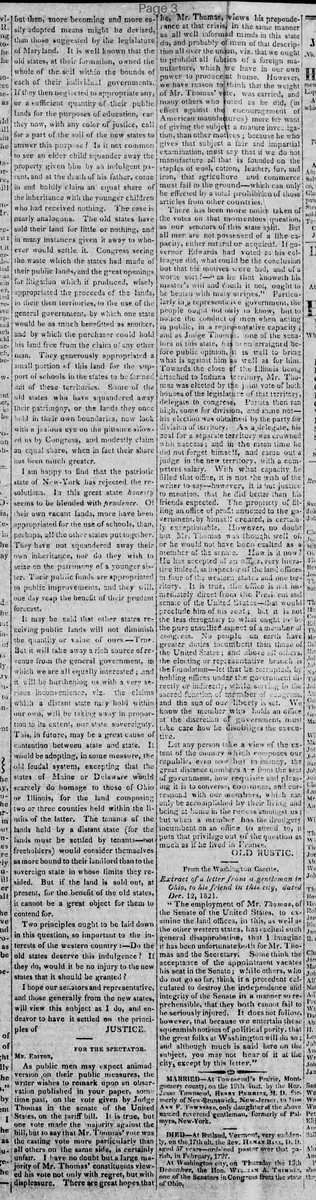
As public men may expect animadversion on their public measures, the writer wishes to remark upon an observation published in your paper, some time past, on the vote given by Judge Thomas in the senate of the United States, on the tariff bill. It is true, but one vote made the majority against the bill, but to say that Mr. Thomas' vote was the casting vote more particularly than all others on the same side, is certainly unfair. I have no doubt but a large majority of Mr. Thomas' constituents viewed his vote not only with regret, but with displeasure. There are great hopes that he, Mr. Thomas, views his preponderance at that crisis, in the same manner as all well informed minds in this state do, and probably of men of that description all over the union, viz. that we ought to prohibit all fabrics of a foreign manufacture, which we have in our own power to produce at home. However, we have reason to think that the weight of Mr. Thomas' vote, was carried, and many others who voted as he did, (in effect against the encouragement of American manufactures) more for want of giving the subject a mature investigation, than other motives; because he who gives that subject a fair and impartial examination, must say that if we do not manufacture all that is founded on the staples of wool, cotton, leather, fur, and iron, that agriculture and commerce must fall to the ground--which can only be effected by a total prohibition of those articles from other countries.
There has been more notice taken of the votes on that momentous question, as our senators of this state split. But all men are not possessed of a like capacity, either natural or acquired. If Governor Edwards had voted as his colleague did, what could be the conclusion but that his motives were bad, and of a worse sort?--"as he that knoweth his master's will and doeth it not, ought to be beaten with many stripes." Particularly in a representative government, the people ought not only to know, but to notice the conduct of men when acting in public, in a representative capacity; and as Judge Thomas, one of the senators of this state, has been arraigned before public opinion, it is well to bring what is against him as well as for him.
Towards the close of the Illinois being attached to Indiana territory, Mr. Thomas was elected by the joint vote of both houses of the legislature of that territory, delegate to congress. Parties then ran high, some for division, and some not--his election was obtained by the party for division of territory. As a delegate, his zeal for a separate territory was crowned with success; and in the mean time he did not forget himself, and came out a judge in the new territory, with a competent salary. With what capacity he filled that office, it is not the wish of the writer to say--however, it is but justice to mention, that he did better than his friends expected. The propriety of filling an office of profit annexed to the government, by himself created, is certainly exceptionable. However, no doubt but Mr. Thomas was thought well of, or he would not have been exalted as a member of the senate. How is it now? He has accepted of an office, very lucrative indeed, as inspector of the land offices in four of the western states and one territory. It is true, the office is not immediately direct from the President and senate of the United States--that would preclude him of his seat; but it is not the less derogatory to what ought to be the pure unsullied aspect of a member of congress. No people on earth have greater duties incumbent than those of the United States: and above all others, the electing or representative branch is the foundation--let that be corrupted, by holding offices under the government directly or indirectly, while serving in the sacred function of member of congress, and the sun of our liberty is set. We know the member who holds an office at the discretion of government, must take care how he disobliges the executive.
Let any person take a view of the extent of the country which composes our republic, even now but in infancy, the great distance numbers are from the seat of government, how requisite and pleasing it is to converse, commune, and correspond with our members, which can only be accomplished by their living and being at home in the recess amongst us; but when a member has the drudgery incumbent on an office to attend to, it puts that privilege out of the question as much as if he lived in France.
OLD RUSTIC.
Mr. Editor,
As public men may expect animadversion on their public measures, the writer wishes to remark upon an observation published in your paper, some time past, on the vote given by Judge Thomas in the senate of the United States, on the tariff bill. It is true, but one vote made the majority against the bill, but to say that Mr. Thomas' vote was the casting vote more particularly than all others on the same side, is certainly unfair. I have no doubt but a large majority of Mr. Thomas' constituents viewed his vote not only with regret, but with displeasure. There are great hopes that he, Mr. Thomas, views his preponderance at that crisis, in the same manner as all well informed minds in this state do, and probably of men of that description all over the union, viz. that we ought to prohibit all fabrics of a foreign manufacture, which we have in our own power to produce at home. However, we have reason to think that the weight of Mr. Thomas' vote, was carried, and many others who voted as he did, (in effect against the encouragement of American manufactures) more for want of giving the subject a mature investigation, than other motives; because he who gives that subject a fair and impartial examination, must say that if we do not manufacture all that is founded on the staples of wool, cotton, leather, fur, and iron, that agriculture and commerce must fall to the ground--which can only be effected by a total prohibition of those articles from other countries.
There has been more notice taken of the votes on that momentous question, as our senators of this state split. But all men are not possessed of a like capacity, either natural or acquired. If Governor Edwards had voted as his colleague did, what could be the conclusion but that his motives were bad, and of a worse sort?--"as he that knoweth his master's will and doeth it not, ought to be beaten with many stripes." Particularly in a representative government, the people ought not only to know, but to notice the conduct of men when acting in public, in a representative capacity; and as Judge Thomas, one of the senators of this state, has been arraigned before public opinion, it is well to bring what is against him as well as for him.
Towards the close of the Illinois being attached to Indiana territory, Mr. Thomas was elected by the joint vote of both houses of the legislature of that territory, delegate to congress. Parties then ran high, some for division, and some not--his election was obtained by the party for division of territory. As a delegate, his zeal for a separate territory was crowned with success; and in the mean time he did not forget himself, and came out a judge in the new territory, with a competent salary. With what capacity he filled that office, it is not the wish of the writer to say--however, it is but justice to mention, that he did better than his friends expected. The propriety of filling an office of profit annexed to the government, by himself created, is certainly exceptionable. However, no doubt but Mr. Thomas was thought well of, or he would not have been exalted as a member of the senate. How is it now? He has accepted of an office, very lucrative indeed, as inspector of the land offices in four of the western states and one territory. It is true, the office is not immediately direct from the President and senate of the United States--that would preclude him of his seat; but it is not the less derogatory to what ought to be the pure unsullied aspect of a member of congress. No people on earth have greater duties incumbent than those of the United States: and above all others, the electing or representative branch is the foundation--let that be corrupted, by holding offices under the government directly or indirectly, while serving in the sacred function of member of congress, and the sun of our liberty is set. We know the member who holds an office at the discretion of government, must take care how he disobliges the executive.
Let any person take a view of the extent of the country which composes our republic, even now but in infancy, the great distance numbers are from the seat of government, how requisite and pleasing it is to converse, commune, and correspond with our members, which can only be accomplished by their living and being at home in the recess amongst us; but when a member has the drudgery incumbent on an office to attend to, it puts that privilege out of the question as much as if he lived in France.
OLD RUSTIC.
What sub-type of article is it?
Persuasive
Political
Ethical Moral
What themes does it cover?
Politics
Economic Policy
Morality
What keywords are associated?
Senator Thomas
Tariff Bill
American Manufactures
Land Office Inspector
Representative Government
Territorial Division
Governor Edwards
What entities or persons were involved?
Old Rustic.
Mr. Editor
Letter to Editor Details
Author
Old Rustic.
Recipient
Mr. Editor
Main Argument
senator thomas's vote against the tariff bill undermined american manufactures and agriculture, and his acceptance of a lucrative office while in congress corrupts representative government by compromising independence and accessibility to constituents.
Notable Details
References Biblical Proverb On Knowing Master's Will
Criticizes Self Appointment To Judgeship In New Territory
Argues Against Holding Executive Offices While In Congress