Thank you for visiting SNEWPapers!
Sign up free
The Nome Nugget
Nome, Nome County, Alaska
What is this article about?
Western senators disputed Treasury Undersecretary Robert V. Roosa's testimony at a Senate Interior Subcommittee hearing in Washington on Friday, arguing that a proposed $35 per ounce subsidy for domestic gold production is needed to increase U.S. reserves and prevent mine closures, despite warnings it would disrupt the global monetary system.
Clipping
OCR Quality
Full Text
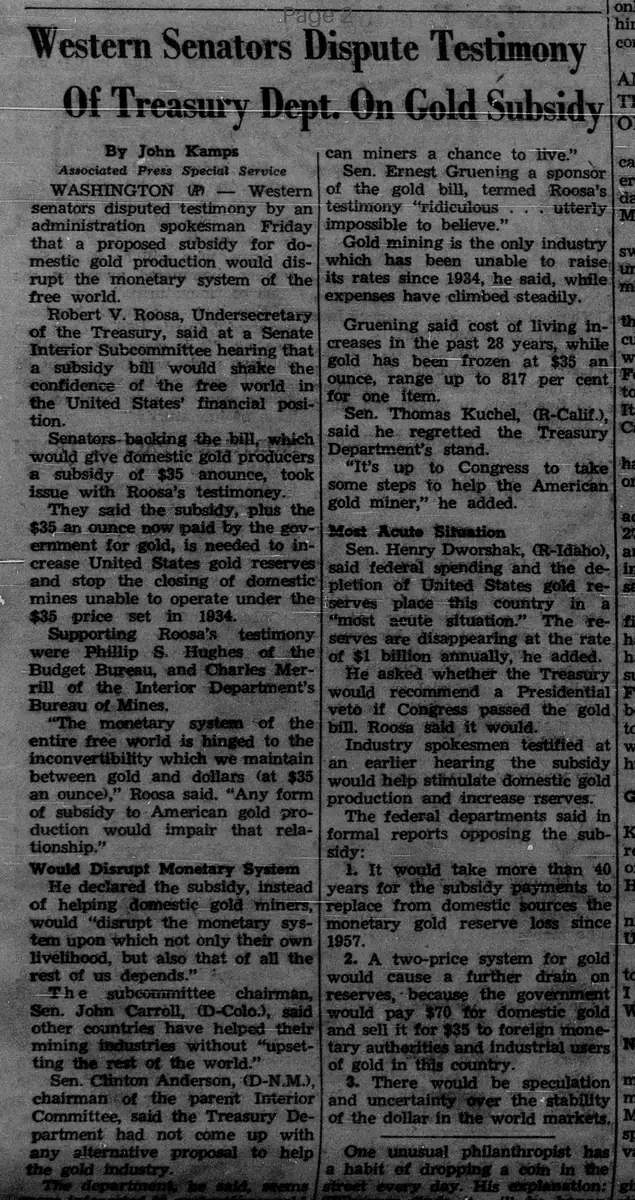
Of Treasury Dept. On Gold Subsidy
By John Kamps
Associated Press Special Service
WASHINGTON (U) Western senators disputed testimony by an administration spokesman Friday that a proposed subsidy for domestic gold production would disrupt the monetary system of the free world.
Robert V. Roosa, Undersecretary of the Treasury, said at a Senate Interior Subcommittee hearing that a subsidy bill would shake the confidence of the free world in the United States' financial position.
Senators backing the bill, which would give domestic gold producers a subsidy of $35 an ounce took issue with Roosa's testimony.
They said the subsidy plus the $35 an ounce now paid by the government for gold is needed to increase United States gold reserves and stop the closing of domestic mines unable to operate under the $35 price set in 1934.
Supporting Roosa's testimony were Phillip S. Hughes of the Budget Bureau, and Charles Merrill of the Interior Department's Bureau of Mines.
"The monetary system of the entire free world is hinged to the inconvertibility which we maintain between gold and dollars (at $35 an ounce)," Roosa said. "Any form of subsidy to American gold production would impair that relationship."
Would Disrupt Monetary System
He declared the subsidy, instead of helping domestic gold miners, would "disrupt the monetary system upon which not only their own livelihood, but also that of all the rest of us depends."
The subcommittee chairman Sen. John Carroll, (D-Colo.) said other countries have helped their mining industries without "upsetting the rest of the world."
Sen. Clinton Anderson, (D-N.M.), chairman of the parent Interior Committee said the Treasury Department had not come up with any alternative proposal to help the gold industry.
can miners a chance to live."
Sen. Ernest Gruening a sponsor of the gold bill, termed Roosa's testimony "ridiculous . . . utterly impossible to believe."
Gold mining is the only industry which has been unable to raise its rates since 1934, he said, while expenses have climbed steadily.
Gruening said cost of living increases in the past 28 years, while gold has been frozen at $35 an ounce, range up to 817 per cent for one item.
Sen. Thomas Kuchel, (R-Calif.), said he regretted the Treasury Department's stand.
"It's up to Congress to take some steps to help the American gold miner," he added.
Most Acute Situation
Sen. Henry Dworshak, (R-Idaho), said federal spending and the depletion of United States gold reserves place this country in a "most acute situation." The reserves are disappearing at the rate of $1 billion annually he added.
He asked whether the Treasury would recommend a Presidential veto if Congress passed the gold bill. Roosa said it would.
Industry spokesmen testified at an earlier hearing the subsidy would help stimulate domestic gold production and increase reserves.
The federal departments said in formal reports opposing the subsidy:
1. It would take more than 40 years for the subsidy payments to replace from domestic sources the monetary gold reserve loss since 1957.
2. A two-price system for gold would cause a further drain on reserves, because the government would pay $70 for domestic gold and sell it for $35 to foreign monetary authorities and industrial users of gold in this country.
3. There would be speculation and uncertainty over the stability of the dollar in the world markets.
What sub-type of article is it?
What keywords are associated?
What entities or persons were involved?
Where did it happen?
Domestic News Details
Primary Location
Washington
Event Date
Friday
Key Persons
Outcome
senators dispute testimony opposing the subsidy; treasury recommends presidential veto if bill passes; federal reports highlight long-term ineffectiveness and risks to reserves and dollar stability.
Event Details
Western senators backing a $35 per ounce subsidy for domestic gold producers disputed Undersecretary of the Treasury Robert V. Roosa's testimony at a Senate Interior Subcommittee hearing that the subsidy would disrupt the free world's monetary system hinged on the $35 per ounce gold price. Supporters argued it is needed alongside the existing $35 payment to boost U.S. gold reserves and prevent mine closures due to costs rising since 1934. Other officials supported Roosa, emphasizing risks to gold-dollar convertibility and potential reserve drains from a two-price system.