Thank you for visiting SNEWPapers!
Sign up free
Editorial
November 23, 1880
The Weekly Miner
Butte, Silver Bow County, Montana
What is this article about?
Editorial criticizes General Sherman's report proposing abandonment of Montana frontier forts like Keogh and Custer for troop concentration at railroad hubs and coastal fortifications, arguing it endangers settlers from Indian raids while prioritizing military comfort over protection. Calls for Congress to reject such measures.
Clipping
OCR Quality
98%
Excellent
Full Text
Sherman's Report.
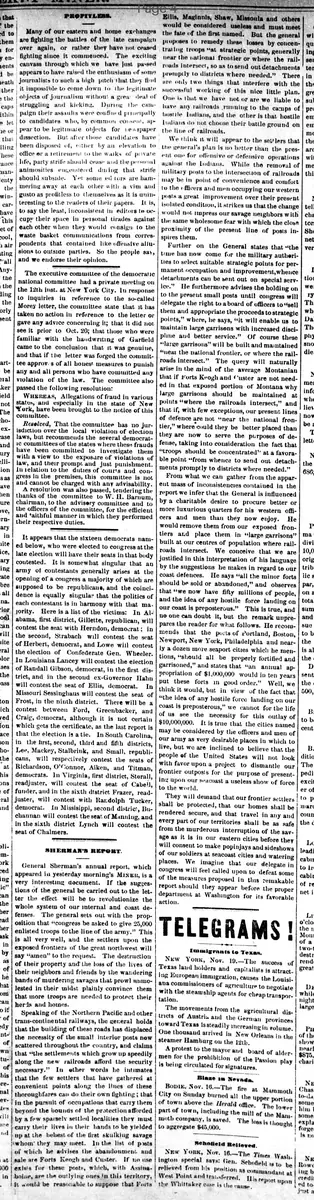
General Sherman's annual report, which appeared in yesterday morning's Miner, is a very interesting document. If the suggestions of the general be carried out to the letter the effect will be to revolutionize the whole system of our internal and coast defenses. The general sets out with the proposition that 'congress be asked to give 25,000 enlisted troops to the line of the army.' This is all very well, and the settlers upon the exposed frontiers of the great northwest will say 'amen' to the request. The destruction of their property and the loss of the lives of their neighbors and friends by the wandering bands of murdering savages that prowl unmolested in their midst plainly convince them that more troops are needed to protect their herds and homes.
Speaking of the Northern Pacific and other trans-continental railways, the general holds that the building of these roads has displaced the necessity of the small interior posts now scattered throughout the country, and claims that 'the settlements which grow up speedily along the new railroads afford the security necessary.' In other words he intimates that the few settlers that have gathered at convenient points along the lines of these thoroughfares can do their own fighting; that in the pursuit of occupations that carry them beyond the bounds of the protection afforded by a few sparsely settled localities they must carry their lives in their hands to be yielded up at the behest of the first skulking savage whom they may meet. In the list of posts of which he advises the abandonment and sale are Forts Keogh and Custer. If no use exists for these posts, which, with Assinaboine, are the outlying ones in this territory, it would be reasonable to suppose that Forts Ellis, Maginnis, Shaw, Missoula and others would be considered useless and must meet the fate of the first named. But the general proposes to remedy these losses by concentrating troops 'at strategic points, generally near the national frontier or where the railroads intersect, so as to send out detachments promptly to districts where needed.' There are only two things that interfere with the successful working of this nice little plan. One is that we have not or are we liable to have any railroads running to the camps of hostile Indians, and the other is that hostile Indians do not choose their battle ground on the line of railroads. We think it will appear to the settlers that the general's plan is no better than the present one for offensive or defensive operations against the Indians. While the removal of military posts to the intersection of railroads may be in point of convenience and comfort to the officers and men occupying our western posts a great improvement over their present isolated condition, it strikes us that the change would not impress our savage neighbors with the same wholesome fear with which the close proximity of the present line of posts inspires them.
Further on the General states that the time has now come for the military authorities to select suitable strategic points for permanent occupation and improvement, whence detachments can be sent out on special service. He furthermore advises the holding on to the present small posts until congress will delegate the right to a board of officers to sell them and appropriate the proceeds to strategic points, where, he says, 'it will enable us to maintain large garrisons with increased discipline and better service.' Of course these 'large garrisons' will be built and maintained 'near the national frontier, or where the railroads intersect.' The query will naturally arise in the mind of the average Montanian that if Forts Keogh and Custer are not needed in that exposed portion of Montana why large garrisons should be maintained at points 'where the railroads intersect,' and that if, with few exceptions, our present lines of defence are not 'near the national frontier,' where could they be better placed than they are now to serve the purposes of defense, taking into consideration the fact that 'troops should be concentrated' at a favorable point 'from whence to send out detachments promptly to districts where needed.' From what we can gather from the apparent mass of inconsistencies contained in the report we infer that the General is influenced by a charitable desire to procure better or more luxurious quarters for his western officers and men than they now enjoy. He would remove them from our exposed frontiers and place them in 'large garrisons' built at our centres of population where railroads intersect. We conceive that we are justified in this interpretation of his language by the suggestions he makes in regard to our coast defences. He says 'all the minor forts should be sold or abandoned,' and observes that 'we now have fifty millions of people and the idea of any hostile force landing on our coast is preposterous.' This is true, and no one can doubt it, but the remark unprepared the reader for what follows. He recommends that the ports of Portland, Boston, Newport, New York, Philadelphia and nearly a dozen more seaport cities which he mentions, 'should all be properly fortified and garrisoned,' and states that 'an annual appropriation of $1,000,000 would in ten years put these forts in good order.' Well, we think it would, but in view of the fact that 'the idea of any hostile force landing on our coast is preposterous,' we cannot for the life of us see the necessity for this outlay of $10,000,000. It is true that the cities named may be considered by the officers and men of our army as very desirable places in which to live, but we are inclined to believe that the people of the United States will not look with favor upon a project to dismantle our frontier outposts for the purpose of presenting upon our seacoast a useless show of force to the world. They will demand that our frontier settlers shall be protected, that our homes shall be rendered secure, and that travel in any and every part of our territories shall be as safe from the murderous interruption of the savage as it is in our eastern cities before they will consent to make popinjays and sideshows of our soldiers at seacoast cities and watering places. We imagine that our delegate in congress will feel called upon to defeat some of the measures proposed in this remarkable report should they appear before the proper department at Washington for its favorable action.
General Sherman's annual report, which appeared in yesterday morning's Miner, is a very interesting document. If the suggestions of the general be carried out to the letter the effect will be to revolutionize the whole system of our internal and coast defenses. The general sets out with the proposition that 'congress be asked to give 25,000 enlisted troops to the line of the army.' This is all very well, and the settlers upon the exposed frontiers of the great northwest will say 'amen' to the request. The destruction of their property and the loss of the lives of their neighbors and friends by the wandering bands of murdering savages that prowl unmolested in their midst plainly convince them that more troops are needed to protect their herds and homes.
Speaking of the Northern Pacific and other trans-continental railways, the general holds that the building of these roads has displaced the necessity of the small interior posts now scattered throughout the country, and claims that 'the settlements which grow up speedily along the new railroads afford the security necessary.' In other words he intimates that the few settlers that have gathered at convenient points along the lines of these thoroughfares can do their own fighting; that in the pursuit of occupations that carry them beyond the bounds of the protection afforded by a few sparsely settled localities they must carry their lives in their hands to be yielded up at the behest of the first skulking savage whom they may meet. In the list of posts of which he advises the abandonment and sale are Forts Keogh and Custer. If no use exists for these posts, which, with Assinaboine, are the outlying ones in this territory, it would be reasonable to suppose that Forts Ellis, Maginnis, Shaw, Missoula and others would be considered useless and must meet the fate of the first named. But the general proposes to remedy these losses by concentrating troops 'at strategic points, generally near the national frontier or where the railroads intersect, so as to send out detachments promptly to districts where needed.' There are only two things that interfere with the successful working of this nice little plan. One is that we have not or are we liable to have any railroads running to the camps of hostile Indians, and the other is that hostile Indians do not choose their battle ground on the line of railroads. We think it will appear to the settlers that the general's plan is no better than the present one for offensive or defensive operations against the Indians. While the removal of military posts to the intersection of railroads may be in point of convenience and comfort to the officers and men occupying our western posts a great improvement over their present isolated condition, it strikes us that the change would not impress our savage neighbors with the same wholesome fear with which the close proximity of the present line of posts inspires them.
Further on the General states that the time has now come for the military authorities to select suitable strategic points for permanent occupation and improvement, whence detachments can be sent out on special service. He furthermore advises the holding on to the present small posts until congress will delegate the right to a board of officers to sell them and appropriate the proceeds to strategic points, where, he says, 'it will enable us to maintain large garrisons with increased discipline and better service.' Of course these 'large garrisons' will be built and maintained 'near the national frontier, or where the railroads intersect.' The query will naturally arise in the mind of the average Montanian that if Forts Keogh and Custer are not needed in that exposed portion of Montana why large garrisons should be maintained at points 'where the railroads intersect,' and that if, with few exceptions, our present lines of defence are not 'near the national frontier,' where could they be better placed than they are now to serve the purposes of defense, taking into consideration the fact that 'troops should be concentrated' at a favorable point 'from whence to send out detachments promptly to districts where needed.' From what we can gather from the apparent mass of inconsistencies contained in the report we infer that the General is influenced by a charitable desire to procure better or more luxurious quarters for his western officers and men than they now enjoy. He would remove them from our exposed frontiers and place them in 'large garrisons' built at our centres of population where railroads intersect. We conceive that we are justified in this interpretation of his language by the suggestions he makes in regard to our coast defences. He says 'all the minor forts should be sold or abandoned,' and observes that 'we now have fifty millions of people and the idea of any hostile force landing on our coast is preposterous.' This is true, and no one can doubt it, but the remark unprepared the reader for what follows. He recommends that the ports of Portland, Boston, Newport, New York, Philadelphia and nearly a dozen more seaport cities which he mentions, 'should all be properly fortified and garrisoned,' and states that 'an annual appropriation of $1,000,000 would in ten years put these forts in good order.' Well, we think it would, but in view of the fact that 'the idea of any hostile force landing on our coast is preposterous,' we cannot for the life of us see the necessity for this outlay of $10,000,000. It is true that the cities named may be considered by the officers and men of our army as very desirable places in which to live, but we are inclined to believe that the people of the United States will not look with favor upon a project to dismantle our frontier outposts for the purpose of presenting upon our seacoast a useless show of force to the world. They will demand that our frontier settlers shall be protected, that our homes shall be rendered secure, and that travel in any and every part of our territories shall be as safe from the murderous interruption of the savage as it is in our eastern cities before they will consent to make popinjays and sideshows of our soldiers at seacoast cities and watering places. We imagine that our delegate in congress will feel called upon to defeat some of the measures proposed in this remarkable report should they appear before the proper department at Washington for its favorable action.
What sub-type of article is it?
Military Affairs
Indian Affairs
Infrastructure
What keywords are associated?
Sherman Report
Frontier Posts
Indian Attacks
Military Reorganization
Railroad Defenses
Coastal Fortifications
Montana Settlers
Army Garrisons
What entities or persons were involved?
General Sherman
Congress
Montana Settlers
Hostile Indians
Forts Keogh
Fort Custer
Fort Assiniboine
Fort Ellis
Fort Maginnis
Fort Shaw
Fort Missoula
Editorial Details
Primary Topic
Critique Of General Sherman's Report On Frontier Defenses And Military Reorganization
Stance / Tone
Critical Opposition To Abandoning Frontier Posts
Key Figures
General Sherman
Congress
Montana Settlers
Hostile Indians
Forts Keogh
Fort Custer
Fort Assiniboine
Fort Ellis
Fort Maginnis
Fort Shaw
Fort Missoula
Key Arguments
Request For 25,000 Additional Troops To Protect Frontiers
Railroads Displace Need For Small Interior Posts, Settlements Provide Security
Abandon Posts Like Forts Keogh And Custer, Concentrate At Strategic Points Near Railroads Or Frontiers
Hostile Indians Do Not Fight Near Railroads, Current Posts Deter Them Better
Select Permanent Strategic Points For Large Garrisons With Better Discipline
Abandon Minor Coastal Forts, Fortify Major Seaports Like New York And Boston With $1m Annual Appropriation
Proposal Prioritizes Officer Comfort Over Frontier Protection
People Will Demand Protection For Settlers Before Funding Coastal Garrisons