Thank you for visiting SNEWPapers!
Sign up free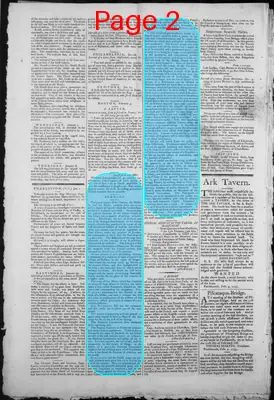
The New Hampshire Gazette
Portsmouth, Rockingham County, New Hampshire
What is this article about?
Paris papers to Nov. 11 report French military successes: capture of Maestricht after 14-day siege by Kleber under Jourdan; Vincent takes Rheinfels bloodlessly; Pichegru routs 300 emigrants. Naval expansion to 50 ships; shipbuilding at Ostend/Dunkirk. Convention regulates societies, plans uniform education. Kosciusko defeated, possibly dead. Urges honorable peace with Rhine boundary, Holland focus to bankrupt England. (278 chars)
Clipping
OCR Quality
Full Text
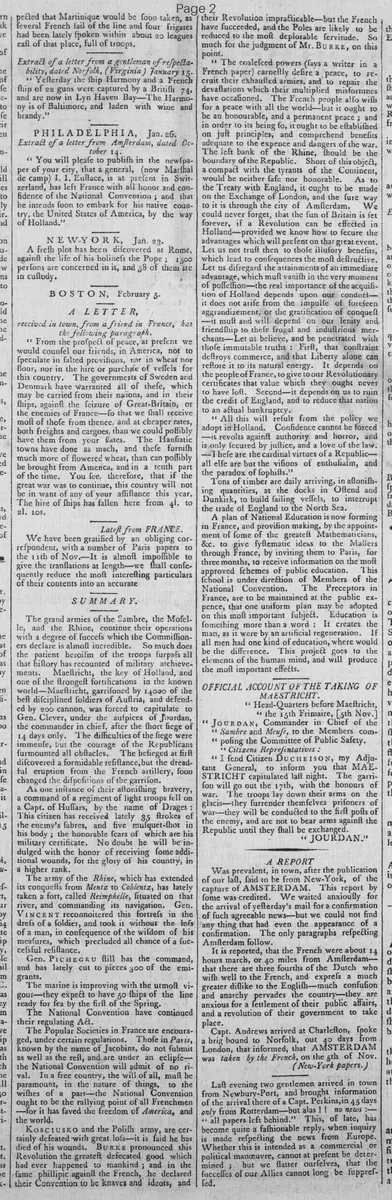
We have been gratified by an obliging correspondent, with a number of Paris papers to the 11th of Nov. It is almost impossible to give the translations at length—we shall consequently reduce the most interesting particulars of their contents into an accurate SUMMARY.
The grand armies of the Sambre, the Moselle, and the Rhine, continue their operations with a degree of success which the Commissioners declare is almost incredible. So much does the patient heroism of the troops surpass all that history has recounted of military achievements. Maestricht, the key of Holland, and one of the strongest fortifications in the known world—Maestricht, garrisoned by 14000 of the best disciplined soldiers of Austria, and defended by 200 cannon, was forced to capitulate to Gen. Kleber, under the auspices of Jourdan, the commander in chief, after the short siege of 14 days only. The difficulties of the siege were immense, but the courage of the Republicans surmounted all obstacles. The besieged at first discovered a formidable resistance, but the dreadful eruption from the French artillery, soon changed the dispositions of the garrison.
As one instance of their astonishing bravery, a command of a regiment of light troops fell on a Capt. of Hussars, by the name of Drages: This citizen has received lately 35 strokes of the enemy's sabres, and five musquet-shot in his body; the honorable scars of which are his military certificate. No doubt he will be indulged with the honor of receiving some additional wounds, for the glory of his country, in a higher rank.
The army, of the Rhine, which has extended its conquests from Mentz to Coblentz, has lately taken a fort, called Rheinfels, situated on that river, and commanding its navigation. Gen. Vincent reconnoitered this fortress in the dress of a soldier, and took it without the loss of a man, in consequence of the wisdom of his measures, which precluded all chance of a successful resistance.
Gen. Pichegru still has the command. and has lately cut to pieces 300 of the emigrants.
The marine is improving with the utmost vigour—they expect to have 50 ships of the line ready for sea by the first of the Spring.
The National Convention have continued their regulating Act.
The Popular Societies in France are encouraged, under certain regulations. Those in Paris, known by the name of Jacobins, do not submit as well as the rest, and are under an eclipse—the National Convention will admit of no rival. In a free country, the will of all, must be paramount, in the nature of things, to the wishes of a part—the National Convention ought to be the rallying point of all Frenchmen—for it has saved the freedom of America, and the world.
Kosciusko and the Polish army, are certainly defeated with great loss—it is said he has died of his wounds. But Burke pronounced this Revolution the greatest defecated good which had ever happened to mankind; and in the same philippic against the French, he declared their Convention to be knaves and idiots, and their Revolution impracticable—but the French have succeeded, and the Poles are likely to be reduced to the most deplorable servitude. So much for the judgment of Mr. Burke, on this point.
"The coalesced powers (says a writer in a French paper) earnestly desire a peace, to recruit their exhausted armies, and to repair the devastations which their multiplied misfortunes have occasioned. The French people also wish for a peace with all the world—but it ought to be an honourable, and a permanent peace; and in order to its being so, it ought to be established on just principles, and comprehend benefits adequate to the expense and dangers of the war. The left bank of the Rhine, should be the boundary of the Republic. Short of this object, a compact with the tyrants of the Continent, would be neither safe nor honorable. As to the Treaty with England, it ought to be made on the Exchange of London, and the sure way to it is through the city of Amsterdam. We could never forget, that the sun of Britain is set forever. if a Revolution can be effected in Holland provided we know how to secure the advantages which will present on that great event. Let us not trust then to those illusory benefits, which lead to consequences the most destructive. Let us disregard the attainments of an immediate advantage, which must vanish in the very moment of possession—the real importance of the acquisition of Holland depends upon our conduct—it does not arise from the impulse of foreseen aggrandizement, or the gratification of conquest—it must and will depend on our lenity and friendship to these frugal and industrious merchants—Let us believe, and be penetrated with those immutable truths: First, that constraint destroys commerce, and that Liberty alone can restore it to its natural energy. It depends on the people of France, to give to our Revolutionary certificates that value which they ought never to have lost. Second—it depends on us to ruin the credit of England, and to reduce that nation to an actual bankruptcy."
All this will result from the policy we adopt in Holland. Confidence cannot be forced—it revolts against authority and horror, and is only secured by justice, and a love of the law. These are the cardinal virtues of a Republic—all else are but the visions of enthusiasm, and the paradox of sophists.
Tons of timber are daily arriving, in astonishing quantities, at the docks in Ostend and Dunkirk, to build sailing vessels, to interrupt the trade of England to the North Sea.
A plan of National Education is now forming in France, and provision making, by the appointment of some of the greatest Mathematicians, &c. to give systematic ideas to the Masters through France, by inviting them to Paris, for three months, to receive information on the most approved schemes of public education. This school is under direction of Members of the National Convention. The Preceptors in France, are to be maintained at the public expense, that one uniform plan may be adopted on this most important subject. Education is something more than a word: It creates the man, as it were by an artificial regeneration. If all men had one kind of education, where would be the difference. This project goes to the elements of the human mind, and will produce the most important effects.
What sub-type of article is it?
What keywords are associated?
What entities or persons were involved?
Where did it happen?
Foreign News Details
Primary Location
France
Event Date
To The 11th Of Nov.
Key Persons
Outcome
maestricht capitulated after 14-day siege; rheinfels taken without loss; 300 emigrants cut to pieces; kosciusko defeated with great loss and reportedly died of wounds; french armies advancing successfully; naval buildup to 50 ships by spring; calls for honorable peace with rhine boundary and focus on holland.
Event Details
French armies of Sambre, Moselle, and Rhine achieve successes, including Gen. Kleber forcing Maestricht to capitulate under Jourdan; Capt. Drages wounded 35 saber strokes and 5 musket shots; Gen. Vincent captures Rheinfels without loss; Gen. Pichegru defeats 300 emigrants. Marine improving with 50 ships expected by spring; timber arrives at Ostend and Dunkirk for vessels to disrupt English trade. National Convention continues regulating Act; Popular Societies encouraged but Jacobins eclipsed. Kosciusko and Polish army defeated. French paper writer urges honorable peace on just principles, Rhine as boundary, policy in Holland to ruin English credit; plan for national education forming with mathematicians instructing masters in Paris.