Thank you for visiting SNEWPapers!
Sign up free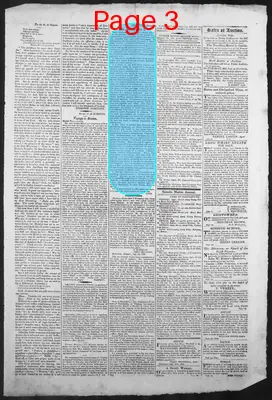
Editorial
September 19, 1820
The New Hampshire Gazette
Portsmouth, Rockingham County, New Hampshire
What is this article about?
Editorial 'The Militia—No. 1.' argues for the vital role of the state militia in preserving the constitution by avoiding a standing army, suppressing domestic disturbances as seen in states like Newhampshire, Massachusetts, and Pennsylvania, and repelling external invasions. Signed 'CIVIS.'
Clipping
OCR Quality
98%
Excellent
Full Text
COMMUNICATIONS.
The Militia—No. 1.
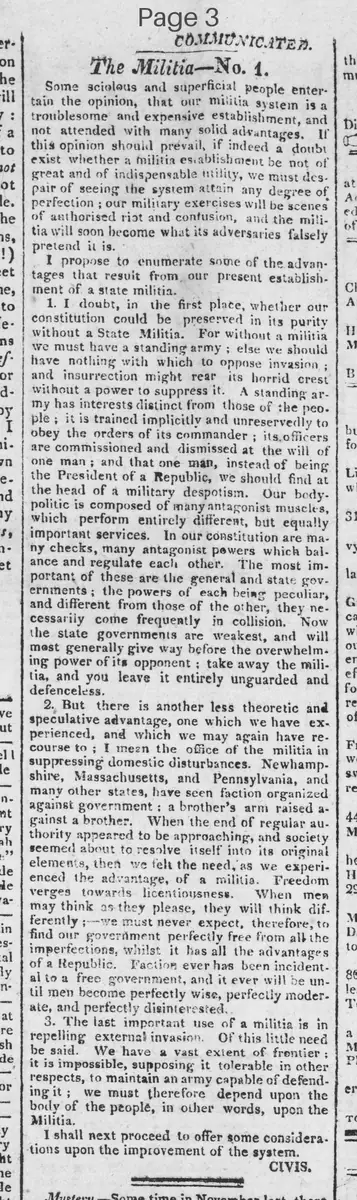
Some sciolous and superficial people entertain the opinion, that our militia system is a troublesome and expensive establishment, and not attended with many solid advantages. If this opinion should prevail, if indeed a doubt exist whether a militia establishment be not of great and of indispensable utility, we must despair of seeing the system attain any degree of perfection ; our military exercises will be scenes of authorised riot and confusion, and the militia will soon become what its adversaries falsely pretend it is.
I propose to enumerate some of the advantages that result from our present establishment of a state militia.
1. I doubt, in the first place, whether our constitution could be preserved in its purity without a State Militia. For without a militia we must have a standing army ; else we should have nothing with which to oppose invasion ; and insurrection might rear its horrid crest without a power to suppress it. A standing army has interests distinct from those of the people ; it is trained implicitly and unreservedly to obey the orders of its commander ; its officers are commissioned and dismissed at the will of one man; and that one man, instead of being the President of a Republic, we should find at the head of a military despotism. Our body-politic is composed of many antagonist muscles, which perform entirely different, but equally important services. In our constitution are many checks, many antagonist powers which balance and regulate each other. The most important of these are the general and state governments; the powers of each being peculiar, and different from those of the other, they necessarily come frequently in collision. Now the state governments are weakest, and will most generally give way before the overwhelming power of its opponent ; take away the militia, and you leave it entirely unguarded and defenceless.
2. But there is another less theoretic and speculative advantage, one which we have experienced, and which we may again have recourse to ; I mean the office of the militia in suppressing domestic disturbances. Newhampshire, Massachusetts, and Pennsylvania, and many other states, have seen faction organized against government; a brother's arm raised against a brother. When the end of regular authority appeared to be approaching, and society seemed about to resolve itself into its original elements, then we felt the need, as we experienced the advantage, of a militia. Freedom verges towards licentiousness. When men may think as they please, they will think differently;—we must never expect, therefore, to find our government perfectly free from all the imperfections, whilst it has all the advantages of a Republic. Faction ever has been incidental to a free government, and it ever will be until men become perfectly wise, perfectly moderate, and perfectly disinterested.
3. The last important use of a militia is in repelling external invasion. Of this little need be said. We have a vast extent of frontier: it is impossible, supposing it tolerable in other respects, to maintain an army capable of defending it; we must therefore depend upon the body of the people, in other words, upon the Militia.
I shall next proceed to offer some considerations upon the improvement of the system.
CIVIS.
The Militia—No. 1.
Some sciolous and superficial people entertain the opinion, that our militia system is a troublesome and expensive establishment, and not attended with many solid advantages. If this opinion should prevail, if indeed a doubt exist whether a militia establishment be not of great and of indispensable utility, we must despair of seeing the system attain any degree of perfection ; our military exercises will be scenes of authorised riot and confusion, and the militia will soon become what its adversaries falsely pretend it is.
I propose to enumerate some of the advantages that result from our present establishment of a state militia.
1. I doubt, in the first place, whether our constitution could be preserved in its purity without a State Militia. For without a militia we must have a standing army ; else we should have nothing with which to oppose invasion ; and insurrection might rear its horrid crest without a power to suppress it. A standing army has interests distinct from those of the people ; it is trained implicitly and unreservedly to obey the orders of its commander ; its officers are commissioned and dismissed at the will of one man; and that one man, instead of being the President of a Republic, we should find at the head of a military despotism. Our body-politic is composed of many antagonist muscles, which perform entirely different, but equally important services. In our constitution are many checks, many antagonist powers which balance and regulate each other. The most important of these are the general and state governments; the powers of each being peculiar, and different from those of the other, they necessarily come frequently in collision. Now the state governments are weakest, and will most generally give way before the overwhelming power of its opponent ; take away the militia, and you leave it entirely unguarded and defenceless.
2. But there is another less theoretic and speculative advantage, one which we have experienced, and which we may again have recourse to ; I mean the office of the militia in suppressing domestic disturbances. Newhampshire, Massachusetts, and Pennsylvania, and many other states, have seen faction organized against government; a brother's arm raised against a brother. When the end of regular authority appeared to be approaching, and society seemed about to resolve itself into its original elements, then we felt the need, as we experienced the advantage, of a militia. Freedom verges towards licentiousness. When men may think as they please, they will think differently;—we must never expect, therefore, to find our government perfectly free from all the imperfections, whilst it has all the advantages of a Republic. Faction ever has been incidental to a free government, and it ever will be until men become perfectly wise, perfectly moderate, and perfectly disinterested.
3. The last important use of a militia is in repelling external invasion. Of this little need be said. We have a vast extent of frontier: it is impossible, supposing it tolerable in other respects, to maintain an army capable of defending it; we must therefore depend upon the body of the people, in other words, upon the Militia.
I shall next proceed to offer some considerations upon the improvement of the system.
CIVIS.
What sub-type of article is it?
Constitutional
Military Affairs
What keywords are associated?
Militia System
Standing Army
Constitutional Preservation
Domestic Disturbances
External Invasion
State Governments
What entities or persons were involved?
State Militia
Standing Army
State Governments
General Government
Newhampshire
Massachusetts
Pennsylvania
Editorial Details
Primary Topic
Advantages Of The State Militia System
Stance / Tone
Advocacy For The Necessity And Utility Of The Militia
Key Figures
State Militia
Standing Army
State Governments
General Government
Newhampshire
Massachusetts
Pennsylvania
Key Arguments
Militia Essential To Preserve Constitution Without Relying On A Standing Army That Could Lead To Despotism
State And Federal Governments Balance Each Other; Militia Protects Weaker State Governments
Militia Suppresses Domestic Disturbances And Factions, As Experienced In Several States
Freedom In Republics Inevitably Leads To Factions, Making Militia Necessary
Militia Crucial For Repelling External Invasions Due To Vast Frontiers