Thank you for visiting SNEWPapers!
Sign up free
Atlanta Daily World
Atlanta, Fulton County, Georgia
What is this article about?
Secretary Dulles views 1954 positively for peace amid Communist threats, citing Indo-China armistice and Manila Pact. Assistant Secretary Allen discusses US economic aid and relations with South Asian nations (India, Pakistan, etc.) and limited technical assistance in Africa. Plans for US facilities in Manila and Djakarta address housing needs.
Clipping
OCR Quality
Full Text
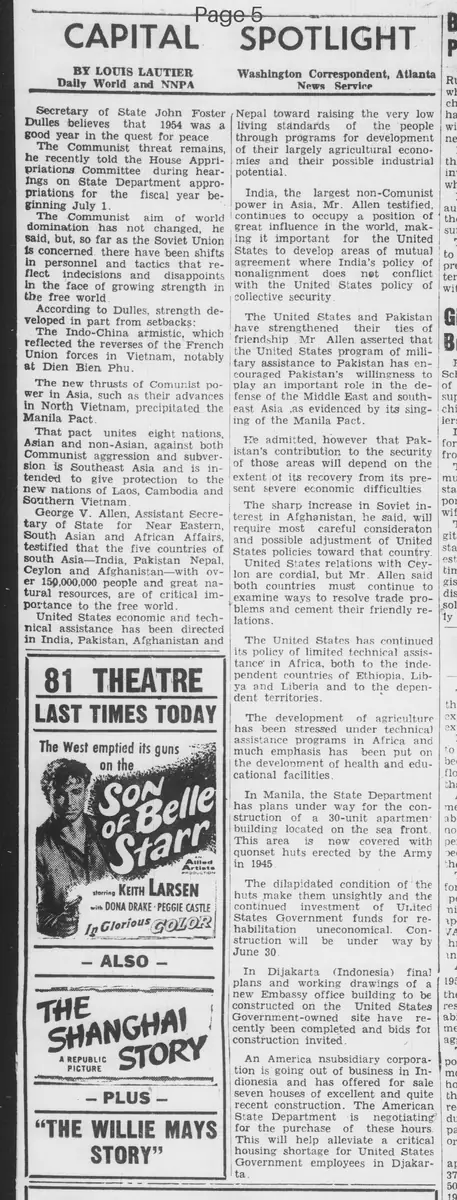
BY LOUIS LAUTIER
Daily World and NNPA
Secretary of State John Foster Dulles believes that 1954 was a good year in the quest for peace.
The Communist threat remains he recently told the House Appropriations Committee during hearings on State Department appropriations for the fiscal year beginning July 1.
The Communist aim of world domination has not changed, he said. But, so far as the Soviet Union is concerned there have been shifts in personnel and tactics that reflect indecisions and disappointments in the face of growing strength in the free world.
According to Dulles, strength developed in part from setbacks:
The Indo-China armistice, which reflected the reverses of the French Union forces in Vietnam, notably at Dien Bien Phu.
The new thrusts of Communist power in Asia, such as their advances in North Vietnam, precipitated the Manila Pact.
That pact unites eight nations, Asian and non-Asian, against both Communist aggression and subversion is Southeast Asia and is intended to give protection to the new nations of Laos, Cambodia and Southern Vietnam.
George V. Allen, Assistant Secretary of State for Near Eastern, South Asian and African Affairs, testified that the five countries of south Asia—India, Pakistan Nepal Ceylon and Afghanistan—with over 150,000,000 people and great natural resources, are of critical importance to the free world.
United States economic and technical assistance has been directed in India, Pakistan, Afghanistan and
Nepal toward raising the very low living standards of the people through programs for development of their largely agricultural economies and their possible industrial potential.
India, the largest non-Communist power in Asia, Mr. Allen testified, continues to occupy a position of great influence in the world, making it important for the United States to develop areas of mutual agreement where India's policy of nonalignment does not conflict with the United States policy of collective security.
The United States and Pakistan have strengthened their ties of friendship Mr Allen asserted that the United States program of military assistance to Pakistan has encouraged Pakistan's willingness to play an important role in the defense of the Middle East and southeast Asia, as evidenced by its signing of the Manila Pact.
He admitted, however that Pakistan's contribution to the security of those areas will depend on the extent of its recovery from its present severe economic difficulties.
The sharp increase in Soviet interest in Afghanistan, he said, will require most careful consideration and possible adjustment of United States policies toward that country.
United States relations with Ceylon are cordial, but Mr. Allen said both countries must continue to examine ways to resolve trade problems and cement their friendly relations.
The United States has continued its policy of limited technical assistance in Africa, both to the independent countries of Ethiopia, Libya and Liberia and to the dependent territories.
The development of agriculture has been stressed under technical assistance programs in Africa and much emphasis has been put on the development of health and educational facilities.
In Manila, the State Department has plans under way for the construction of a 30-unit apartment building located on the sea front.
This area is now covered with quonset huts erected by the Army in 1945.
The dilapidated condition of the huts make them unsightly and the continued investment of United States Government funds for rehabilitation uneconomical.
Construction will be under way by June 30.
In Djakarta (Indonesia) final plans and working drawings of a new Embassy office building to be constructed on the United States Government-owned site have recently been completed and bids for construction invited.
An American subsidiary corporation is going out of business in Indonesia and has offered for sale seven houses of excellent and quite recent construction. The American State Department is negotiating for the purchase of these houses.
This will help alleviate a critical housing shortage for United States Government employees in Djakarta.
What sub-type of article is it?
What keywords are associated?
What entities or persons were involved?
Where did it happen?
Foreign News Details
Primary Location
South Asia And Africa
Event Date
1954
Key Persons
Outcome
indo-china armistice; manila pact uniting eight nations against communist aggression in southeast asia; us economic and technical assistance programs in south asia and africa; strengthened us-pakistan ties; plans for us facilities in manila and djakarta
Event Details
Dulles testified on Communist threats and Soviet shifts amid free world strength from Indo-China setbacks and Manila Pact formation. Allen highlighted US aid to South Asian countries for economic development, India's influence and nonalignment, Pakistan's military role despite economic issues, Soviet interest in Afghanistan, cordial US-Ceylon relations with trade focus, and limited African assistance emphasizing agriculture, health, and education. Administrative updates include Manila apartment construction and Djakarta embassy and housing plans.