Thank you for visiting SNEWPapers!
Sign up free
Kentucky Gazette
Lexington, Fayette County, Kentucky
What is this article about?
In the U.S. House of Representatives, a select committee reported on charges against Rep. George Kremer stemming from a letter he wrote criticizing the Speaker. Kremer declined to appear, citing constitutional concerns over House jurisdiction. The report and his letter were ordered printed and laid on the table. (Washington, Feb. 1825)
Clipping
OCR Quality
Full Text
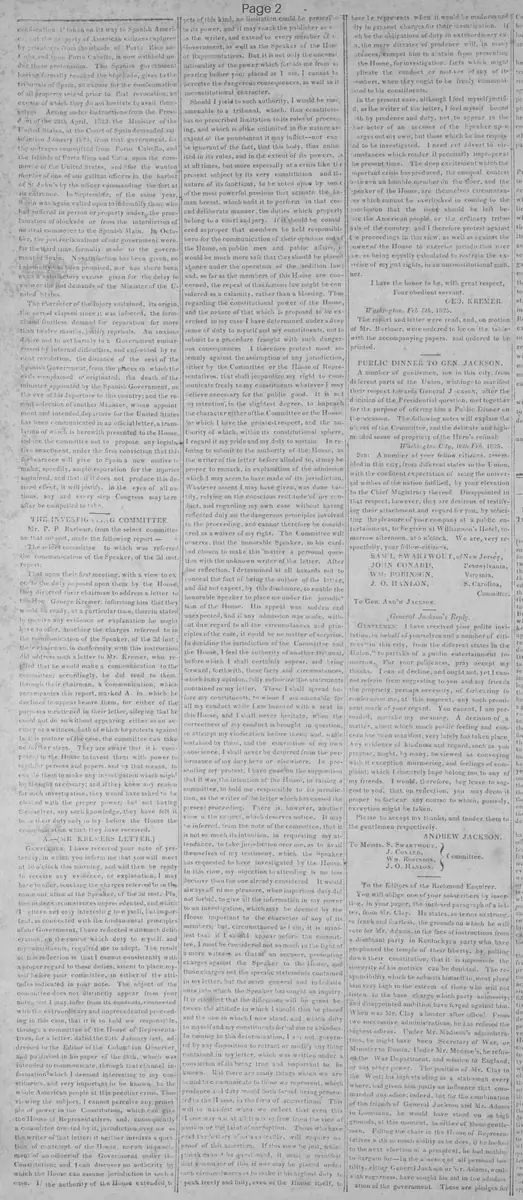
Mr. P. P. Barbour, from the select committee on that subject, made the following report:
The select committee to which was referred the communication of the Speaker, of the 3d inst. report:
That upon their first meeting, with a view to execute the duty imposed upon them by the House, they directed their chairman to address a letter to the Hon. George Kremer, informing him that they would be ready, at a particular time, therein stated to receive any evidence or explanation he might have to offer, touching the charges referred to in the communication of the Speaker, of the 3d inst.; their chairman, in conformity with this instruction did address such a letter to Mr. Kremer, who replied that he would make a communication to the committee; accordingly, he did send to them through their chairman, a communication, which accompanies this report, marked A. in which he declines to appear before them, for either of the purposes mentioned in their letter, alleging that he could not do so without appearing either as an accuser or a witness, both of which he protests against. In this posture of the case, the committee can take no further steps. They are aware that it is competent to the House to invest them with power to send for persons and papers, and by that means, to enable them to make any investigation which might be thought necessary; and if they knew any reason for such investigation, they would have asked to be clothed with the proper power; but not having themselves, any such knowledge, they have felt it to their duty only to lay before the House the communication which they have received.
A.--(MR. KREMER'S LETTER.)
Gentlemen. I have received your note of yesterday, in which you inform me that you will meet at 10 o'clock this morning, and will then be ready to receive any evidence, or explanation, I may have to offer, touching the charges referred to in the communication of the Speaker, of the 3d inst. Placed under circumstances unprecedented, and which I believe not only interesting to myself, but important, as connected with the fundamental principles of our Government, I have reflected with much deliberation on the course which duty to myself, and my constituents, required me to adopt. The result of this reflection is that I cannot consistently with a proper regard to those duties, assent to place myself before your committee, in either of the attitudes indicated in your note. The object of the committee does not distinctly appear from your note. but I may infer from its contents, connected with the extraordinary and unprecedented proceeding in this case, that it is to hold me responsible, through a committee of the House of Representatives, for a letter, dated the 20th January last, addressed to the Editor of the Columbian Observer and published in his paper of the 28th, which was intended to communicate, through that channel information which I deemed interesting to my constituents, and very important to be known to the whole American people at this peculiar crisis. Thus viewing the subject, I cannot perceive any principle of power in the Constitution, which can give the House of Representatives, and, consequently a committee created by it, jurisdiction over me as the writer of that letter; it neither involves a question of contempt of the House, nor an impeachment of an officer of the Government under the Constitution; and I can discover no authority by which the House can assume jurisdiction in such a case. If the authority of the House extended to acts of this kind, no limitation could be prescribed to its power, and it may reach the publisher as well as the writer, and extend to every member of Government, as well as the Speaker of the House of Representatives. But it is not only the unconstitutionality of the power which forbids me from appearing before you; placed as I am, I cannot but perceive the dangerous consequences, as well as its unconstitutional character.
Should I yield to such authority, I would be made amenable to a tribunal, which, thus constituted has no prescribed limitation to its rules of proceeding, and which is alike unlimited in the nature and extent of the punishment it may inflict—nor can I be ignorant of the fact, that this body, thus unlimited in its rules, and in the extent of its powers, is at all times, but more especially at a crisis like the present subject by its very constitution and the nature of its functions, to be acted upon by some of the most powerful passions that actuate the human breast, which unfit it to perform in that cool and deliberate manner, the duties which properly belong to a court and jury. If it should be considered as proper that members be held responsible here for the communication of their opinions out of the House, on public men and public affairs, it would be much more safe that they should be placed at once under the operation of the sedition law; and, so far as the members of this House are concerned, the repeal of that famous law might be considered as a calamity, rather than a blessing. Thus regarding the constitutional power of the House, and the nature of that which is proposed to be exercised in my case I have determined under a deep sense of duty to myself and my constituents, not to submit to a procedure fraught with such dangerous consequences I therefore protest most solemnly against the assumption of any jurisdiction, either by the Committee or the House of Representatives, that shall jeopardize my right to communicate freely to my constituents whatever I may believe necessary for the public good. It is not my intention, in the slightest degree, to impeach the character either of the Committee or the House for which I have the greatest respect, and the authority of which, within its constitutional sphere, I regard it my pride and my duty to sustain. In refusing to submit to the authority of the House, as the writer of the letter before alluded to, it may be proper to remark, in explanation of the admission which I may seem to have made of its jurisdiction. Whatever assent I may have given, was done hastily, relying on the conscious rectitude of my conduct, and regarding my own case without having reflected duly on the dangerous principles involved in the proceeding, and cannot therefore be considered as a waiver of my right. The Committee will observe, that the honorable Speaker, in his card, had chosen to make this matter a personal question with the unknown writer of the letter. After due reflection, I determined at all hazards not to conceal the fact of being the author of the letter, and did not expect, by this disclosure, to enable the honorable Speaker to place me under the jurisdiction of the House. His appeal was sudden and unexpected, and if any admission was made, without due regard to all the circumstances and principles of the case, it could be no matter of surprise.
In deciding the jurisdiction of the Committee and the House, I feel the authority of another tribunal, before which I shall certainly appear, and I bring forward, forthwith, those facts and circumstances, which in my opinion, fully authorize the statements contained in my letter. These I shall spread before my constituents, to whom I am amenable for all my conduct while I am honored with a seat in this House, and I shall never hesitate, when the correctness of my conduct is brought in question, to attempt my vindication before them; and, while sustained by them, and the conviction of my own conscience, I shall never be deterred from the performance of my duty here or elsewhere. In presenting my protest, I have gone on the supposition that it was the intention of the House, in raising a committee, to hold me responsible to its jurisdiction, as the writer of the letter which has caused the present proceeding. There is, however, another view of the subject, which deserves notice. It may be inferred, from the note of the committee, that it is not so much its intention, in requesting my attendance, to take jurisdiction over me, as to avail themselves of my testimony, which the Speaker has requested to have investigated by the House. In this view, my objection to attending is no less decisive than the one already considered It would always afford me pleasure, when imperious duty did not forbid, to give all the information in my power to an investigation, which may be deemed by the House important to the character of any of its members; but, circumstanced as I am, it is manifest that if I should appear before the committee, I must be considered not so much in the light of a mere witness as that of an accuser, presenting charges against the Speaker to the House, and those charges not the specific statements contained in my letter, but the more general and indefinite ones into which the Speaker has sought an inquiry. It is manifest that the difference will be great between the attitude in which I should thus be placed and the one in which I now stand, and which duty to myself and my constituents forbid me to abandon.
In coming to this determination, I am not governed by any disposition to retract or modify any thing contained in my letter, which was written under a conviction of its being true and important to be known. But there are many things which we are bound to communicate to those we represent, which prudence and duty would both forbid being presented to the House, in the form of accusations. This will be manifest when we reflect that even this House may not at all times be free from the vice of passion or the taint of corruption. Those who have read the history of admiralty, will require no proof of this assertion. If this view be just, which I think cannot be questioned, it must be manifest that a member of this House may be placed under such circumstances as to make it his highest duty to speak freely and fully, even of the House itself, to those he represents when it would be madness and folly to present charges for their investigation. If such be the obligations of duty in extraordinary cases, the mere dictates of prudence will, in many instances, compel him to abstain from presenting, to the House, for investigation, facts which might implicate the conduct or motives of any of its members, when they ought to be freely communicated to his constituents.
In the present case, although I feel myself justified, as the writer of the letter, I feel myself bound both by prudence and duty, not to appear in the character of an accuser of the Speaker upon charges not my own, but those which he has requested to be investigated. I need not advert to circumstances which render it peculiarly improper at the present time. The deep excitement which the important crisis has produced, the unequal contest between an humble member on the floor, and the Speaker of the House, are themselves circumstances which cannot be overlooked in coming to the conclusion that the issue should be left before the American people, or the ordinary tribunals of the country: and I therefore protest against the proceedings in this view, as well as against the power of the House to exercise jurisdiction over me, as being equally calculated to restrain the exercise of my just rights, in an unconstitutional manner.
I have the honor to be, with great respect,
Your obedient servant.
GEO. KREMER.
Washington. Feb 8th, 1825.
The report and letter were read, and, on motion of Mr. Barbour, were ordered to lie on the table with the accompanying papers, and ordered to be printed.
What sub-type of article is it?
What keywords are associated?
What entities or persons were involved?
Where did it happen?
Domestic News Details
Primary Location
Washington
Event Date
February 8, 1825
Key Persons
Outcome
the committee report and kremer's letter were read, ordered to lie on the table, and printed; no further investigation proceeded.
Event Details
A select committee of the U.S. House of Representatives, chaired by Mr. P. P. Barbour, reported on charges against Rep. George Kremer related to a letter he wrote criticizing the Speaker. Kremer declined to appear before the committee, arguing that the House lacked constitutional jurisdiction over his actions as a private citizen and that appearing would position him as an accuser or witness, which he refused. The committee, lacking power to compel testimony without House authorization and having no independent knowledge of wrongdoing, presented Kremer's letter to the House.