Thank you for visiting SNEWPapers!
Sign up free
Literary
June 29, 1830
Phenix Gazette
Alexandria, Virginia
What is this article about?
Encyclopedic entry from the Encyclopedia Americana describing caves and grottos: their formation in various rocks, classification by structure, causes like water dissolution or gas, notable examples worldwide including Fingal's Cave, Antiparos, and American sites like Madison's Cave.
Clipping
OCR Quality
98%
Excellent
Full Text
From the Encyclopedia Americana.
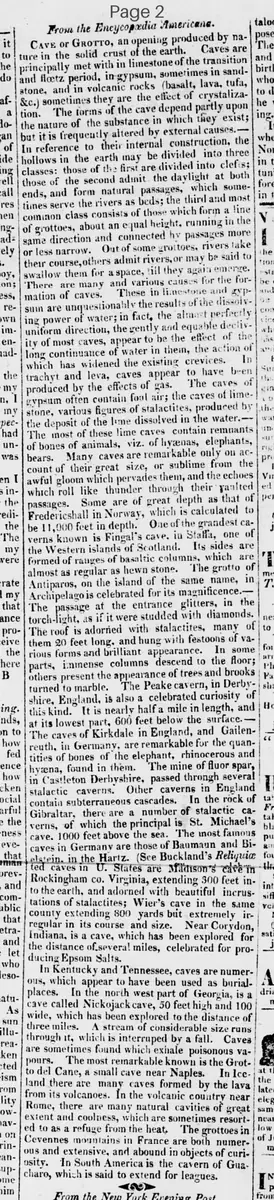
Cave or Grotto, an opening produced by nature in the solid crust of the earth. Caves are principally met with in limestone of the transition and floetz period, in gypsum, sometimes in sandstone, and in volcanic rocks (basalt, lava, tufa, &c.) sometimes they are the effect of crystallization. The forms of the cave depend partly upon the nature of the substance in which they exist; but it is frequently altered by external causes.
In reference to their internal construction, the hollows in the earth may be divided into three classes: those of the first are divided into clefts: those of the second admit the daylight at both ends, and form natural passages, which sometimes serve the rivers as beds; the third and most common class consists of those which form a line of grottoes, about an equal height, running in the same direction and connected by passages more or less narrow. Out of some grottoes, rivers take their course, others admit rivers, or may be said to swallow them for a space, till they again emerge.
There are many and various causes for the formation of caves. These in limestone and gypsum are unquestionably the results of the dissolving power of water; in fact, the almost perfectly uniform direction, the gently and equable declivity of most caves, appear to be the effect of the long continuance of water in them, the action of which has widened the existing crevices.
In trachyte and lava, caves appear to have been produced by the effects of gas. The caves of gypsum often contain foul air; the caves of limestone, various figures of stalactites, produced by the deposit of the lime dissolved in the water.
The most of these lime caves contain remnants of bones of animals, viz. of hyenas, elephants, bears. Many caves are remarkable only on account of their great size, or sublime from the awful gloom which pervades them, and the echoes which roll like thunder through their vaulted passages. Some are of great depth as that of Fredericshall in Norway, which is calculated to be 11,000 feet in depth. One of the grandest caverns known is Fingal's cave, in Staffa, one of the Western islands of Scotland. Its sides are formed of ranges of basaltic columns, which are almost as regular as hewn stone. The grotto of Antiparos, on the island of the same name, in the Archipelago is celebrated for its magnificence.
The passage at the entrance glitters, in the torch-light, as if it were studded with diamonds. The roof is adorned with stalactites, many of them 20 feet long, and hung with festoons of various forms and brilliant appearance. In some parts, immense columns descend to the floor; others present the appearance of trees and brooks turned to marble. The Peake cavern, in Derbyshire, England, is also a celebrated curiosity of this kind. It is nearly half a mile in length, and at its lowest part, 600 feet below the surface.
The caves of Kirkdale in England, and Gailenreuth, in Germany, are remarkable for the quantities of bones of the elephant, rhinoceros and hyena, found in them. The mine of fluor spar, in Castleton Derbyshire, passed through several stalactic caverns. Other caverns in England contain subterraneous cascades. In the rock of Gibraltar, there are a number of stalactic caverns, of which the principal is St. Michael's cave, 1000 feet above the sea. The most famous caves in Germany are those of Baumann and Bielstein, in the Hartz. (See Buckland's Reliquiae Diluvianae.)
The noted caves in U. States are Madison's cave in Rockingham co. Virginia, extending 300 feet into the earth, and adorned with beautiful incrustations of stalactites; Weyer's cave in the same county extending 800 yards but extremely irregular in its course and size. Near Corydon, Indiana, is a cave, which has been explored for the distance of several miles, celebrated for producing Epsom Salts.
In Kentucky and Tennessee, caves are numerous, which appear to have been used as burial-places. In the north west part of Georgia, is a cave called Nickojack cave, 50 feet high and 100 wide, which has been explored to the distance of three miles. A stream of considerable size runs through it, which is interrupted by a fall. Caves are sometimes found which exhale poisonous vapors. The most remarkable known is the Grotto del Cane, a small cave near Naples. In Iceland there are many caves formed by the lava from its volcanoes. In the volcanic country near Rome, there are many natural cavities of great extent and coolness, which are sometimes resorted to as a refuge from the heat. The grottoes in Cevennes mountains in France are both numerous and extensive, and abound in objects of curiosity. In South America is the cavern of Guacharo, which is said to extend for leagues.
Cave or Grotto, an opening produced by nature in the solid crust of the earth. Caves are principally met with in limestone of the transition and floetz period, in gypsum, sometimes in sandstone, and in volcanic rocks (basalt, lava, tufa, &c.) sometimes they are the effect of crystallization. The forms of the cave depend partly upon the nature of the substance in which they exist; but it is frequently altered by external causes.
In reference to their internal construction, the hollows in the earth may be divided into three classes: those of the first are divided into clefts: those of the second admit the daylight at both ends, and form natural passages, which sometimes serve the rivers as beds; the third and most common class consists of those which form a line of grottoes, about an equal height, running in the same direction and connected by passages more or less narrow. Out of some grottoes, rivers take their course, others admit rivers, or may be said to swallow them for a space, till they again emerge.
There are many and various causes for the formation of caves. These in limestone and gypsum are unquestionably the results of the dissolving power of water; in fact, the almost perfectly uniform direction, the gently and equable declivity of most caves, appear to be the effect of the long continuance of water in them, the action of which has widened the existing crevices.
In trachyte and lava, caves appear to have been produced by the effects of gas. The caves of gypsum often contain foul air; the caves of limestone, various figures of stalactites, produced by the deposit of the lime dissolved in the water.
The most of these lime caves contain remnants of bones of animals, viz. of hyenas, elephants, bears. Many caves are remarkable only on account of their great size, or sublime from the awful gloom which pervades them, and the echoes which roll like thunder through their vaulted passages. Some are of great depth as that of Fredericshall in Norway, which is calculated to be 11,000 feet in depth. One of the grandest caverns known is Fingal's cave, in Staffa, one of the Western islands of Scotland. Its sides are formed of ranges of basaltic columns, which are almost as regular as hewn stone. The grotto of Antiparos, on the island of the same name, in the Archipelago is celebrated for its magnificence.
The passage at the entrance glitters, in the torch-light, as if it were studded with diamonds. The roof is adorned with stalactites, many of them 20 feet long, and hung with festoons of various forms and brilliant appearance. In some parts, immense columns descend to the floor; others present the appearance of trees and brooks turned to marble. The Peake cavern, in Derbyshire, England, is also a celebrated curiosity of this kind. It is nearly half a mile in length, and at its lowest part, 600 feet below the surface.
The caves of Kirkdale in England, and Gailenreuth, in Germany, are remarkable for the quantities of bones of the elephant, rhinoceros and hyena, found in them. The mine of fluor spar, in Castleton Derbyshire, passed through several stalactic caverns. Other caverns in England contain subterraneous cascades. In the rock of Gibraltar, there are a number of stalactic caverns, of which the principal is St. Michael's cave, 1000 feet above the sea. The most famous caves in Germany are those of Baumann and Bielstein, in the Hartz. (See Buckland's Reliquiae Diluvianae.)
The noted caves in U. States are Madison's cave in Rockingham co. Virginia, extending 300 feet into the earth, and adorned with beautiful incrustations of stalactites; Weyer's cave in the same county extending 800 yards but extremely irregular in its course and size. Near Corydon, Indiana, is a cave, which has been explored for the distance of several miles, celebrated for producing Epsom Salts.
In Kentucky and Tennessee, caves are numerous, which appear to have been used as burial-places. In the north west part of Georgia, is a cave called Nickojack cave, 50 feet high and 100 wide, which has been explored to the distance of three miles. A stream of considerable size runs through it, which is interrupted by a fall. Caves are sometimes found which exhale poisonous vapors. The most remarkable known is the Grotto del Cane, a small cave near Naples. In Iceland there are many caves formed by the lava from its volcanoes. In the volcanic country near Rome, there are many natural cavities of great extent and coolness, which are sometimes resorted to as a refuge from the heat. The grottoes in Cevennes mountains in France are both numerous and extensive, and abound in objects of curiosity. In South America is the cavern of Guacharo, which is said to extend for leagues.
What sub-type of article is it?
Essay
What themes does it cover?
Nature
What keywords are associated?
Caves
Grottos
Limestone
Stalactites
Natural Formation
Volcanic Rocks
Famous Caverns
What entities or persons were involved?
Encyclopedia Americana
Literary Details
Title
Cave Or Grotto
Author
Encyclopedia Americana