Thank you for visiting SNEWPapers!
Sign up free
Carroll Free Press
Carrollton, Carroll County, Ohio
What is this article about?
On February 2, 1856, Nathaniel P. Banks of Massachusetts was elected Speaker of the U.S. House of Representatives under a new plurality rule after intense balloting and debates among Republicans, Democrats, and Know-Nothings. The victory sparked Republican celebrations in Washington.
Clipping
OCR Quality
Full Text
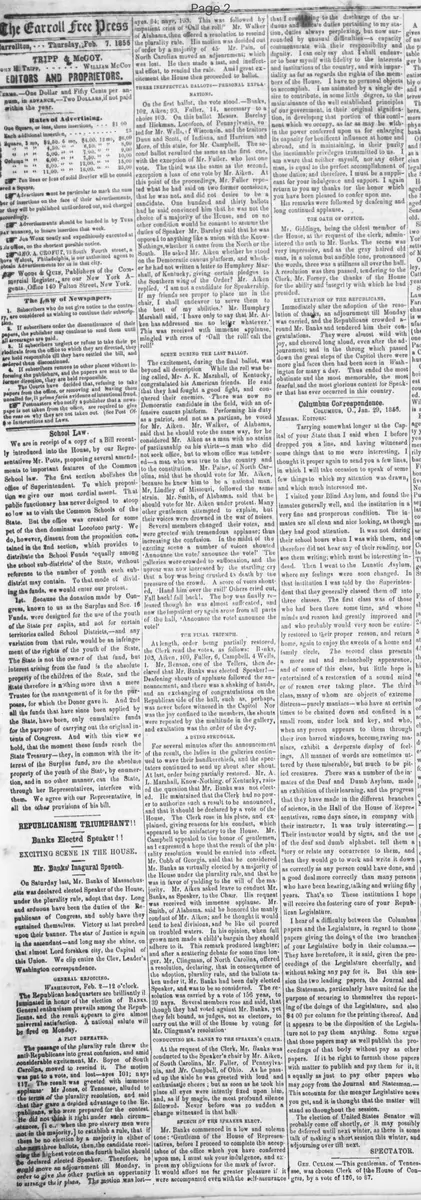
Banks Elected Speaker!!
EXCITING SCENE IN THE HOUSE.
Mr. Banks' Inaugural Speech.
On Saturday last, Mr. Banks of Massachusetts was declared elected Speaker of the House, under the plurality rule, adopted that day. Long and arduous have been the duties of the Republicans of Congress, and nobly have they sustained themselves. Victory at last perched upon their banner. The star of Justice is again in the ascendant—and long may she shine on that almost Lord forsaken city, the Capital of this Union. We clip entire the Cleve. Leader's Washington correspondence.
GENERAL REJOICING.
Washington, Feb. 2—12 o'clock.
The Republican headquarters are brilliantly illuminated in honor of the election of Banks. General enthusiasm prevails among the Republicans, and the result appears to give almost universal satisfaction. A national salute will be fired on Monday.
A PLOT DEFEATED.
The passage of the plurality rule threw the anti-Republicans into great confusion, and amid considerable excitement, Mr. Boyce of South Carolina, moved to rescind it. The motion was put to a vote, and lost—ayes 101; nays 117. The result was greeted with immense applause. Mr. Jones, of Tennessee, alluded to the terms of the plurality resolution, and said—that they gave a decided advantage to the Republicans, who were prepared for the contest. He did not think it right under such circumstances, i.e., when the pro-slavery men were not in the majority, to establish a rule, that if there be no election by a majority in either of the next three ballots, then, the candidate receiving the highest vote on the fourth ballot should be declared elected Speaker. Therefore, he would move an adjournment till Monday, in order to give the other parties an opportunity to arrange their plans. The motion was lost—ayes 84; nays 103. This was followed by impatient cries of 'Call the roll!' Mr. Walker of Alabama, then offered a resolution to rescind the plurality rule. His motion was decided out of order by a majority of 45. Mr. Pain, of North Carolina moved an adjournment; which was lost. He then made a last, and ineffectual effort, to rescind the rule. Amid great excitement the House then proceeded to ballot.
THREE INEFFECTUAL BALLOTS—PERSONAL EXPLANATIONS.
On the first ballot, the vote stood—Banks, 102, Aiken; 93, Fuller, 14, necessary to a choice 103. On this ballot Messrs. Barclay and Hickman, Locofoco, of Pennsylvania, voted for Mr. Wells, of Wisconsin, and the traitors Dunn and Scott, of Indiana, and Harrison and More, of this state, for Mr. Campbell. The second ballot resulted the same as the first one, with the exception of Mr. Fuller, who lost one vote. The third was the same as the second, with the exception a loss of one vote by Mr. Aiken. At this point of the proceedings, Mr. Fuller repeated what he had said on two former occasions, that he was not, and did not desire to be a candidate. One hundred and thirty ballots had he said convinced him that he was not the choice of a majority of the House, and on no other condition would he consent to assume the duties of Speaker. Mr. Barclay said that he was opposed to anything like a union with the Know-Nothings, whether it came from the North or the South. He asked Mr. Aiken whether he stood on the Democratic caucus platform, and whether he had not written a letter to Humphrey Marshall, of Kentucky, giving certain pledges to the Southern wing of the Order? Mr. Aiken replied, 'I am not a candidate for Speakership. If my friends see proper to place me in the chair, I shall endeavor to serve them to the best of my abilities.' Mr. Humphrey Marshall said, 'I have only to say that Mr. Aiken has addressed me no letter whatever.' This was received with immense applause, mingled with cries of 'Call the roll! call the roll!'
SCENE DURING THE LAST BALLOT.
The excitement, during the final ballot, was beyond all description. While the roll was being called, Mr. A. K. Marshall, of Kentucky, congratulated his American friends. He said that they had fought a good fight, and conquered their enemies. There was now no Democratic candidate in the field, with an offensive caucus platform. Performing his duty as a patriot, and not as a partizan, he voted for Mr. Aiken. Mr. Walker, of Alabama, said that he should vote the same way, for he considered Mr. Aiken as a man with no stains of partizanship on his skirts—a man who did not seek office, but to whom office was tendered—a man who was true to the country and to the constitution. Mr. Paine, of North Carolina, said that he should vote for Mr. Aiken, because he knew him to be a national man. Mr. Lindley of Missouri, followed the same strain. Mr. Smith, of Alabama, said that he should vote for Mr. Aiken under protest. Many other gentlemen attempted to explain, but their voices were drowned in the war of noises. Several members changed their votes, and were greeted with tremendous applause; thus increasing the confusion. In the midst of the exciting scene a number of voices shouted 'Announce the vote! announce the vote!' The galleries were crowded to suffocation, and the uproar was now increased by the startling cry that a boy was being crushed to death by the pressure of the crowd. A score of voices shouted 'Hand him over the rail!' Others cried out, 'Fall back! fall back!' The boy was finally released though he was almost suffocated, and now the impatient cry again arose from all parts of the hall, 'Announce the vote! announce the vote!'
THE FINAL TRIUMPH.
At length, order being partially restored, the Clerk read the votes, as follows: Banks, 103. Aiken, 100, Fuller, 6, Campbell, 4 Wells, 1. Mr. Benson, one of the Tellers, then declared that Mr. Banks was elected Speaker!— Deafening shouts of applause followed the announcement, and there was a shaking of hands, and an exchanging of congratulations on the Republican side of the hall, such as, perhaps, was never before witnessed in the Capitol. Nor was the joy confined to the members, the shouts were repeated by the multitude in the gallery, and exultation was the order of the day.
For several minutes after the announcement of the result, the ladies in the galleries continued to wave their handkerchiefs, and the spectators continued to send up shout after shout. At last, order being partially restored. Mr. A. L. Marshall, Know-Nothing, of Kentucky, raised the question that Mr. Banks was not elected. He maintained that the Clerk had no power to authorize such a result to be announced, and that it should be declared by a vote of the House. The Clerk rose in his place, and explained, giving reasons for his conduct, which appeared to be satisfactory to the House. Mr. Campbell appealed to the honor of gentlemen, and expressed a hope that the result of the plurality resolution would be carried into effect. Mr. Cobb of Georgia, said that he considered Mr. Banks as virtually elected by a majority of the House under the plurality rule, and that he was in favor of yielding to the will of the majority. Mr. Aiken asked leave to conduct Mr. Banks, as Speaker, to the Chair. His request was received with immense applause. Mr. Smith, of Alabama, said he honored the manly conduct of Mr. Aiken; and he thought it would tend to heal divisions, and be like oil poured on troubled waters. In his opinion, when full grown men made a child's bargain they should adhere to it. This remark produced laughter; and after a scattering debate for some time longer, Mr. Clingman, of North Carolina, offered a resolution, declaring, that in consequence of the adoption, plurality rule, and the ballots taken under it, Mr. Banks had been duly elected Speaker, and was to be so considered. The resolution was carried by a vote of 156 yeas, to 39 nays. Several members rose and said, that though they had voted against Mr. Banks, yet they felt bound, as judges, not as electors, to carry out the will of the House by voting for Mr. Clingman's resolution.
At the request of the Clerk, Mr. Banks was conducted to the Speaker's chair by Mr. Aiken, of South Carolina, Mr. Fuller, of Pennsylvania, and Mr. Campbell, of Ohio. As he passed up the aisle he was greeted with loud and enthusiastic cheers; but as soon as he took his place all eyes were intently fixed upon him, and, as if by magic, the most profound silence followed. Never before was so sudden a change witnessed in that hall.
SPEECH OF THE SPEAKER ELECT.
Mr. Banks commenced in a low and solemn tone: 'Gentlemen of the House of Representatives, before I proceed to complete the acceptance of the office which you have conferred upon me, I must ask your indulgence, and express my obligations for the mark of favor. It would afford me far greater pleasure if it were accompanied even with the self-assurance that I could bring to the discharge of the arduous and delicate duties pertaining to my station, duties always perplexing, but now surrounded by unusual difficulties—a capacity commensurate with their responsibility and dignity. I can only say that I shall endeavor to bear myself with fidelity to the interests and institutions of the country, and with impartiality as far as regards the rights of the members of the House. I have no personal objects to accomplish. I am animated by a single desire to contribute, in some little degree, to the maintenance of the well established principles of our government, in their original signification, in developing that portion of this continent which we occupy, as far as may be within the power conferred upon us for enlarging its capacity for beneficent influence at home and abroad, and in maintaining, in their purity the inestimable privileges transmitted to us. I am aware that neither myself, nor any other man, is equal to the perfect accomplishment of those duties; and therefore, I must be a suppliant for your indulgence and support. I again return to you my thanks for the honor which you have been pleased to confer upon me.'
His remarks were followed by deafening and prolonged applause.
Mr. Giddings, being the oldest member of the House, at the request of the clerk, administered the oath to Mr. Banks. The scene was very impressive, and as the gray haired old man, in a solemn but audible tone, pronounced the words, there was a stillness all over the hall. A resolution was then passed, tendering to the Clerk, Mr. Forney, the thanks of the House for the ability and integrity with which he had presided.
EXULTATION OF THE REPUBLICANS.
Immediately after the adoption of the resolution of thanks, an adjournment till Monday was carried, and the Republicans crowded around Mr. Banks and tendered him their congratulations. They were almost wild with joy, and cheered long aloud, even after the adjournment; and in the throng which passed down the great steps of the Capitol there were more glad faces than had been seen in Washington for many a day. Thus ended the most obstinate and the most memorable, the most fearful and the most glorious contest for Speaker that has ever occurred in this country.
What sub-type of article is it?
What keywords are associated?
What entities or persons were involved?
Where did it happen?
Domestic News Details
Primary Location
Washington
Event Date
Saturday Last, Feb. 2
Key Persons
Outcome
mr. banks declared elected speaker by 103 votes under plurality rule; resolution confirming election passed 156-39; republicans celebrated with illuminations and cheers; house adjourned till monday.
Event Details
After adopting a plurality rule, the House balloted multiple times amid excitement and attempts to rescind the rule. On the fourth ballot, Banks received 103 votes to Aiken's 100, securing his election as Speaker. He delivered an inaugural speech pledging impartiality and fidelity to the country. Mr. Giddings administered the oath.