Thank you for visiting SNEWPapers!
Sign up free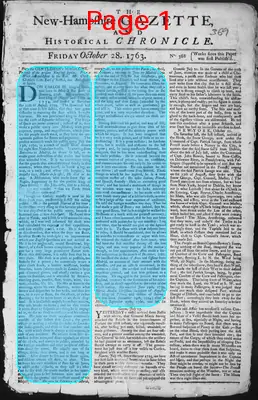
The New Hampshire Gazette And Historical Chronicle
Portsmouth, Greenland, Rockingham County, New Hampshire
What is this article about?
Biographical sketch of King Carlos III of Spain, covering his birth in 1716, proclamation in 1759, personal habits like shooting, daily routine, physical description, temperament, absolute rule, marriages, and political actions including banishments and war with England.
Clipping
OCR Quality
Full Text
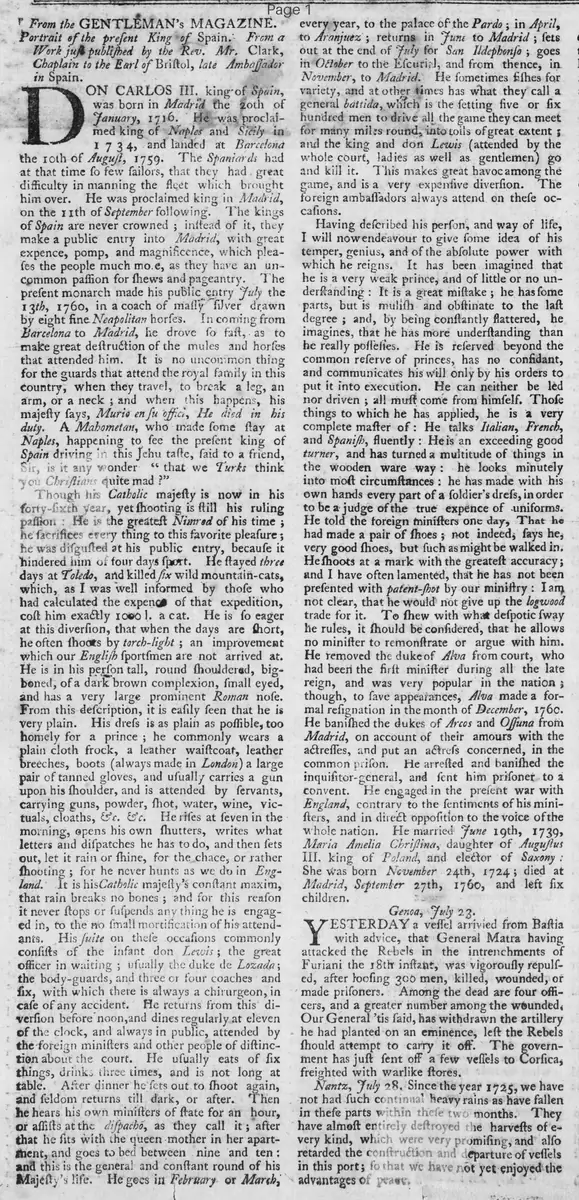
Portrait of the present King of Spain: From a Work just published by the Rev. Mr. Clark,
Chaplain to the Earl of Bristol, late Ambassador in Spain.
ON CARLOS III. king of Spain, was born in Madrid the 20th of January, 1716. He was proclaimed king of Naples and Sicily in 1734, and landed at Barcelona the 10th of August, 1759. The Spaniards had at that time so few sailors, that they had great difficulty in manning the fleet which brought him over. He was proclaimed king in Madrid, on the 11th of September following. The kings of Spain are never crowned; instead of it, they make a public entry into Madrid, with great expense, pomp, and magnificence, which pleases the people much more, as they have an uncommon passion for shows and pageantry. The present monarch made his public entry July the 13th, 1760, in a coach of massive silver drawn by eight fine Neapolitan horses. In coming from Barcelona to Madrid, he drove so fast as to make great destruction of the mules and horses that attended him. It is no uncommon thing for the guards that attend the royal family in this country, when they travel, to break a leg, an arm, or a neck; and when this happens, his majesty says, Murio en su officio, He died in his duty. A Mahometan, who made some stay at Naples, happening to see the present king of Spain driving in this Jehu state, said to a friend, Sir, is it any wonder that we Turks think you Christians quite mad?
Though his Catholic majesty is now in his forty-sixth year, yet shooting is still his ruling passion: He is the greatest Nimrod of his time; he sacrifices every thing to this favorite pleasure; he was disgusted at his public entry, because it hindered him of four days sport. He stayed three days at Toledo, and killed six wild mountain-cats, which, as I was well informed by those who had calculated the expense of that expedition, cost him exactly 1000 l. a cat. He is so eager at this diversion, that when the days are short, he often shoots by torch-light; an improvement which our English sportsmen are not arrived at.
He is in his person tall, round shouldered, big-boned, of a dark brown complexion, small eyed, and has a very large prominent Roman nose. From this description, it is easily seen that he is very plain. His dress is as plain as possible, too homely for a prince; he commonly wears a plain cloth frock, a leather waistcoat, leather breeches, boots (always made in London) a large pair of tanned gloves, and usually carries a gun upon his shoulder, and is attended by servants, carrying guns, powder, shot, water, wine, victuals, clothes, &c. &c. He rises at seven in the morning, opens his own shutters, writes what letters and dispatches he has to do, and then sets out, let it rain or shine, for the chase, or rather shooting; for he never hunts as we do in England. It is his Catholic majesty's constant maxim, that rain breaks no bones; and for this reason it never stops or suspends any thing he is engaged in, to the no small mortification of his attendants. His suite on these occasions commonly consists of the Infante don Lewis; the great officer in waiting; usually the duke de Losada: the body-guards, and three or four coaches and six, with which there is always a chirurgeon, in case of any accident. He returns from this diversion before noon, and dines regularly at eleven of the clock, and always in public, attended by the foreign ministers and other people of distinction about the court. He usually eats of six things, drinks three times, and is not long at table. After dinner he sets out to shoot again, and seldom returns till dark, or after. Then he hears his own ministers of state for an hour, or assists at the despacho, as they call it; after that he sits with the queen mother in her apartment, and goes to bed between nine and ten: and this is the general and constant round of his Majesty's life. He goes in February or March, every year, to the palace of the Pardo: in April to Aranjuez: returns in June to Madrid: sets out at the end of July for San Ildefonso; goes in October to the Escurial, and from thence, in November, to Madrid. He sometimes fishes for variety, and at other times has what they call a general battida, which is the setting five or six hundred men to drive all the game they can meet for many miles round, into toils of great extent; and the king and don Lewis (attended by the whole court, ladies as well as gentlemen) go and kill it. This makes great havoc among the game, and is a very expensive diversion. The foreign ambassadors always attend on these occasions.
Having described his person, and way of life, I will now endeavour to give some idea of his temper, genius, and of the absolute power with which he reigns. It has been imagined that he is a very weak prince, and of little or no understanding: It is a great mistake: he has some parts, but is mulish and obstinate to the last degree; and, by being constantly flattered, he imagines, that he has more understanding than he really possesses. He is reserved beyond the common reserve of princes, has no confidant, and communicates his will only by his orders to put it into execution. He can neither be led nor driven; all must come from himself. Those things to which he has applied, he is a very complete master of: He talks Italian, French, and Spanish, fluently: He is an exceeding good turner, and has turned a multitude of things in the wooden ware way: he looks minutely into most circumstances: he has made with his own hands every part of a soldier's dress, in order to be a judge of the true expense of uniforms. He told the foreign ministers one day, That he had made a pair of shoes; not indeed, says he, very good shoes, but such as might be walked in. He shoots at a mark with the greatest accuracy; and I have often lamented that he has not been presented with patent-shot by our ministry: I am not clear, that he would not give up the logwood trade for it. To show with what despotic way he rules, it should be considered, that he allows no minister to remonstrate or argue with him. He removed the duke of Alva from court, who had been the first minister during all the late reign, and was very popular in the nation; though, to save appearances, Alva made a formal resignation in the month of December, 1760. He banished the dukes of Arcos and Ossuna from Madrid, on account of their amours with the actress, and put an actress concerned, in the common prison. He arrested and banished the inquisitor-general, and sent him prisoner to a convent. He engaged in the present war with England, contrary to the sentiments of his ministers, and in direct opposition to the voice of the whole nation. He married June 19th, 1739, Maria Amelia Christina, daughter of Augustus III. king of Poland, and elector of Saxony: She was born November 24th, 1724; died at Madrid, September 27th, 1760, and left six children.
What sub-type of article is it?
What keywords are associated?
What entities or persons were involved?
Where did it happen?
Foreign News Details
Primary Location
Madrid, Spain
Event Date
Born 20th January 1716; Proclaimed 11th September 1759; Public Entry 13th July 1760
Key Persons
Outcome
removed duke of alva in december 1760; banished dukes of arcos and ossuna; arrested and banished inquisitor-general; engaged in war with england; wife died 27th september 1760 leaving six children
Event Details
Biographical account of Carlos III's life, ascension from Naples and Sicily to Spanish throne, public entry, passion for shooting, physical description, plain dress, daily routine focused on hunting and state affairs, seasonal travels, absolute rule demonstrated by dismissals and decisions, marriage in 1739.