Thank you for visiting SNEWPapers!
Sign up free
Story
April 13, 1907
The Semi Weekly Leader
Brookhaven, Lincoln County, Mississippi
What is this article about?
Women's clubs in a Mississippi town met at the Presbyterian church to advocate for a Child Labor Law, featuring speeches, a poem, and discussions on child exploitation in industries, emphasizing moral and educational imperatives.
Clipping
OCR Quality
98%
Excellent
Full Text
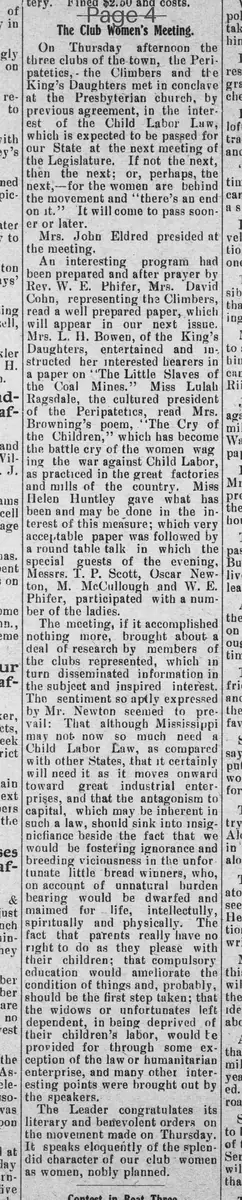
The Club Women's Meeting.
On Thursday afternoon the three clubs of the town, the Peripatetics, the Climbers and the King's Daughters met in conclave at the Presbyterian church, by previous agreement, in the interest of the Child Labor Law, which is expected to be passed for our State at the next meeting of the Legislature. If not the next, then the next; or, perhaps, the next,—for the women are behind the movement and "there's an end on it." It will come to pass sooner or later.
Mrs. John Eldred presided at the meeting.
An interesting program had been prepared and after prayer by Rev. W. E. Phifer, Mrs. David Cohn, representing the Climbers, read a well prepared paper, which will appear in our next issue.
Mrs. L. H. Bowen, of the King's Daughters, entertained and instructed her interested hearers in a paper on "The Little Slaves of the Coal Mines." Miss Lula Ragsdale, the cultured president of the Peripatetics, read Mrs. Browning's poem, "The Cry of the Children," which has become the battle cry of the women waging the war against Child Labor, as practiced in the great factories and mills of the country. Miss Helen Huntley gave what has been and may be done in the interest of this measure; which very acceptable paper was followed by a round table talk in which the special guests of the evening, Messrs. T. P. Scott, Oscar Newton, M. McCullough and W. E. Phifer, participated with a number of the ladies.
The meeting, if it accomplished nothing more, brought about a deal of research by members of the clubs represented, which in turn disseminated information in the subject and inspired interest.
The sentiment so aptly expressed by Mr. Newton seemed to prevail: That although Mississippi may not now so much need a Child Labor Law, as compared with other States, that it certainly will need it as it moves onward toward great industrial enterprises, and that the antagonism to capital, which may be inherent in such a law, should sink into insignificance beside the fact that we would be fostering ignorance and breeding viciousness in the unfortunate little bread winners, who, on account of unnatural burden bearing would be dwarfed and maimed for life, intellectually, spiritually and physically. The fact that parents really have no right to do as they please with their children; that compulsory education would ameliorate the condition of things and, probably, should be the first step taken; that the widows or unfortunates left dependent, in being deprived of their children's labor, would be provided for through some exception of the law or humanitarian enterprise, and many other interesting points were brought out by the speakers.
The Leader congratulates its literary and benevolent orders on the movement made on Thursday. It speaks eloquently of the splendid character of our club women as women, nobly planned.
On Thursday afternoon the three clubs of the town, the Peripatetics, the Climbers and the King's Daughters met in conclave at the Presbyterian church, by previous agreement, in the interest of the Child Labor Law, which is expected to be passed for our State at the next meeting of the Legislature. If not the next, then the next; or, perhaps, the next,—for the women are behind the movement and "there's an end on it." It will come to pass sooner or later.
Mrs. John Eldred presided at the meeting.
An interesting program had been prepared and after prayer by Rev. W. E. Phifer, Mrs. David Cohn, representing the Climbers, read a well prepared paper, which will appear in our next issue.
Mrs. L. H. Bowen, of the King's Daughters, entertained and instructed her interested hearers in a paper on "The Little Slaves of the Coal Mines." Miss Lula Ragsdale, the cultured president of the Peripatetics, read Mrs. Browning's poem, "The Cry of the Children," which has become the battle cry of the women waging the war against Child Labor, as practiced in the great factories and mills of the country. Miss Helen Huntley gave what has been and may be done in the interest of this measure; which very acceptable paper was followed by a round table talk in which the special guests of the evening, Messrs. T. P. Scott, Oscar Newton, M. McCullough and W. E. Phifer, participated with a number of the ladies.
The meeting, if it accomplished nothing more, brought about a deal of research by members of the clubs represented, which in turn disseminated information in the subject and inspired interest.
The sentiment so aptly expressed by Mr. Newton seemed to prevail: That although Mississippi may not now so much need a Child Labor Law, as compared with other States, that it certainly will need it as it moves onward toward great industrial enterprises, and that the antagonism to capital, which may be inherent in such a law, should sink into insignificance beside the fact that we would be fostering ignorance and breeding viciousness in the unfortunate little bread winners, who, on account of unnatural burden bearing would be dwarfed and maimed for life, intellectually, spiritually and physically. The fact that parents really have no right to do as they please with their children; that compulsory education would ameliorate the condition of things and, probably, should be the first step taken; that the widows or unfortunates left dependent, in being deprived of their children's labor, would be provided for through some exception of the law or humanitarian enterprise, and many other interesting points were brought out by the speakers.
The Leader congratulates its literary and benevolent orders on the movement made on Thursday. It speaks eloquently of the splendid character of our club women as women, nobly planned.
What sub-type of article is it?
Historical Event
What themes does it cover?
Moral Virtue
Justice
Family
What keywords are associated?
Child Labor Law
Women's Clubs
Advocacy Meeting
Child Exploitation
Compulsory Education
Mississippi Legislature
What entities or persons were involved?
Mrs. John Eldred
Rev. W. E. Phifer
Mrs. David Cohn
Mrs. L. H. Bowen
Miss Lula Ragsdale
Miss Helen Huntley
T. P. Scott
Oscar Newton
M. Mccullough
Where did it happen?
Presbyterian Church, Town, Mississippi
Story Details
Key Persons
Mrs. John Eldred
Rev. W. E. Phifer
Mrs. David Cohn
Mrs. L. H. Bowen
Miss Lula Ragsdale
Miss Helen Huntley
T. P. Scott
Oscar Newton
M. Mccullough
Location
Presbyterian Church, Town, Mississippi
Event Date
Thursday Afternoon
Story Details
Three women's clubs met to support Child Labor Law passage; program included prayer, papers on child labor in mines and factories, Browning's poem 'The Cry of the Children,' and round table discussion with guests on education, parental rights, and industrial needs.