Thank you for visiting SNEWPapers!
Sign up free
Fowle's New Hampshire Gazette And General Advertiser
Portsmouth, Rockingham County, New Hampshire
What is this article about?
Dublin, Sept. 28: Sheriffs declined to preside over a meeting to appoint Congress delegates after lawyer Counsellor Whittingham deemed it illegal, canceling the event. Article critiques lawyers' behavior, invokes biblical and Swiss analogies against tyranny, and praises General Washington's wartime integrity, contrasting it with British generals.
Clipping
OCR Quality
Full Text
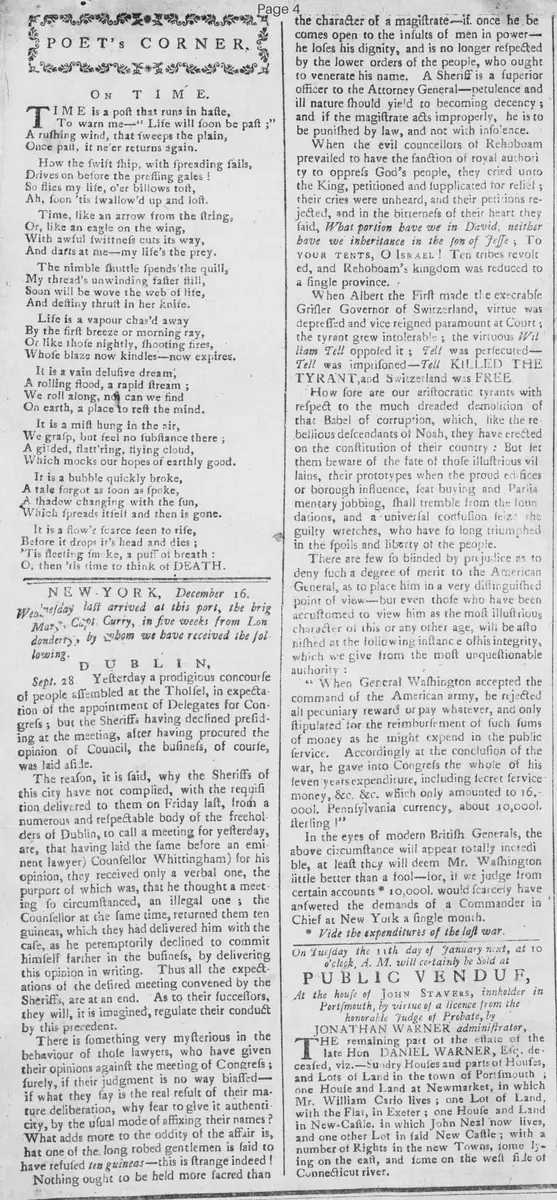
Wednesday last arrived at this port, the brig Londonderry, by whom we have received the following.
DUBLIN, Sept. 28. Yesterday a prodigious concourse of people assembled at the Tholsel, in expectation of the appointment of Delegates for Congress; but the Sheriffs having declined presiding at the meeting, after having procured the opinion of Council, the business, of course, was laid aside.
The reason, it is said, why the Sheriffs of this city have not complied, with the requisition delivered to them on Friday last, from a numerous and respectable body of the freeholders of Dublin, to call a meeting for yesterday, are, that having laid the same before an eminent lawyer (Counsellor Whittingham) for his opinion, they received only a verbal one, the purport of which was, that he thought a meeting so circumstanced, an illegal one; the Counsellor at the same time, returned them ten guineas, which they had delivered him with the case, as he peremptorily declined to commit himself farther in the business, by delivering this opinion in writing. Thus all the expectations of the desired meeting convened by the Sheriffs, are at an end. As to their successors, they will, it is imagined, regulate their conduct by this precedent.
There is something very mysterious in the behaviour of those lawyers, who have given their opinions against the meeting of Congress; surely, if their judgment is no way biassed—if what they say is the real result of their mature deliberation, why fear to give it authenticity, by the usual mode of affixing their names? What adds more to the oddity of the affair is, that one of the long robed gentlemen is said to have refused ten guineas—this is strange indeed!
Nothing ought to be held more sacred than the character of a magistrate—if once he becomes open to the insults of men in power—he loses his dignity, and is no longer respected by the lower orders of the people, who ought to venerate his name. A Sheriff is a superior officer to the Attorney General—Petulance and ill nature should yield to becoming decency; and if the magistrate acts improperly, he is to be punished by law, and not with insolence.
When the evil counsellors of Rehoboam prevailed to have the sanction of royal authority to oppress God's people, they cried unto the King, petitioned and supplicated for relief; their cries were unheard, and their petitions rejected, and in the bitterness of their heart they said, What portion have we in David, neither have we inheritance in the son of Jesse; To YOUR TENTS, O ISRAEL! Ten tribes revolted, and Rehoboam's kingdom was reduced to a single province.
When Albert the First made the execrable Gessler Governor of Switzerland, virtue was depressed and vice reigned paramount at Court; the tyrant grew intolerable; the virtuous William Tell opposed it; Tell was persecuted—Tell was imprisoned—Tell KILLED THE TYRANT, and Switzerland was FREE.
How sore are our aristocratic tyrants with respect to the much dreaded demolition of that Babel of corruption, which, like the rebellious descendants of Noah, they have erected on the constitution of their country: But let them beware of the fate of those illustrious villains, their prototypes when the proud edifices of borough influence, seat buying and Parliamentary jobbing, shall tremble from the foundations, and a universal confusion seize the guilty wretches, who have so long triumphed in the spoils and liberty of the people.
There are few so blinded by prejudice as to deny such a degree of merit to the American General, as to place him in a very distinguished point of view—but even those who have been accustomed to view him as the most illustrious character of this or any other age, will be astonished at the following instance of his integrity, which we give from the most unquestionable authority:
"When General Washington accepted the command of the American army, he rejected all pecuniary reward or pay whatever, and only stipulated for the reimbursement of such sums of money as he might expend in the public service. Accordingly at the conclusion of the war, he gave into Congress the whole of his eleven years expenditure, including secret service money, &c. &c. which only amounted to 16,000 Pennsylvania currency, about 10,000l. sterling!"
In the eyes of modern British Generals, the above circumstance will appear totally incredible, at least they will deem Mr. Washington little better than a fool—for, if we judge from certain accounts 10,000l. would scarcely have answered the demands of a Commander in Chief at New York a single month.
Vide the expenditures of the last war.
What sub-type of article is it?
What keywords are associated?
What entities or persons were involved?
Where did it happen?
Foreign News Details
Primary Location
Dublin
Event Date
Sept. 28
Key Persons
Outcome
the meeting for appointing delegates for congress was laid aside due to the sheriffs' decline following legal opinion deeming it illegal.
Event Details
A large crowd assembled at the Tholsel in Dublin expecting the appointment of Delegates for Congress, but the Sheriffs declined to preside after obtaining a verbal opinion from Counsellor Whittingham that the meeting was illegal; he refused to provide it in writing and returned the fee. The article criticizes the lawyers' mysterious behavior and reluctance to commit, defends the magistrates' dignity, draws parallels to biblical revolt under Rehoboam and William Tell's resistance in Switzerland against tyranny, warns aristocratic tyrants of impending doom from corruption like borough influence and parliamentary jobbing, and praises General Washington's integrity in rejecting pay and expending only 16,000 Pennsylvania currency over eleven years of service, contrasting it with extravagant British generals.