Thank you for visiting SNEWPapers!
Sign up free
Literary
May 10, 1827
The Wilmingtonian, And Delaware Advertiser
Wilmington, New Castle County, Delaware
What is this article about?
Practical advice on planting potatoes, including cutting methods, spacing, soil preparation, and manuring, drawn from observations and Dr. Cooper's recommendations for optimal crop yield.
Clipping
OCR Quality
95%
Excellent
Full Text
PLANTING POTATOES.
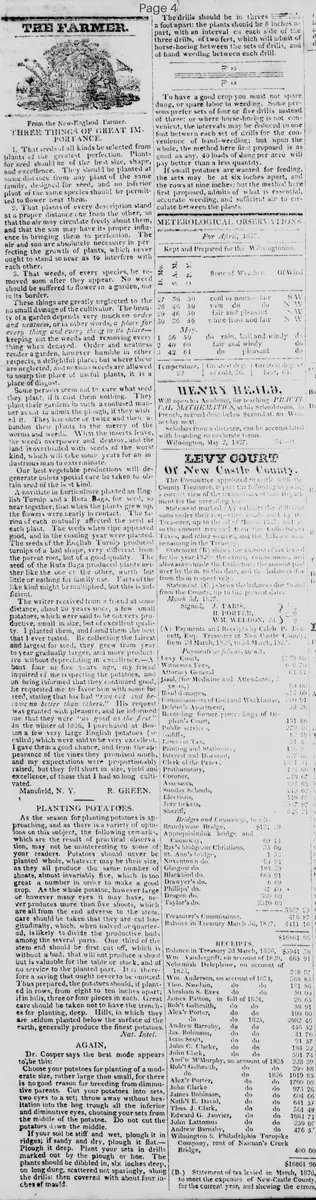
As the season for planting potatoes is approaching, and as there is a variety of opinions on this subject, the following remarks, which are the result of practical observation, may not be uninteresting to some of your readers. Potatoes should never be planted whole, whatever may be their size, as they all produce the same number of shoots, almost invariably five, which is too great a number in order to make a good crop. As the whole potato, however large or however many eyes it may have, never produces more than five shoots, which are all from the end adverse to the stem, care should be taken that they are cut longitudinally, which, when halved or quartered, is likely to divide the productive buds among the several parts. One third of the stem end should be first cut off, which is without a bud, that will not produce a shoot but is valuable for the table or stock, and of no service to the planted part. It is therefore a saving that ought never to be omitted.
Thus prepared, the potatoes should, if planted in rows, from eight to ten inches apart; if in hills, three or four pieces in each. Great care should be taken not to have the trenches for planting, deep. Hills, in which they are seldom planted below the surface of the earth, generally produce the finest potatoes.
Nat. Intel.
AGAIN.
Dr. Cooper says the best mode appears to be this:
Choose your potatoes for planting of a moderate size, rather large than small, for there is no good reason for breeding from diminutive parents. Cut your potatoes into sets, two eyes to a set; throw away without hesitation into the hog trough all the inferior and diminutive eyes, choosing your sets from the middle of the potato. Do not cut the potatoes down the middle.
If your soil be stiff and wet, plough it in ridges; if sandy and dry, plough it flat.--Plough it deep. Plant your sets in drills marked out by the plough or hoe. The plants should be dibbled in, six inches deep, on long dung, scattered not sparingly, along the drills: then covered with about four inches of mould.
The drills should be in threes, a foot apart: the plants should be 8 inches apart, with an interval on each side of the three drills, of two feet, which will admit of horse-hoeing between the sets of drills, and of hand weeding between each drill.
To have a good crop you must not spare dung, or spare labor in weeding. Some persons prefer sets of four or five drills instead of three: or where horse-hoeing is not convenient, the intervals may be reduced to one foot between each set of drills for the convenience of hand-weeding: but upon the whole, the method here first proposed is as good as any. 40 loads of dung per acre will pay better than a less quantity.
If small potatoes are wanted for feeding, the sets may be at six inches apart, and the rows at nine inches: but the method here first proposed, admits of what is essential, accurate weeding, and sufficient air to circulate between the plants.
As the season for planting potatoes is approaching, and as there is a variety of opinions on this subject, the following remarks, which are the result of practical observation, may not be uninteresting to some of your readers. Potatoes should never be planted whole, whatever may be their size, as they all produce the same number of shoots, almost invariably five, which is too great a number in order to make a good crop. As the whole potato, however large or however many eyes it may have, never produces more than five shoots, which are all from the end adverse to the stem, care should be taken that they are cut longitudinally, which, when halved or quartered, is likely to divide the productive buds among the several parts. One third of the stem end should be first cut off, which is without a bud, that will not produce a shoot but is valuable for the table or stock, and of no service to the planted part. It is therefore a saving that ought never to be omitted.
Thus prepared, the potatoes should, if planted in rows, from eight to ten inches apart; if in hills, three or four pieces in each. Great care should be taken not to have the trenches for planting, deep. Hills, in which they are seldom planted below the surface of the earth, generally produce the finest potatoes.
Nat. Intel.
AGAIN.
Dr. Cooper says the best mode appears to be this:
Choose your potatoes for planting of a moderate size, rather large than small, for there is no good reason for breeding from diminutive parents. Cut your potatoes into sets, two eyes to a set; throw away without hesitation into the hog trough all the inferior and diminutive eyes, choosing your sets from the middle of the potato. Do not cut the potatoes down the middle.
If your soil be stiff and wet, plough it in ridges; if sandy and dry, plough it flat.--Plough it deep. Plant your sets in drills marked out by the plough or hoe. The plants should be dibbled in, six inches deep, on long dung, scattered not sparingly, along the drills: then covered with about four inches of mould.
The drills should be in threes, a foot apart: the plants should be 8 inches apart, with an interval on each side of the three drills, of two feet, which will admit of horse-hoeing between the sets of drills, and of hand weeding between each drill.
To have a good crop you must not spare dung, or spare labor in weeding. Some persons prefer sets of four or five drills instead of three: or where horse-hoeing is not convenient, the intervals may be reduced to one foot between each set of drills for the convenience of hand-weeding: but upon the whole, the method here first proposed is as good as any. 40 loads of dung per acre will pay better than a less quantity.
If small potatoes are wanted for feeding, the sets may be at six inches apart, and the rows at nine inches: but the method here first proposed, admits of what is essential, accurate weeding, and sufficient air to circulate between the plants.
What sub-type of article is it?
Essay
What themes does it cover?
Agriculture Rural
What keywords are associated?
Potato Planting
Agricultural Advice
Crop Yield
Soil Preparation
Weeding Techniques
What entities or persons were involved?
Nat. Intel. And Dr. Cooper
Literary Details
Title
Planting Potatoes.
Author
Nat. Intel. And Dr. Cooper
Subject
Practical Observations On Potato Planting Methods
Form / Style
Prose Agricultural Advice
Key Lines
Potatoes Should Never Be Planted Whole, Whatever May Be Their Size, As They All Produce The Same Number Of Shoots, Almost Invariably Five, Which Is Too Great A Number In Order To Make A Good Crop.
Cut Your Potatoes Into Sets, Two Eyes To A Set; Throw Away Without Hesitation Into The Hog Trough All The Inferior And Diminutive Eyes, Choosing Your Sets From The Middle Of The Potato.
To Have A Good Crop You Must Not Spare Dung, Or Spare Labor In Weeding.