Thank you for visiting SNEWPapers!
Sign up free
Editorial
October 27, 1893
The Seattle Post Intelligencer
Seattle, King County, Washington
What is this article about?
This editorial praises the Senate's passage of the silver purchase repeal bill as beneficial for restoring monetary confidence but criticizes the Democratic majority's delay, which has damaged the party's reputation and led to electoral losses in local elections across several states.
Merged-components note: Dateline overlaps spatially with the editorial text and provides context for the article on the value of repeal.
Clipping
OCR Quality
95%
Excellent
Full Text
SEATTLE, FRIDAY, OCT. 27
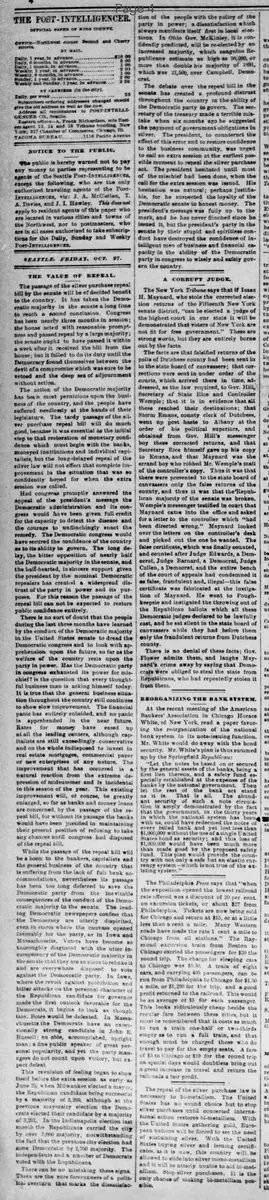
THE VALUE OF REPEAL.
The passage of the silver purchase repeal bill by the senate will be of decided benefit to the country. It has taken the Democratic majority in the senate a long time to reach a sound conclusion. Congress has been nearly three months in session; the house acted with reasonable promptness and passed repeal by a large majority; the senate ought to have passed it within a week after it received the bill from the house; but it failed to do its duty until the Democracy found themselves between the devil of a compromise which was sure to be vetoed and the deep sea of adjournment without action.
The action of the Democratic majority has been most pernicious upon the business of the country, and the people have suffered needlessly at the hands of their legislature. The tardy passage of the silver purchase repeal bill will do much good, because it was essential as the initial step to that restoration of monetary confidence which must begin with the banks, moneyed institutions and individual capitalists, but the long-delayed repeal of the silver law will not effect that complete improvement in the situation that was so confidently hoped for when the extra session was called.
Had congress promptly answered the appeal of the president's message the Democratic administration and its congress would have been given full credit for the capacity to detect the disease and the courage to unflinchingly enact the remedy. The Democratic congress would have secured the confidence of the country as to its ability to govern. The long delay, the bitter opposition of nearly half the Democratic majority in the senate, and the half-hearted, insincere support given the president by the nominal Democratic repealers has created a widespread distrust of the party in power and its purposes. For this reason the passage of the repeal bill can not be expected to restore public confidence entirely.
There is no sort of doubt that the people during the last three months have learned by the conduct of the Democratic majority in the United States senate to dread the Democratic congress and to look with apprehension upon the future, so far as the welfare of the country rests upon the party in power. Has the Democratic party in congress exhausted its power for mischief? is the question that every thoughtful business man is asking himself today.
It is true that the general business situation throughout the country still continues to show slow improvement. The financial panic has entirely subsided, and no panic is apprehended in the near future. Rates for money have eased up at all the leading centers, although capitalists are still exceedingly conservative and on the whole indisposed to invest in real estate mortgages, commercial paper or new enterprises of any nature. The improvement that has occurred is a natural reaction from the extreme depression of midsummer and is incidental to this season of the year. This existing improvement will, of course, be greatly enlarged, so far as banks and money loans are concerned, by the passage of the repeal bill, for without its passage the banks would have been justified in maintaining their present position of refusing to take any chances until congress had disposed of the repeal bill.
While the passage of the repeal bill will be a boon to the bankers, capitalists and the general business of the country that is suffering from the lack of full bank accommodations, nevertheless its passage has been too long deferred to save the Democratic party from the inevitable consequences of the conduct of the Democratic majority in the senate. The leading Democratic newspapers confess that the Democracy are utterly dispirited, even in states where the canvass opened favorably for the party, as in Iowa and Massachusetts. Voters have become so thoroughly disgusted with the utter incompetency of the Democratic majority in the senate that they are anxious to rebuke it and are everywhere disposed to vote against the Democratic party. In Iowa, where the revolt against prohibition and bitter attacks on the personal character of the Republican candidate for governor made the first outlook favorable for the Democrats, it begins to look as though Gov. Boies would be defeated. In Massachusetts the Democrats have an exceptionally strong candidate in John E. Russell; an able, accomplished, upright man; a fine public speaker of great personal popularity, and yet the party managers do not count upon victory, but expect defeat.
This revulsion of feeling began to show itself before the extra session as early as June, when Milwaukee elected a mayor, the Republican candidate being successful by a majority of 3,000 although at the previous mayoralty election the Democrats elected their candidate by a majority of 3,000. In the Indianapolis election last month the Republicans carried the city by over 5,000 majority, notwithstanding the fact that the previous city election had gone Democratic by 2,700 majority. The independents and a number of Democrats voted with the Republicans.
There can be no mistaking these signs. There are the sure forerunners of a political overturn that marks the dissatisfaction of the people with the policy of the party in power; a dissatisfaction which always manifests itself first in local elections. In Ohio Gov. McKinley, it is confidently predicted, will be re-elected by an increased majority, which sanguine Republicans estimate as high as 50,000, or more than double his majority of 1891, which was 21,500, over Campbell, Democrat.
The debate over the repeal bill in the senate has created a profound distrust throughout the country in the ability of the Democratic party to govern. The secretary of the treasury made a terrible mistake when six months ago he suggested the payment of government obligations in silver. The president, to counteract the effect of this error and to restore confidence to the business community, was urged to call an extra session at the earliest possible moment to repeal the silver purchase act. The president hesitated until most of the mischief had been done, when the call for the extra session was issued. His hesitation was natural; perhaps justifiable, for he suspected the loyalty of the Democratic senate to honest money. The president's message was fully up to the mark, and he has never flinched since he issued it, but the president's party in the senate by their stupid and spiritless conduct have destroyed the confidence of intelligent men of business and financial capacity in the ability of the Democratic party in congress to wisely and safely govern the country.
THE VALUE OF REPEAL.
The passage of the silver purchase repeal bill by the senate will be of decided benefit to the country. It has taken the Democratic majority in the senate a long time to reach a sound conclusion. Congress has been nearly three months in session; the house acted with reasonable promptness and passed repeal by a large majority; the senate ought to have passed it within a week after it received the bill from the house; but it failed to do its duty until the Democracy found themselves between the devil of a compromise which was sure to be vetoed and the deep sea of adjournment without action.
The action of the Democratic majority has been most pernicious upon the business of the country, and the people have suffered needlessly at the hands of their legislature. The tardy passage of the silver purchase repeal bill will do much good, because it was essential as the initial step to that restoration of monetary confidence which must begin with the banks, moneyed institutions and individual capitalists, but the long-delayed repeal of the silver law will not effect that complete improvement in the situation that was so confidently hoped for when the extra session was called.
Had congress promptly answered the appeal of the president's message the Democratic administration and its congress would have been given full credit for the capacity to detect the disease and the courage to unflinchingly enact the remedy. The Democratic congress would have secured the confidence of the country as to its ability to govern. The long delay, the bitter opposition of nearly half the Democratic majority in the senate, and the half-hearted, insincere support given the president by the nominal Democratic repealers has created a widespread distrust of the party in power and its purposes. For this reason the passage of the repeal bill can not be expected to restore public confidence entirely.
There is no sort of doubt that the people during the last three months have learned by the conduct of the Democratic majority in the United States senate to dread the Democratic congress and to look with apprehension upon the future, so far as the welfare of the country rests upon the party in power. Has the Democratic party in congress exhausted its power for mischief? is the question that every thoughtful business man is asking himself today.
It is true that the general business situation throughout the country still continues to show slow improvement. The financial panic has entirely subsided, and no panic is apprehended in the near future. Rates for money have eased up at all the leading centers, although capitalists are still exceedingly conservative and on the whole indisposed to invest in real estate mortgages, commercial paper or new enterprises of any nature. The improvement that has occurred is a natural reaction from the extreme depression of midsummer and is incidental to this season of the year. This existing improvement will, of course, be greatly enlarged, so far as banks and money loans are concerned, by the passage of the repeal bill, for without its passage the banks would have been justified in maintaining their present position of refusing to take any chances until congress had disposed of the repeal bill.
While the passage of the repeal bill will be a boon to the bankers, capitalists and the general business of the country that is suffering from the lack of full bank accommodations, nevertheless its passage has been too long deferred to save the Democratic party from the inevitable consequences of the conduct of the Democratic majority in the senate. The leading Democratic newspapers confess that the Democracy are utterly dispirited, even in states where the canvass opened favorably for the party, as in Iowa and Massachusetts. Voters have become so thoroughly disgusted with the utter incompetency of the Democratic majority in the senate that they are anxious to rebuke it and are everywhere disposed to vote against the Democratic party. In Iowa, where the revolt against prohibition and bitter attacks on the personal character of the Republican candidate for governor made the first outlook favorable for the Democrats, it begins to look as though Gov. Boies would be defeated. In Massachusetts the Democrats have an exceptionally strong candidate in John E. Russell; an able, accomplished, upright man; a fine public speaker of great personal popularity, and yet the party managers do not count upon victory, but expect defeat.
This revulsion of feeling began to show itself before the extra session as early as June, when Milwaukee elected a mayor, the Republican candidate being successful by a majority of 3,000 although at the previous mayoralty election the Democrats elected their candidate by a majority of 3,000. In the Indianapolis election last month the Republicans carried the city by over 5,000 majority, notwithstanding the fact that the previous city election had gone Democratic by 2,700 majority. The independents and a number of Democrats voted with the Republicans.
There can be no mistaking these signs. There are the sure forerunners of a political overturn that marks the dissatisfaction of the people with the policy of the party in power; a dissatisfaction which always manifests itself first in local elections. In Ohio Gov. McKinley, it is confidently predicted, will be re-elected by an increased majority, which sanguine Republicans estimate as high as 50,000, or more than double his majority of 1891, which was 21,500, over Campbell, Democrat.
The debate over the repeal bill in the senate has created a profound distrust throughout the country in the ability of the Democratic party to govern. The secretary of the treasury made a terrible mistake when six months ago he suggested the payment of government obligations in silver. The president, to counteract the effect of this error and to restore confidence to the business community, was urged to call an extra session at the earliest possible moment to repeal the silver purchase act. The president hesitated until most of the mischief had been done, when the call for the extra session was issued. His hesitation was natural; perhaps justifiable, for he suspected the loyalty of the Democratic senate to honest money. The president's message was fully up to the mark, and he has never flinched since he issued it, but the president's party in the senate by their stupid and spiritless conduct have destroyed the confidence of intelligent men of business and financial capacity in the ability of the Democratic party in congress to wisely and safely govern the country.
What sub-type of article is it?
Economic Policy
Partisan Politics
What keywords are associated?
Silver Repeal
Democratic Delay
Monetary Confidence
Partisan Distrust
Electoral Losses
Financial Panic
What entities or persons were involved?
Democratic Majority In The Senate
President
Gov. Boies
John E. Russell
Gov. Mckinley
Secretary Of The Treasury
Editorial Details
Primary Topic
Repeal Of The Silver Purchase Act And Democratic Incompetence
Stance / Tone
Critical Of Democratic Delay And Supportive Of Repeal
Key Figures
Democratic Majority In The Senate
President
Gov. Boies
John E. Russell
Gov. Mckinley
Secretary Of The Treasury
Key Arguments
Passage Of Repeal Bill Benefits The Country By Restoring Monetary Confidence.
Democratic Senate's Delay Caused Needless Suffering And Distrust.
Prompt Action Would Have Credited Democrats With Governance Ability.
Electoral Setbacks In Iowa, Massachusetts, Milwaukee, Indianapolis, And Ohio Reflect Public Dissatisfaction.
Secretary's Silver Payment Suggestion And President's Hesitation Worsened The Situation.
Senate's Conduct Destroyed Confidence In Democratic Governance.