Thank you for visiting SNEWPapers!
Sign up free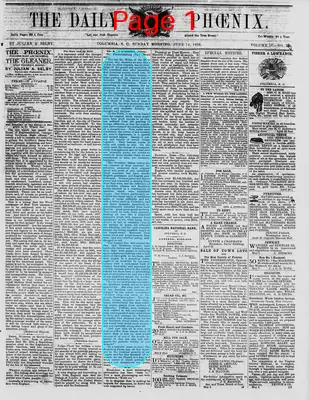
The Daily Phoenix
Columbia, Richland County, South Carolina
What is this article about?
An article from the Fredericksburg Herald praises the elegance, purity, and heroism of Southern women, contrasting them with Northern society, and highlights their roles in preserving aristocratic spirit, domestic virtues, and support during the Civil War.
Clipping

OCR Quality
Full Text
The Fredericksburg (Va.) Herald says:
"The late Mr. Willis, of the Home Journal, who, whatever we may think of him in other respects, was no mean judge of the graces and amenities of life, remarked, soon after secession, that American society would lose, in the absence of Southern women, a large portion of its elegance and refinement. Mr. Willis never made a more sensible observation. There is something in the manners, the appearance, the entire bearing of our Southern women of the world, (we use the expression in its most favorable sense,) which speaks unmistakably of not only the 'sanguine azzura' or blue blood of birth, but of what is nobler far, the truly aristocratic and royal spirit—the spirit of purity, sentiment and exquisite delicacy of thought and purpose.
"At the North, it cannot be denied that the original stock, which might have been good enough in its way, has suffered from the grafting of foreign offshoots, so that the population shows some of the characteristics of a mongrel race. Now, under such conditions, the women of any country are sure to degenerate, in a special and marked degree. Beauty of person and beauty of morale decays together. They become coarse in body and coarse in soul. On the other hand, the women of a comparatively homogeneous race (if that race was primarily pure,) are certain to retain all those charms which we are accustomed to term, par excellence, feminine.
"The Southern States before the war, because of their 'peculiar' institution, preserved their original blood and pride of race untainted. Their ancestors had been chiefly English gentlemen and English gentlewomen. Norman grace and Saxon power had combined in making them what they were, and the influence of a Southern climate and Southern habits resulted in a combination of qualities which were admirable and unique. Our women particularly exhibited the rarest union of fastidious tastes of social pliability and art, with a virtue stern as Cornelia's, and also those domestic household accomplishments inherited from their English great-great-grand-mothers. They could be arch, lively, piquant, flashing all over like a beautiful summer's cloud, with innocent 'heat lightning's' of wit, while doing their devoirs at ball or assembly—but in the privacy of home, wit softened into affection, and the arch coquette became the loving unselfish 'angel of the hearth-stone.'
Moreover, what house-wives and house-keepers they were, (and are,) whether young, middle-aged or old.
"The Yankee who first started the idea that Southern women were habitually listless and indolent, that their days were passed in reclining upon sumptuous cushions with a half score of slave-girls to fan them, and their nights in a perpetual waltz, ought to be rewarded by his countrymen with a monument built of Boston 'hard-tack,' and cemented by cod-fish, because never in the world's history has there been so unblushing and preposterous a lie, and not a few of our neighbors across the border appreciate mendacity as a 'fine art.'
"No! in our most prosperous times, the Southern woman was as we have painted her. But what shall we say of her devotion and heroism, developed by the recent revolution? 'Noblesse oblige' was never so gloriously illustrated before! These delicate beings, sensitive and high-toned, encountered the most revolting scenes, simply from motives of humanity. Fathers, sons, brothers, were excited in will, encouraged in trial, and supported under misfortune by them, and perhaps, the Northern journalist who declared that but for the 'Southern female rebels' the contest would have ended much sooner, was not especially wrong after all.
"And now that all is over, now that we suffer from almost 'every ill which flesh is heir to,' what would become of us men of the South, deprived of that last stay and safeguard, the pathetic fidelity of our women?
"In a national sense we have, like Francis at Pavia, lost all but honor, yet in the sweetest security of our homes, and the 'leal devotion' of our women, we are blessed in a way, and to an extent of which perhaps few among our conquerors can justly boast."
What sub-type of article is it?
What themes does it cover?
What keywords are associated?
What entities or persons were involved?
Where did it happen?
Story Details
Key Persons
Location
Southern States, Fredericksburg (Va.)
Event Date
Soon After Secession, Before The War, During The Recent Revolution, Post War
Story Details
The article extols the elegance, purity, and aristocratic spirit of Southern women, their preservation of homogeneous English heritage, domestic virtues, and heroic devotion during the Civil War, contrasting with Northern degeneracy and debunking stereotypes of indolence.