Thank you for visiting SNEWPapers!
Sign up free
Editorial
October 30, 1930
The Daily Worker
Chicago, Cook County, Illinois
What is this article about?
This editorial clarifies the Marxist distinction between 'exploitation' in production (surplus value retained by employers) and 'robbery' via high prices or taxes. It criticizes unions for focusing on consumer boycotts over workplace organization and calls for action against rising retail food prices amid unemployment.
Clipping
OCR Quality
98%
Excellent
Full Text
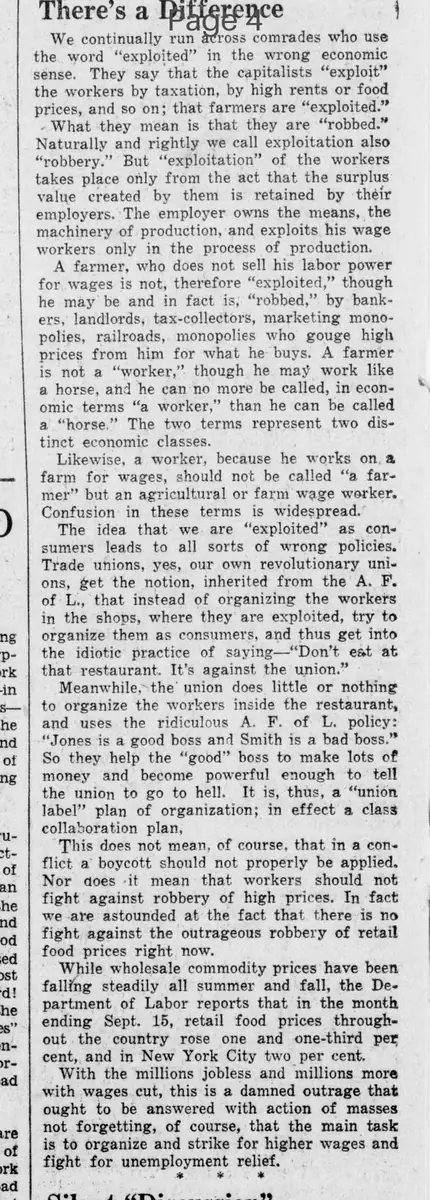
We continually run across comrades who use the word "exploited" in the wrong economic sense. They say that the capitalists "exploit" the workers by taxation, by high rents or food prices, and so on; that farmers are "exploited." What they mean is that they are "robbed."
Naturally and rightly we call exploitation also "robbery." But "exploitation" of the workers takes place only from the fact that the surplus value created by them is retained by their employers. The employer owns the means, the machinery of production, and exploits his wage workers only in the process of production.
A farmer, who does not sell his labor power for wages is not, therefore "exploited," though he may be and in fact is, "robbed," by bankers, landlords, tax-collectors, marketing monopolies, railroads, monopolies who gouge high prices from him for what he buys. A farmer is not a "worker," though he may work like a horse, and he can no more be called, in economic terms "a worker," than he can be called a "horse." The two terms represent two distinct economic classes.
Likewise, a worker, because he works on a farm for wages, should not be called "a farmer" but an agricultural or farm wage worker.
Confusion in these terms is widespread. The idea that we are "exploited" as consumers leads to all sorts of wrong policies. Trade unions, yes, our own revolutionary unions, get the notion, inherited from the A. F. of L., that instead of organizing the workers in the shops, where they are exploited, try to organize them as consumers, and thus get into the idiotic practice of saying-"Don't eat at that restaurant. It's against the union."
Meanwhile. the union does little or nothing to organize the workers inside the restaurant, and uses the ridiculous A. F. of L. policy: "Jones is a good boss and Smith is a bad boss." So they help the "good" boss to make lots of money and become powerful enough to tell the union to go to hell. It is, thus, a "union label" plan of organization; in effect a class collaboration plan,
This does not mean, of course, that in a conflict. a boycott should not properly be applied. Nor does it mean that workers should not fight against robbery of high prices. In fact we are astounded at the fact that there is no fight against the outrageous robbery of retail food prices right now.
While wholesale commodity prices have been falling steadily all summer and fall, the Department of Labor reports that in the month ending Sept. 15, retail food prices throughout the country rose one and one-third per cent, and in New York City two per cent.
With the millions jobless and millions more with wages cut, this is a damned outrage that ought to be answered with action of masses not forgetting, of course, that the main task is to organize and strike for higher wages and fight for unemployment relief.
Naturally and rightly we call exploitation also "robbery." But "exploitation" of the workers takes place only from the fact that the surplus value created by them is retained by their employers. The employer owns the means, the machinery of production, and exploits his wage workers only in the process of production.
A farmer, who does not sell his labor power for wages is not, therefore "exploited," though he may be and in fact is, "robbed," by bankers, landlords, tax-collectors, marketing monopolies, railroads, monopolies who gouge high prices from him for what he buys. A farmer is not a "worker," though he may work like a horse, and he can no more be called, in economic terms "a worker," than he can be called a "horse." The two terms represent two distinct economic classes.
Likewise, a worker, because he works on a farm for wages, should not be called "a farmer" but an agricultural or farm wage worker.
Confusion in these terms is widespread. The idea that we are "exploited" as consumers leads to all sorts of wrong policies. Trade unions, yes, our own revolutionary unions, get the notion, inherited from the A. F. of L., that instead of organizing the workers in the shops, where they are exploited, try to organize them as consumers, and thus get into the idiotic practice of saying-"Don't eat at that restaurant. It's against the union."
Meanwhile. the union does little or nothing to organize the workers inside the restaurant, and uses the ridiculous A. F. of L. policy: "Jones is a good boss and Smith is a bad boss." So they help the "good" boss to make lots of money and become powerful enough to tell the union to go to hell. It is, thus, a "union label" plan of organization; in effect a class collaboration plan,
This does not mean, of course, that in a conflict. a boycott should not properly be applied. Nor does it mean that workers should not fight against robbery of high prices. In fact we are astounded at the fact that there is no fight against the outrageous robbery of retail food prices right now.
While wholesale commodity prices have been falling steadily all summer and fall, the Department of Labor reports that in the month ending Sept. 15, retail food prices throughout the country rose one and one-third per cent, and in New York City two per cent.
With the millions jobless and millions more with wages cut, this is a damned outrage that ought to be answered with action of masses not forgetting, of course, that the main task is to organize and strike for higher wages and fight for unemployment relief.
What sub-type of article is it?
Labor
Economic Policy
What keywords are associated?
Exploitation
Robbery
Workers
Farmers
Unions
Boycotts
Food Prices
Class Collaboration
What entities or persons were involved?
Capitalists
Workers
Farmers
Bankers
Landlords
Tax Collectors
Marketing Monopolies
Railroads
A. F. Of L.
Trade Unions
Editorial Details
Primary Topic
Distinction Between Economic Exploitation And Robbery
Stance / Tone
Corrective And Revolutionary
Key Figures
Capitalists
Workers
Farmers
Bankers
Landlords
Tax Collectors
Marketing Monopolies
Railroads
A. F. Of L.
Trade Unions
Key Arguments
Exploitation Occurs Only When Surplus Value Created By Wage Workers Is Retained By Employers During Production.
Farmers Are Not Exploited But Robbed By Various Monopolies And High Prices.
Workers On Farms Are Wage Workers, Not Farmers.
Confusion In Terms Leads To Wrong Policies Like Organizing Consumers Instead Of Production Workers.
Boycotts Can Be Used In Conflicts, But Main Focus Should Be Organizing And Striking For Wages And Relief.
Retail Food Prices Rose Despite Falling Wholesale Prices, Which Is An Outrage.