Thank you for visiting SNEWPapers!
Sign up free
Story
November 13, 1897
The Eddy Current
Carlsbad, Eddy County, New Mexico
What is this article about?
Description of the gaucho's life as a South American cowboy, spent on horseback herding cattle and hunting with lasso, bolas, and knife across endless plains.
Clipping
OCR Quality
95%
Excellent
Full Text
The South American Cowboy.
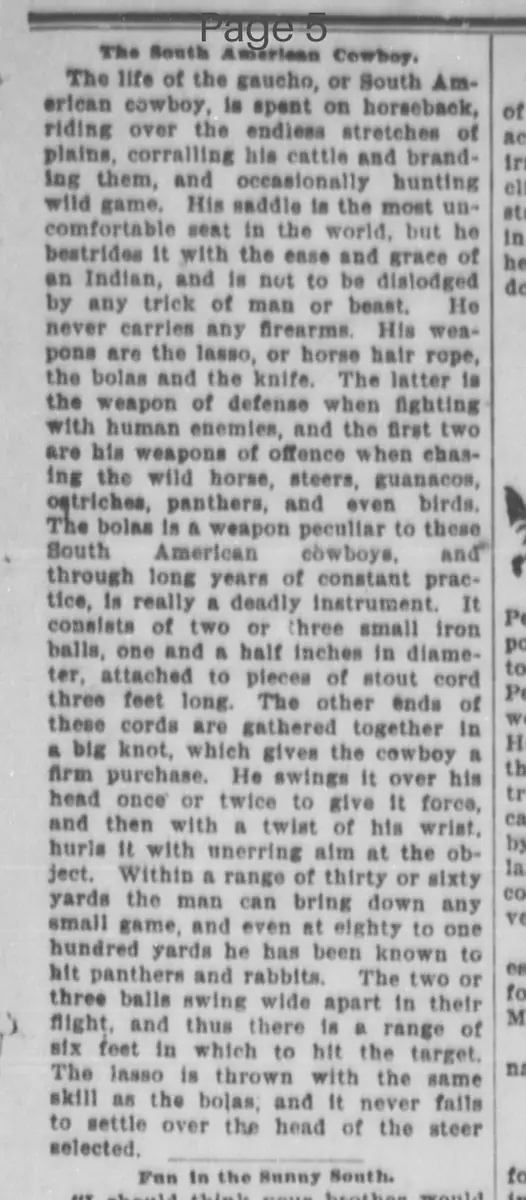
The life of the gaucho, or South American cowboy, is spent on horseback, riding over the endless stretches of plains, corralling his cattle and branding them, and occasionally hunting wild game. He sits in the most uncomfortable saddle in the world, but he bestrides it with the ease and grace of an Indian, and is not to be dislodged by any trick of man or beast. He never carries any firearms. His weapons are the lasso, or horse hair rope, the bolas and the knife. The latter is the weapon of defense when fighting with human enemies, and the first two are his weapons of offense when chasing the wild horse, steers, guanacos, ostriches, panthers, and even birds. The bolas is a weapon peculiar to these South American cowboys, and through long years of constant practice, is really a deadly instrument. It consists of two or three small iron balls, one and a half inches in diameter, attached to pieces of stout cord three feet long. The other ends of these cords are gathered together in a big knot, which gives the cowboy a firm purchase. He swings it over his head once or twice to give it force, and then with a twist of his wrist, hurls it with unerring aim at the object. Within a range of thirty or sixty yards the man can bring down any small game, and even at eighty to one hundred yards he has been known to hit panthers and rabbits. The two or three balls swing wide apart in their flight, and thus there is a range of six feet in which to hit the target. The lasso is thrown with the same skill as the bolas, and it never fails to settle over the head of the steer selected.
The life of the gaucho, or South American cowboy, is spent on horseback, riding over the endless stretches of plains, corralling his cattle and branding them, and occasionally hunting wild game. He sits in the most uncomfortable saddle in the world, but he bestrides it with the ease and grace of an Indian, and is not to be dislodged by any trick of man or beast. He never carries any firearms. His weapons are the lasso, or horse hair rope, the bolas and the knife. The latter is the weapon of defense when fighting with human enemies, and the first two are his weapons of offense when chasing the wild horse, steers, guanacos, ostriches, panthers, and even birds. The bolas is a weapon peculiar to these South American cowboys, and through long years of constant practice, is really a deadly instrument. It consists of two or three small iron balls, one and a half inches in diameter, attached to pieces of stout cord three feet long. The other ends of these cords are gathered together in a big knot, which gives the cowboy a firm purchase. He swings it over his head once or twice to give it force, and then with a twist of his wrist, hurls it with unerring aim at the object. Within a range of thirty or sixty yards the man can bring down any small game, and even at eighty to one hundred yards he has been known to hit panthers and rabbits. The two or three balls swing wide apart in their flight, and thus there is a range of six feet in which to hit the target. The lasso is thrown with the same skill as the bolas, and it never fails to settle over the head of the steer selected.
What sub-type of article is it?
Curiosity
Biography
Adventure
What themes does it cover?
Survival
Bravery Heroism
What keywords are associated?
Gaucho
South American Cowboy
Lasso
Bolas
Plains
Hunting
Cattle Herding
What entities or persons were involved?
Gaucho
Where did it happen?
Endless Stretches Of Plains
Story Details
Key Persons
Gaucho
Location
Endless Stretches Of Plains
Story Details
The gaucho lives on horseback, herding and branding cattle, hunting game with lasso and bolas, demonstrating exceptional skill and endurance on the South American plains.