Thank you for visiting SNEWPapers!
Sign up free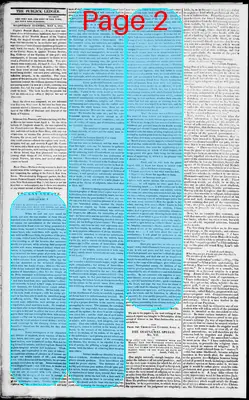
Literary
May 8, 1805
Norfolk Gazette And Publick Ledger
Norfolk, Virginia
What is this article about?
In Discourse X, the Lay Curate exhorts readers to practice benevolence and mercy towards the poor, quoting Deuteronomy and critiquing the wealthy's indifference. He emphasizes societal interdependence, Christian duty, and discerning charity for the deserving, promising eternal rewards for acts of compassion.
Clipping
OCR Quality
98%
Excellent
Full Text
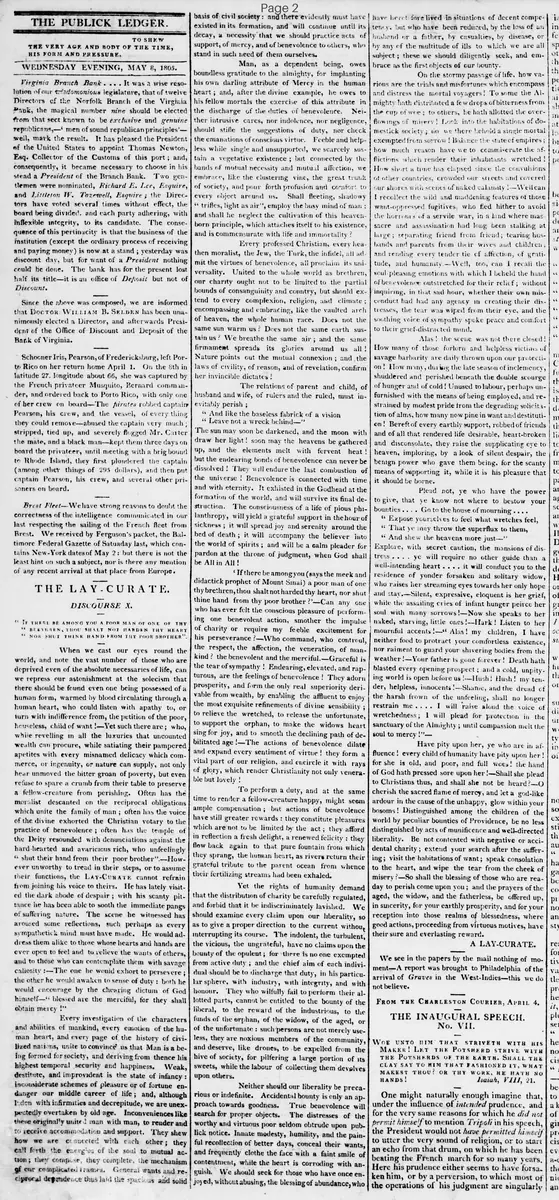
THE LAY CURATE.
DISCOURSE X.
"IF THERE BE AMONG YOU A POOR MAN OF ONE OF THY BRETHREN, THOU SHALT NOT HARDEN THY HEART NOR SHUT THINE HAND FROM THY POOR BROTHER".
When we cast our eyes round the world, and note the vast number of those who are deprived even of the absolute necessaries of life, can we repress our astonishment at the solecism that there should be found even one being possessed of a human form, warmed by blood circulating through a human heart, who could listen with apathy to, or turn with indifference from, the petition of the poor, houseless, child of want!—Yet such there are; who, while revelling in all the luxuries that uncounted wealth can procure, while satiating their pampered appetites with every misnamed delicacy which commerce, or ingenuity, or nature can supply, not only hear unmoved the bitter groan of poverty, but even refuse to spare a crumb from their table to preserve a fellow-creature from perishing. Often has the moralist descanted on the reciprocal obligations which unite the family of man; often has the voice of the divine exhorted the Christian votary to the practice of benevolence; often has the temple of the Deity resounded with denunciations against the hard-hearted and avaricious rich, who unfeelingly "shut their hand from their poor brother".—However unworthy to tread in their steps, or to assume their functions, the LAY-CURATE cannot refrain from joining his voice to theirs. He has lately visited the dark abode of despair; with his scanty pittance he has been able to soothe the immediate pangs of suffering nature. The scene he witnessed has aroused some reflections, such perhaps as every sympathising mind must have made. He would address them alike to those whose hearts and hands are ever open to feel and to relieve the wants of others, and to those who can contemplate them with savage callosity:—The one he would exhort to persevere; the other he would awaken to sense of duty: both he would encourage by the cheering dictum of God himself—"blessed are the merciful, for they shall obtain mercy!"
Every investigation of the characters and abilities of mankind, every emotion of the human heart, and every page of the history of civilised nations, unite to convince us that Man is a being formed for society, and deriving from thence his highest temporal security and happiness. Weak, destitute, and improvident is the state of infancy: inconsiderate schemes of pleasure or of fortune endanger our middle career of life; and, laden with infirmities and decrepitude, we are unexpectedly overtaken by old age. Inconveniences like these originally unite man with man, to render and to receive accommodation and support. They shew how we are connected with each other; they call forth the energies of the soul to mutual action; they compose, they complete, the mechanism of our complicated frames. General wants and reciprocal dependence thus laid the spacious and solid basis of civil society: and there evidently must have existed in its formation, and will continue until its decay, a necessity that we should practice acts of support, of mercy, and of benevolence to others, who stand in such need of them ourselves.
Man, as a dependent being, owes boundless gratitude to the almighty, for implanting his own darling attribute of Mercy in the human heart; and, after the divine example, he owes to his fellow mortals the exercise of this attribute in the discharge of the duties of benevolence. Neither intrusive cares, nor indolence, nor negligence, should stifle the suggestions of duty, nor check the emanations of conscious virtue. Feeble and helpless while single and unsupported, we scarcely sustain a vegetative existence; but connected by the bands of mutual necessity and mutual affection, we embrace, like the clustering vine, the great trunk of society, and pour forth profusion and comfort to every object around us. Shall fleeting, shadowy "trifles, light as air", employ the busy mind of man; and shall he neglect the cultivation of this heaven-born principle, which attaches itself to his existence, and is commensurate with life and immortality?
Every professed Christian, every heathen moralist, the Jew, the Turk, the infidel, all admit the virtues of benevolence, all proclaim its universality. United to the whole world as brethren, our charity ought not to be limited to the partial bounds of consanguinity and country, but should extend to every complexion, religion, and climate; encompassing and embracing, like the vaulted arch of heaven, the whole human race. Does not the same sun warm us? Does not the same earth sustain us? We breathe the same air; and the same firmament spreads its glories around us all!
Nature points out the mutual connexion; and the laws of civility, of reason, and of revelation, confirm her invincible dictates!
The relations of parent and child, of husband and wife, of rulers and the ruled, must inevitably perish;
"And like the baseless fabrick of a vision
Leave not a wreck behind—"
The sun may soon be darkened, and the moon withdraw her light! soon may the heavens be gathered up, and the elements melt with fervent heat! but the endearing bonds of benevolence can never be dissolved! They will endure the last combustion of the universe! Benevolence is connected with time and with eternity. It existed in the Godhead at the formation of the world, and will survive its final destruction. The consciousness of a life of pious philanthropy, will yield a grateful support in the hour of sickness; it will spread joy and serenity around the bed of death; it will accompany the believer into the world of spirits; and will be a calm pleader for pardon at the throne of judgment, when God shall be All in All!
"If there be among you (says the meek and didactick prophet of Mount Sinai) a poor man of one of thy brethren, thou shalt not harden thy heart, nor shut thine hand from thy poor brother?"—Can any one who has ever felt the conscious pleasure of performing one benevolent action, smother the impulse of charity or require my feeble excitement for his perseverance?—Who command, who controul, the respect, the affection, the veneration, of mankind? the benevolent and the merciful.—Graceful is the tear of sympathy! Endearing, elevated, and rapturous, are the feelings of benevolence! They adorn prosperity, and form the only real superiority derivable from wealth, by enabling the affluent to enjoy the most exquisite refinements of divine sensibility; to relieve the wretched, to release the unfortunate, to support the orphan, to make the widow's heart sing for joy, and to smooth the declining path of debilitated age!—The actions of benevolence dilate and expand every sentiment of virtue! they form a vital part of our religion, and encircle it with rays of glory, which render Christianity not only venerable but lovely!
To perform a duty, and at the same time to render a fellow-creature happy, might seem ample compensation; but actions of benevolence have still greater rewards: they constitute pleasures which are not to be limited by the act; they afford in reflection a fresh delight, a renewed felicity: they flow back again to that pure fountain from which they sprang, the human heart, as rivers return their grateful tribute to the parent ocean from whence their fertilizing streams had been exhaled.
Yet the rights of humanity demand that the distribution of charity be carefully regulated, and forbid that it be indiscriminately lavished. We should examine every claim upon our liberality, so as to give a proper direction to the current without interrupting its course. The indolent, the turbulent, the vicious, the ungrateful, have no claims upon the bounty of the opulent; for there is no one exempted from active duty; and the chief aim of each individual should be to discharge that duty, in his particular sphere, with industry, with integrity, and with honour.
They who wilfully fail to perform their allotted parts, cannot be entitled to the bounty of the liberal, to the reward of the industrious, to the funds of the orphan, of the widow, of the aged, or of the unfortunate: such persons are not merely useless, they are noxious members of the community, and deserve, like drones, to be expelled from the hive of society, for pilfering a large portion of its sweets, while the labour of collecting them devolves upon others.
Neither should our liberality be precarious or indefinite. Accidental bounty is only an approach towards goodness. True benevolence will search for proper objects. The distresses of the worthy and virtuous poor seldom obtrude upon publick notice. Innate modesty, humility, and the painful recollection of better days, conceal their wants, and frequently clothe the face with a faint smile of contentment, while the heart is corroding with anguish. We should seek for those who have once enjoyed, without abusing, the blessing of abundance, who have heretofore lived in situations of decent competency, but who have been reduced, by the loss of an husband or a father, by casualties, by disease, or by any of the multitude of ills to which we are all subject; these we should diligently seek, and embrace as the first objects of our bounty.
On the stormy passage of life, how various are the trials and misfortunes which encompass and distress the mortal voyagers! To some the Almighty hath distributed a few drops of bitterness from the cup of woe; to others, he hath allotted the overflowings of misery! Look into the habitations of domestick society: do we there behold a single mortal exempted from sorrow! Balance the state of empires; how much reason have we to commiserate the afflictions which render their inhabitants wretched! How short a time has elapsed since the convulsions of other countries, crowded our streets and covered our shores with scenes of naked calamity!—Well can I recollect the wild and maddening features of those want-oppressed fugitives, who fled hither to avoid the horrors of a servile war, in a land where massacre and assassination had long been stalking at large; separating friend from friend; tearing husbands and parents from their wives and children; and rending every tender tie of affection, of gratitude, and humanity.—Well, too, can I recall the soul-pleasing emotions with which I beheld the hand of benevolence outstretched for their relief; without inquiring, in that sad hour, whether their own misconduct had had any agency in creating their distresses, the tear was wiped from their eye, and the soothing voice of sympathy spoke peace and comfort to their grief-distracted mind.
Alas! the scene was not there closed! How many of those forlorn and helpless victims of savage barbarity are daily thrown upon our protection! How many, during the late season of inclemency, shuddered and perished beneath the double scourge of hunger and of cold! Unused to labour, perhaps unfurnished with the means of being employed, and restrained by modest pride from the degrading solicitation of alms, how many now pine in want and destitution! Bereft of every earthly support, robbed of friends and of all that rendered life desirable, heart-broken and disconsolate, they raise the supplicating eye to heaven, imploring, by a look of silent despair, the benign power who gave them being, for the scanty means of supporting it, while it is his pleasure that it should be borne.
Plead not, ye who have the power to give, that ye know not where to bestow your bounties... Go to the house of mourning...
"Expose yourselves to feel what wretches feel,
That ye may throw the superflux to them,
And shew the heavens more just—"
Explore, with secret caution, the mansions of distress.... ye will require no other guide than a well-intending heart... it will conduct you to the residence of yonder forsaken and solitary widow, who raises her streaming eyes towards her only hope and stay.—Silent, expressive, eloquent is her grief, while the assailing cries of infant hunger pierce her soul with many sorrows!—Now she speaks to her naked, starving, little ones!—Hark! Listen to her mournful accents!—“Alas! my children, I have neither food to protract your comfortless existence, nor raiment to guard your shivering bodies from the weather!—Your father is gone forever! Death hath blasted every opening prospect; and a cold, unpitiful world is open before us!—Hush! hush! my tender, helpless, innocents!—Shame, and the dread of the harsh frown of the unfeeling, shall no longer restrain me.... I will raise aloud the voice of wretchedness; I will plead for protection in the sanctuary of the Almighty; until compassion melt the soul to mercy!”—
Have pity upon her, ye who are in affluence! every child of humanity have pity upon her! for she is old, and poor, and full of woes! the hand of God hath pressed sore upon her!—Shall she plead to Christians thus, and shall she not be heard?—O cherish the sacred flame of mercy, and let a god-like ardour in the cause of the unhappy, glow within your bosoms! Distinguished among the children of the world by peculiar bounties of Providence, be no less distinguished by acts of munificence and well-directed liberality. Be not contented with negative or accidental charity; extend your search after the suffering; visit the habitations of want; speak consolation to the heart, and wipe the tear from the cheek of misery? So shall the blessing of those who are ready to perish come upon you; and the prayers of the aged, the widow, and the fatherless, be offered up, in sincerity, for your earthly prosperity, and for your reception into those realms of blessedness, where good actions, proceeding from virtuous motives, have their sure and everlasting reward.
A LAY-CURATE.
DISCOURSE X.
"IF THERE BE AMONG YOU A POOR MAN OF ONE OF THY BRETHREN, THOU SHALT NOT HARDEN THY HEART NOR SHUT THINE HAND FROM THY POOR BROTHER".
When we cast our eyes round the world, and note the vast number of those who are deprived even of the absolute necessaries of life, can we repress our astonishment at the solecism that there should be found even one being possessed of a human form, warmed by blood circulating through a human heart, who could listen with apathy to, or turn with indifference from, the petition of the poor, houseless, child of want!—Yet such there are; who, while revelling in all the luxuries that uncounted wealth can procure, while satiating their pampered appetites with every misnamed delicacy which commerce, or ingenuity, or nature can supply, not only hear unmoved the bitter groan of poverty, but even refuse to spare a crumb from their table to preserve a fellow-creature from perishing. Often has the moralist descanted on the reciprocal obligations which unite the family of man; often has the voice of the divine exhorted the Christian votary to the practice of benevolence; often has the temple of the Deity resounded with denunciations against the hard-hearted and avaricious rich, who unfeelingly "shut their hand from their poor brother".—However unworthy to tread in their steps, or to assume their functions, the LAY-CURATE cannot refrain from joining his voice to theirs. He has lately visited the dark abode of despair; with his scanty pittance he has been able to soothe the immediate pangs of suffering nature. The scene he witnessed has aroused some reflections, such perhaps as every sympathising mind must have made. He would address them alike to those whose hearts and hands are ever open to feel and to relieve the wants of others, and to those who can contemplate them with savage callosity:—The one he would exhort to persevere; the other he would awaken to sense of duty: both he would encourage by the cheering dictum of God himself—"blessed are the merciful, for they shall obtain mercy!"
Every investigation of the characters and abilities of mankind, every emotion of the human heart, and every page of the history of civilised nations, unite to convince us that Man is a being formed for society, and deriving from thence his highest temporal security and happiness. Weak, destitute, and improvident is the state of infancy: inconsiderate schemes of pleasure or of fortune endanger our middle career of life; and, laden with infirmities and decrepitude, we are unexpectedly overtaken by old age. Inconveniences like these originally unite man with man, to render and to receive accommodation and support. They shew how we are connected with each other; they call forth the energies of the soul to mutual action; they compose, they complete, the mechanism of our complicated frames. General wants and reciprocal dependence thus laid the spacious and solid basis of civil society: and there evidently must have existed in its formation, and will continue until its decay, a necessity that we should practice acts of support, of mercy, and of benevolence to others, who stand in such need of them ourselves.
Man, as a dependent being, owes boundless gratitude to the almighty, for implanting his own darling attribute of Mercy in the human heart; and, after the divine example, he owes to his fellow mortals the exercise of this attribute in the discharge of the duties of benevolence. Neither intrusive cares, nor indolence, nor negligence, should stifle the suggestions of duty, nor check the emanations of conscious virtue. Feeble and helpless while single and unsupported, we scarcely sustain a vegetative existence; but connected by the bands of mutual necessity and mutual affection, we embrace, like the clustering vine, the great trunk of society, and pour forth profusion and comfort to every object around us. Shall fleeting, shadowy "trifles, light as air", employ the busy mind of man; and shall he neglect the cultivation of this heaven-born principle, which attaches itself to his existence, and is commensurate with life and immortality?
Every professed Christian, every heathen moralist, the Jew, the Turk, the infidel, all admit the virtues of benevolence, all proclaim its universality. United to the whole world as brethren, our charity ought not to be limited to the partial bounds of consanguinity and country, but should extend to every complexion, religion, and climate; encompassing and embracing, like the vaulted arch of heaven, the whole human race. Does not the same sun warm us? Does not the same earth sustain us? We breathe the same air; and the same firmament spreads its glories around us all!
Nature points out the mutual connexion; and the laws of civility, of reason, and of revelation, confirm her invincible dictates!
The relations of parent and child, of husband and wife, of rulers and the ruled, must inevitably perish;
"And like the baseless fabrick of a vision
Leave not a wreck behind—"
The sun may soon be darkened, and the moon withdraw her light! soon may the heavens be gathered up, and the elements melt with fervent heat! but the endearing bonds of benevolence can never be dissolved! They will endure the last combustion of the universe! Benevolence is connected with time and with eternity. It existed in the Godhead at the formation of the world, and will survive its final destruction. The consciousness of a life of pious philanthropy, will yield a grateful support in the hour of sickness; it will spread joy and serenity around the bed of death; it will accompany the believer into the world of spirits; and will be a calm pleader for pardon at the throne of judgment, when God shall be All in All!
"If there be among you (says the meek and didactick prophet of Mount Sinai) a poor man of one of thy brethren, thou shalt not harden thy heart, nor shut thine hand from thy poor brother?"—Can any one who has ever felt the conscious pleasure of performing one benevolent action, smother the impulse of charity or require my feeble excitement for his perseverance?—Who command, who controul, the respect, the affection, the veneration, of mankind? the benevolent and the merciful.—Graceful is the tear of sympathy! Endearing, elevated, and rapturous, are the feelings of benevolence! They adorn prosperity, and form the only real superiority derivable from wealth, by enabling the affluent to enjoy the most exquisite refinements of divine sensibility; to relieve the wretched, to release the unfortunate, to support the orphan, to make the widow's heart sing for joy, and to smooth the declining path of debilitated age!—The actions of benevolence dilate and expand every sentiment of virtue! they form a vital part of our religion, and encircle it with rays of glory, which render Christianity not only venerable but lovely!
To perform a duty, and at the same time to render a fellow-creature happy, might seem ample compensation; but actions of benevolence have still greater rewards: they constitute pleasures which are not to be limited by the act; they afford in reflection a fresh delight, a renewed felicity: they flow back again to that pure fountain from which they sprang, the human heart, as rivers return their grateful tribute to the parent ocean from whence their fertilizing streams had been exhaled.
Yet the rights of humanity demand that the distribution of charity be carefully regulated, and forbid that it be indiscriminately lavished. We should examine every claim upon our liberality, so as to give a proper direction to the current without interrupting its course. The indolent, the turbulent, the vicious, the ungrateful, have no claims upon the bounty of the opulent; for there is no one exempted from active duty; and the chief aim of each individual should be to discharge that duty, in his particular sphere, with industry, with integrity, and with honour.
They who wilfully fail to perform their allotted parts, cannot be entitled to the bounty of the liberal, to the reward of the industrious, to the funds of the orphan, of the widow, of the aged, or of the unfortunate: such persons are not merely useless, they are noxious members of the community, and deserve, like drones, to be expelled from the hive of society, for pilfering a large portion of its sweets, while the labour of collecting them devolves upon others.
Neither should our liberality be precarious or indefinite. Accidental bounty is only an approach towards goodness. True benevolence will search for proper objects. The distresses of the worthy and virtuous poor seldom obtrude upon publick notice. Innate modesty, humility, and the painful recollection of better days, conceal their wants, and frequently clothe the face with a faint smile of contentment, while the heart is corroding with anguish. We should seek for those who have once enjoyed, without abusing, the blessing of abundance, who have heretofore lived in situations of decent competency, but who have been reduced, by the loss of an husband or a father, by casualties, by disease, or by any of the multitude of ills to which we are all subject; these we should diligently seek, and embrace as the first objects of our bounty.
On the stormy passage of life, how various are the trials and misfortunes which encompass and distress the mortal voyagers! To some the Almighty hath distributed a few drops of bitterness from the cup of woe; to others, he hath allotted the overflowings of misery! Look into the habitations of domestick society: do we there behold a single mortal exempted from sorrow! Balance the state of empires; how much reason have we to commiserate the afflictions which render their inhabitants wretched! How short a time has elapsed since the convulsions of other countries, crowded our streets and covered our shores with scenes of naked calamity!—Well can I recollect the wild and maddening features of those want-oppressed fugitives, who fled hither to avoid the horrors of a servile war, in a land where massacre and assassination had long been stalking at large; separating friend from friend; tearing husbands and parents from their wives and children; and rending every tender tie of affection, of gratitude, and humanity.—Well, too, can I recall the soul-pleasing emotions with which I beheld the hand of benevolence outstretched for their relief; without inquiring, in that sad hour, whether their own misconduct had had any agency in creating their distresses, the tear was wiped from their eye, and the soothing voice of sympathy spoke peace and comfort to their grief-distracted mind.
Alas! the scene was not there closed! How many of those forlorn and helpless victims of savage barbarity are daily thrown upon our protection! How many, during the late season of inclemency, shuddered and perished beneath the double scourge of hunger and of cold! Unused to labour, perhaps unfurnished with the means of being employed, and restrained by modest pride from the degrading solicitation of alms, how many now pine in want and destitution! Bereft of every earthly support, robbed of friends and of all that rendered life desirable, heart-broken and disconsolate, they raise the supplicating eye to heaven, imploring, by a look of silent despair, the benign power who gave them being, for the scanty means of supporting it, while it is his pleasure that it should be borne.
Plead not, ye who have the power to give, that ye know not where to bestow your bounties... Go to the house of mourning...
"Expose yourselves to feel what wretches feel,
That ye may throw the superflux to them,
And shew the heavens more just—"
Explore, with secret caution, the mansions of distress.... ye will require no other guide than a well-intending heart... it will conduct you to the residence of yonder forsaken and solitary widow, who raises her streaming eyes towards her only hope and stay.—Silent, expressive, eloquent is her grief, while the assailing cries of infant hunger pierce her soul with many sorrows!—Now she speaks to her naked, starving, little ones!—Hark! Listen to her mournful accents!—“Alas! my children, I have neither food to protract your comfortless existence, nor raiment to guard your shivering bodies from the weather!—Your father is gone forever! Death hath blasted every opening prospect; and a cold, unpitiful world is open before us!—Hush! hush! my tender, helpless, innocents!—Shame, and the dread of the harsh frown of the unfeeling, shall no longer restrain me.... I will raise aloud the voice of wretchedness; I will plead for protection in the sanctuary of the Almighty; until compassion melt the soul to mercy!”—
Have pity upon her, ye who are in affluence! every child of humanity have pity upon her! for she is old, and poor, and full of woes! the hand of God hath pressed sore upon her!—Shall she plead to Christians thus, and shall she not be heard?—O cherish the sacred flame of mercy, and let a god-like ardour in the cause of the unhappy, glow within your bosoms! Distinguished among the children of the world by peculiar bounties of Providence, be no less distinguished by acts of munificence and well-directed liberality. Be not contented with negative or accidental charity; extend your search after the suffering; visit the habitations of want; speak consolation to the heart, and wipe the tear from the cheek of misery? So shall the blessing of those who are ready to perish come upon you; and the prayers of the aged, the widow, and the fatherless, be offered up, in sincerity, for your earthly prosperity, and for your reception into those realms of blessedness, where good actions, proceeding from virtuous motives, have their sure and everlasting reward.
A LAY-CURATE.
What sub-type of article is it?
Essay
What themes does it cover?
Moral Virtue
Religious
What keywords are associated?
Benevolence
Charity
Mercy
Poor
Christian Duty
Moral Obligation
Social Interdependence
Widow
Orphan
What entities or persons were involved?
A Lay Curate.
Literary Details
Title
The Lay Curate. Discourse X.
Author
A Lay Curate.
Subject
On Benevolence And Mercy Towards The Poor
Key Lines
"If There Be Among You A Poor Man Of One Of Thy Brethren, Thou Shalt Not Harden Thy Heart Nor Shut Thine Hand From Thy Poor Brother".
"Blessed Are The Merciful, For They Shall Obtain Mercy!"
"Expose Yourselves To Feel What Wretches Feel,
That Ye May Throw The Superflux To Them,
And Shew The Heavens More Just—"
“Alas! My Children, I Have Neither Food To Protract Your Comfortless Existence, Nor Raiment To Guard Your Shivering Bodies From The Weather!—Your Father Is Gone Forever! Death Hath Blasted Every Opening Prospect; And A Cold, Unpitiful World Is Open Before Us!—Hush! Hush! My Tender, Helpless, Innocents!—Shame, And The Dread Of The Harsh Frown Of The Unfeeling, Shall No Longer Restrain Me.... I Will Raise Aloud The Voice Of Wretchedness; I Will Plead For Protection In The Sanctuary Of The Almighty; Until Compassion Melt The Soul To Mercy!”—