Thank you for visiting SNEWPapers!
Sign up free
Letter to Editor
November 16, 1829
Lynchburg Virginian
Lynchburg, Virginia
What is this article about?
In a letter dated Oct. 26, 1829, from Mount Clare, James Carroll describes benefits of storing corn with husks on, based on his experience, to avoid shattering, pest damage, and weevil infestation, adding to a prior article in the American Farmer.
Clipping
OCR Quality
95%
Excellent
Full Text
HOUSING CORN
Mount Clare, Oct 26, 1829.
MR. SHINNER:
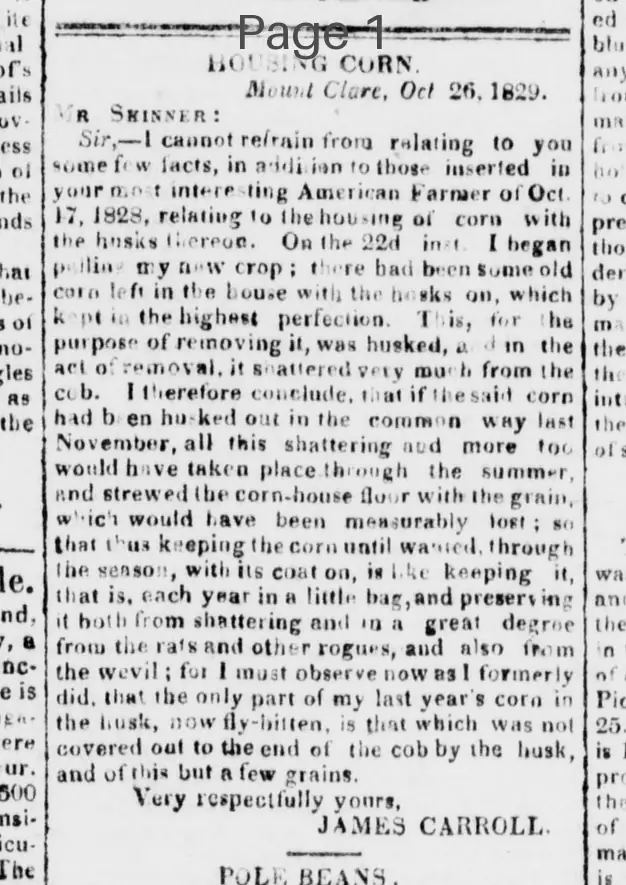
Sir,-I cannot refrain from relating to you some few facts, in addition to those inserted in your most interesting American Farmer of Oct. 17, 1828, relative to the housing of corn with the husks thereon. On the 22d inst. I began housing my new crop: there had been some old corn left in the house with the husks on, which kept in the highest perfection. This, for the purpose of removing it, was husked, and in the act of removal, it scattered very much from the cob. I therefore conclude, that if the said corn had been husked out in the common way last November, all this shattering and more too would have taken place through the summer, and strewed the corn-house floor with the grain, which would have been measurably lost; so that this keeping the corn until wanted, through the season, with its coat on, is like keeping it, that is, each year in a little bag, and preserving it both from shattering and in a great degree from the rats and other rogues, and also from the weevil; for I must observe now as I formerly did, that the only part of my last year's corn in the husk, now fly-bitten, is that which was not covered out to the end of the cob by the husk, and of this but a few grains.
Very respectfully yours,
JAMES CARROLL.
Mount Clare, Oct 26, 1829.
MR. SHINNER:
Sir,-I cannot refrain from relating to you some few facts, in addition to those inserted in your most interesting American Farmer of Oct. 17, 1828, relative to the housing of corn with the husks thereon. On the 22d inst. I began housing my new crop: there had been some old corn left in the house with the husks on, which kept in the highest perfection. This, for the purpose of removing it, was husked, and in the act of removal, it scattered very much from the cob. I therefore conclude, that if the said corn had been husked out in the common way last November, all this shattering and more too would have taken place through the summer, and strewed the corn-house floor with the grain, which would have been measurably lost; so that this keeping the corn until wanted, through the season, with its coat on, is like keeping it, that is, each year in a little bag, and preserving it both from shattering and in a great degree from the rats and other rogues, and also from the weevil; for I must observe now as I formerly did, that the only part of my last year's corn in the husk, now fly-bitten, is that which was not covered out to the end of the cob by the husk, and of this but a few grains.
Very respectfully yours,
JAMES CARROLL.
What sub-type of article is it?
Informative
What themes does it cover?
Agriculture
What keywords are associated?
Corn Housing
Husks Preservation
Shattering Prevention
Weevils
Rats
Agricultural Method
What entities or persons were involved?
James Carroll
Mr. Shinner
Letter to Editor Details
Author
James Carroll
Recipient
Mr. Shinner
Main Argument
housing corn with husks on prevents shattering, loss to rats and weevils, and preserves it better than husking immediately after harvest.
Notable Details
References American Farmer Of Oct. 17, 1828
Old Corn Kept With Husks In High Perfection
Only Exposed Grains Fly Bitten