Thank you for visiting SNEWPapers!
Sign up free
Rhode Island American And Providence Gazette
Providence, Providence County, Rhode Island
What is this article about?
Report on Rhode Island towns' compliance with the new free school act, detailing committees appointed and taxes raised in June meetings, with expectations for August. Eleven towns have appropriated over $13,700 total, showing strong support for establishing free public schools.
Clipping
OCR Quality
Full Text
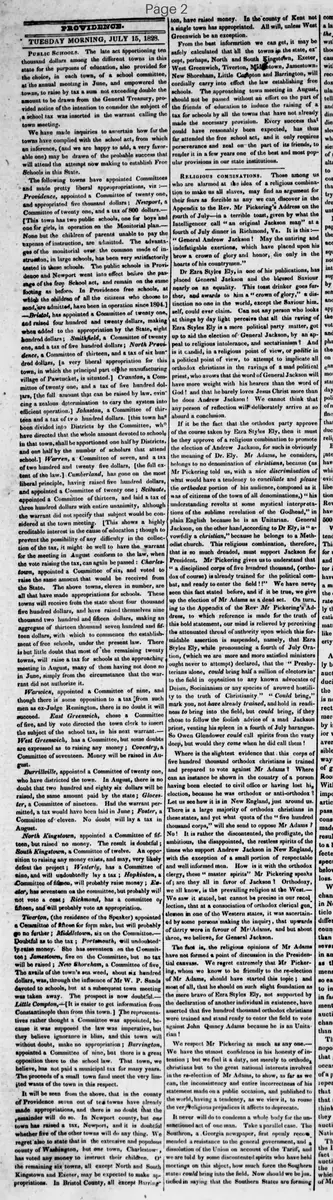
PUBLIC SCHOOLS. The late act apportioning ten thousand dollars among the different towns in this state for the purposes of education, also provided for the choice, in each town, of a school committee, at the annual meeting in June, and empowered the towns, to raise by tax a sum not exceeding double the amount to be drawn from the General Treasury, provided notice of the intention to consider the subject of a school tax was inserted in the warrant calling the town meeting.
We have made inquiries to ascertain how far the towns have complied with the school act, from which an inference, (and we are happy to add, a very favorable one) may be drawn of the probable success that will attend the attempt now making to establish Free Schools in this State.
The following towns have appointed Committees and made pretty liberal appropriations, viz:
Providence, appointed a Committee of twenty one, and appropriated five thousand dollars; Newport, a Committee of twenty one, and a tax of 800 dollars.— [This town has two public schools, one for boys and one for girls, in operation on the Monitorial plan.— None but the children of parents unable to pay the expenses of instruction, are admitted. The advantages of the monitorial over the common mode of instruction, in large schools, has been very satisfactorily tested in these schools. The public schools in Providence and Newport went into effect before the passage of the free School act, and remain on the same footing as before. In Providence free schools, at which the children of all the citizens who choose to send, are admitted, have been in operation since 1804.]
Bristol, has appointed a Committee of twenty one, and raised four hundred and twenty dollars, making when added to the appropriation by the State, eight hundred dollars; Smithfield, a Committee of twenty one, and a tax of five hundred dollars; North Providence, a Committee of thirteen, and a tax of six hundred dollars, [a very liberal appropriation for this town, in which the principal part of the manufacturing village of Pawtucket, is situated.] Cranston, a Committee of twenty one, and a tax of five hundred dollars, [the full amount that can be raised by law, evincing a zealous determination to carry the system into efficient operation.] Johnston, a Committee of thirteen and a tax of two hundred dollars. [this town has been divided into Districts by the Committee, who have directed that the whole amount devoted to schools in that town, shall be apportioned one half by Districts, and one half by the number of scholars that attend school.] Warren, a Committee of seven, and a tax of two hundred and twenty five dollars, [the full extent of the law.] Cumberland, has gone on the most liberal principle, having raised five hundred dollars, and appointed a Committee of twenty one; Scituate, appointed a Committee of thirteen, and laid a tax of three hundred dollars with entire unanimity, although the warrant did not specify that subject would be considered at the town meeting. [This shows a highly creditable interest in the cause of education; though to prevent the possibility of any difficulty in the collection of the tax, it might be well to have the warrant for the meeting in August conform to the law, when the vote raising the tax, can again be passed:] Charlestown, appointed a Committee of six, and voted to raise the same amount that would be received from the State. The above towns, eleven in number, are all that have made appropriations for schools. These towns will receive from the state about four thousand five hundred dollars, and have raised themselves nine thousand two hundred and fifteen dollars, making an aggregate of thirteen thousand seven hundred and fifteen dollars, with which to commence the establishment of free schools, under the present law. There is but little doubt that most of the remaining twenty towns, will raise a tax for schools at the approaching meeting in August, many of them having not done so in June, simply from the circumstance that the warrant did not authorize it.
Warwick, appointed a Committee of nine, and though there is some opposition to a tax from such men as ex-Judge Remington, there is no doubt it will succeed. East Greenwich, chose a Committee of five, and by vote directed the town clerk to insert the subject of the school tax, in his next warrant.— West Greenwich, has a Committee, but some doubts are expressed as to raising any money; Coventry, a Committee of seventeen. Money will be raised in August. Burrillville, appointed a Committee of twenty one, who have districted the town. In August, there is no doubt that two hundred and eighty six dollars will be raised, the same amount paid by the state; Gloucester, a Committee of nineteen. Had the warrant permitted, a tax would have been laid in June; Foster, a Committee of eleven. No doubt will lay a tax in August. North Kingstown, appointed a Committee of fifteen, but raised no money. The result is doubtful: South Kingstown, a Committee of twelve. An opposition to raising any money exists, and may, very likely defeat the project; Westerly, has a Committee of nine, and will undoubtedly lay a tax; Hopkinton, a Committee of fifteen, will probably raise money; Exeter, has seventeen on the committee, but probably will not vote a cent; Richmond, has a committee of fifteen, and will probably vote an appropriation. Tiverton, (the residence of the Speaker) appointed a Committee of fifteen for form sake, but will probably no further; Middletown, six on the Committee.— Doubtful as to the tax; Portsmouth, will undoubtedly raise money. She has seventeen on the Committee; Jamestown, five on the Committee, but no tax will be raised; New Shoreham, a Committee of five The avails of the town's sea weed, about six hundred dollars, was, through the influence of Mr W. P. Sands devoted to schools, but at a subsequent town meeting was taken away. The prospect is now doubtful.— Little Compton,—[It is easier to get information from Constantinople than from this town.] The representatives rather thought a Committee was appointed, because it was supposed the law was imperative, but they believe ignorance is bliss, and this town will without doubt, make no appropriation; Barrington, appointed a Committee of nine, but there is a great opposition there to the school law. That town, we believe, has not paid a municipal tax for many years. The proceeds of a small town fund meet the very limited wants of the town in this respect.
It will be seen from the above, that in the county of Providence seven out of ten towns have already made appropriations, and there is no doubt that the remainder will do so. In Newport county, but one town has raised a tax, Newport, and it is doubtful whether five of the other towns will do any thing. We regret also to state that in the extensive and populous county of Washington, but one town, Charlestown, has voted any money to instruct their children. Of the remaining six towns, all except North and South Kingstown and Exeter, may be expected to make appropriations. In Bristol County, all except Barrington, have raised money. In the county of Kent not a single town has appropriated. All will, unless West Greenwich be an exception.
From the best information we can get, it may be safely calculated that all the towns in the state, except, perhaps, North and South Kingstown, Exeter, West Greenwich, Tiverton, Middletown, Jamestown, New Shoreham, Little Compton and Barrington, will cordially carry into effect the law establishing free schools. The approaching town meeting in August, should not be passed without an effort on the part of the friends of education to induce the raising of a tax for schools by all the towns that have not already made the necessary provision. Every success that could have reasonably been expected, has thus far attended the free school act, and it only requires perseverance and zeal on the part of its friends, to render it in a few years one of the best and most popular provisions in our state institutions.
What sub-type of article is it?
What keywords are associated?
What entities or persons were involved?
Where did it happen?
Domestic News Details
Primary Location
Rhode Island
Event Date
June August
Key Persons
Outcome
eleven towns appropriated $9,215 in taxes plus $4,500 from state, totaling $13,715 for free schools; most remaining towns expected to follow in august.
Event Details
Rhode Island's new education act allocates $10,000 statewide for free schools, requiring town committees and optional taxes up to double the state share. Report details compliance: 11 towns appointed committees and raised funds; others plan for August meetings despite some opposition.