Thank you for visiting SNEWPapers!
Sign up free
Pawtucket Gazette And Chronicle
Pawtucket, Providence County, Rhode Island
What is this article about?
In late 18th-century Aberdeen, students at Marischal College stage a mock trial and execution to scare their strict janitor, Richard Downie, during New Year's vacation. The terror causes his death by fright, and the 'murder' remains a mystery for 15 years until a deathbed confession.
Clipping
OCR Quality
Full Text
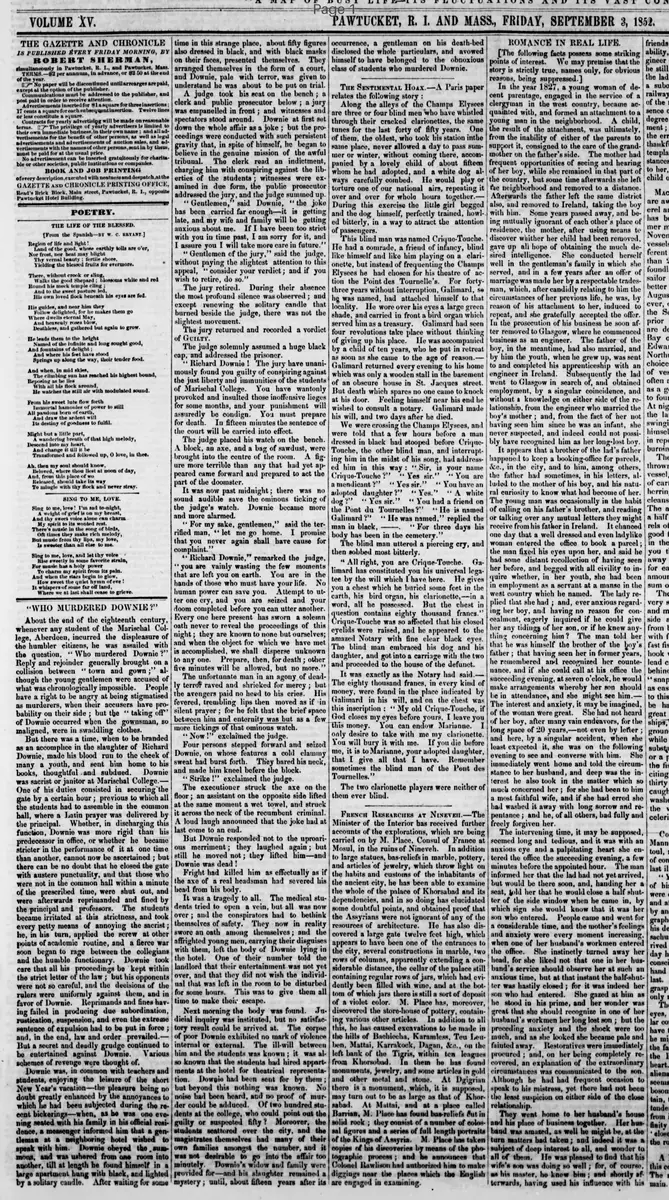
About the end of the eighteenth century, whenever any student of the Marischal College, Aberdeen, incurred the displeasure of the humbler citizens, he was assailed with the question, "Who murdered Downie?" Reply and rejoinder generally brought on a collision between "town and gown;" although the young gentlemen were accused of what was chronologically impossible. People have a right to be angry at being stigmatised as murderers, when their accusers have probability on their side; but the "taking off" of Downie occurred when the gownsman, so maligned, were in swaddling clothes.
But there was a time, when to be branded as an accomplice in the slaughter of Richard Downie, made his blood run to the cheek of many a youth, and sent him home to his books, thoughtful and subdued. Downie was sacrist or janitor at Marischal College.—One of his duties consisted in securing the gate by a certain hour; previous to which all the students had to assemble in the common hall, where a Latin prayer was delivered by the principal. Whether, in discharging this function, Downie was more rigid than his predecessor in office, or whether he became stricter in the performance of it at one time than another, cannot now be ascertained; but there can be no doubt that he closed the gate with austere punctuality, and that those who were not in the common hall within a minute of the prescribed time, were shut out, and were afterwards reprimanded and fined by the principal and professors. The students became irritated at this strictness, and took every petty means of annoying the sacrist; he, in his turn, applied the screw at other points of academic routine, and a fierce war soon began to rage between the collegians and the humble functionary. Downie took care that all his proceedings be kept within the strict letter of the law; but his opponents were not so careful, and the decisions of the rulers were uniformly against them, and in favor of Downie. Reprimands and fines having failed in producing due subordination, rustication, suspension, and even the extreme sentence of expulsion had to be put in force; and, in the end, law and order prevailed.—But a secret and deadly grudge continued to be entertained against Downie. Various schemes of revenge were thought of.
Downie was, in common with teachers and students, enjoying the leisure of the short New Year's vacation—the pleasure being no doubt greatly enhanced by the annoyances to which he had been subjected during the recent bickerings—when, as he was one evening seated with his family in his official residence, a messenger informed him that a gentleman at a neighboring hotel wished to speak with him. Downie obeyed the summons, and was ushered from one room into another, till at length he found himself in a large apartment hung with black, and lighted by a solitary candle. After waiting for some time in this strange place, about fifty figures also dressed in black, and with black masks on their faces, presented themselves. They arranged themselves in the form of a court, and Downie, pale with terror, was given to understand he was about to be put on trial.
A judge took his seat on the bench; a clerk and public prosecutor below; a jury was empanelled in front; and witnesses and spectators stood around. Downie at first set down the whole affair as a joke; but the proceedings were conducted with such persistent gravity that, in spite of himself, he began to believe in the genuine mission of the awful tribunal. The clerk read an indictment, charging him with conspiring against the liberties of the students: witnesses were examined in due form, the public prosecutor addressed the jury, and the judge summed up.
"Gentlemen," said Downie, "the joke has been carried far enough—it is getting late, and my wife and family will be getting anxious about me. If I have been too strict with you in time past, I am sorry for it, and I assure you I will take more care in future."
"Gentlemen of the jury," said the judge, without paying the slightest attention to this appeal, "consider your verdict; and if you wish to retire, do so."
The jury retired. During their absence the most profound silence was observed; and except renewing the solitary candle that burned beside the judge, there was not the slightest movement.
The jury returned and recorded a verdict of GUILTY.
The judge solemnly assumed a huge black cap, and addressed the prisoner.
Richard Downie! The jury have unanimously found you guilty of conspiring against the just liberty and immunities of the students of Marischal College. You have wantonly provoked and insulted those inoffensive lieges for some months, and your punishment will assuredly be condign. You must prepare for death. In fifteen minutes the sentence of the court will be carried into effect.
The judge placed his watch on the bench. A block, an axe, and a bag of sawdust, were brought into the centre of the room. A figure more terrible than any that had yet appeared came forward and prepared to act the part of the doomster.
It was now past midnight; there was no sound audible save the ominous ticking of the judge's watch. Downie became more and more alarmed.
"For my sake, gentlemen," said the terrified man, "let me go home. I promise that you never again shall have cause for complaint."
"Richard Downie," remarked the judge. "you are vainly wasting the few moments that are left you on earth. You are in the hands of those who must have your life. No human power can save you. Attempt to utter one cry, and you are seized and your doom completed before you can utter another. Every one here present has sworn a solemn oath never to reveal the proceedings of this night; they are known to none but ourselves; and when the object for which we have met is accomplished, we shall disperse unknown to any one. Prepare, then, for death; other five minutes will be allowed, but no more."
The unfortunate man in an agony of deadly terror raved and shrieked for mercy; but the avengers paid no heed to his cries. His fevered, trembling lips then moved as if in silent prayer: for he felt that the brief space between him and eternity was but as a few more tickings of that ominous watch.
"Now!" exclaimed the judge.
Four persons stepped forward and seized Downie, on whose features a cold clammy sweat had burst forth. They bared his neck, and made him kneel before the block.
"Strike!" exclaimed the judge.
The executioner struck the axe on the floor; an assistant on the opposite side lifted at the same moment a wet towel, and struck it across the neck of the recumbent criminal. A loud laugh announced that the joke had at last come to an end.
But Downie responded not to the uproarious merriment; they laughed again; but still he moved not; they lifted him—and Downie was dead!
Fright had killed him as effectually as if the axe of a real headsman had severed his head from his body.
It was a tragedy to all. The medical students tried to open a vein, but all was now over; and the conspirators had to bethink themselves of safety. They now in reality swore an oath among themselves: and the affrighted young men, carrying their disguises with them, left the body of Downie lying in the hotel. One of their number told the landlord that their entertainment was not yet over, and that they did not wish the individual that was left in the room to be disturbed for some hours. This was to give them all time to make their escape.
Next morning the body was found. Judicial inquiry was instituted, but no satisfactory result could be arrived at. The corpse of poor Downie exhibited no mark of violence internal or external. The ill-will between him and the students was known; it was also known that the students had hired apartments at the hotel for theatrical representation. Downie had been sent for by them; but beyond this nothing was known. No noise had been heard, and no proof of murder could be adduced. Of two hundred students at the college, who could point out the guilty or suspected fifty? Moreover, the students scattered over the city, and the magistrates themselves had many of their own families amongst the number, and it was not desirable to go into the affair too minutely. Downie's widow and family were provided for—and his slaughter remained a mystery; until, about fifteen years after its occurrence, a gentleman on his death-bed disclosed the whole particulars, and avowed himself to have belonged to the obnoxious class of students who murdered Downie.
What sub-type of article is it?
What themes does it cover?
What keywords are associated?
What entities or persons were involved?
Where did it happen?
Story Details
Key Persons
Location
Marischal College, Aberdeen
Event Date
About The End Of The Eighteenth Century
Story Details
Students at Marischal College, resentful of strict janitor Richard Downie's enforcement of rules, stage an elaborate mock trial and execution prank during New Year's vacation to frighten him. The terror causes Downie to die of fright. The perpetrators escape, the death is ruled a mystery with no evidence of violence, and the truth emerges 15 years later via a deathbed confession.