Thank you for visiting SNEWPapers!
Sign up free
The Wrangell Sentinel
Wrangell, Alaska
What is this article about?
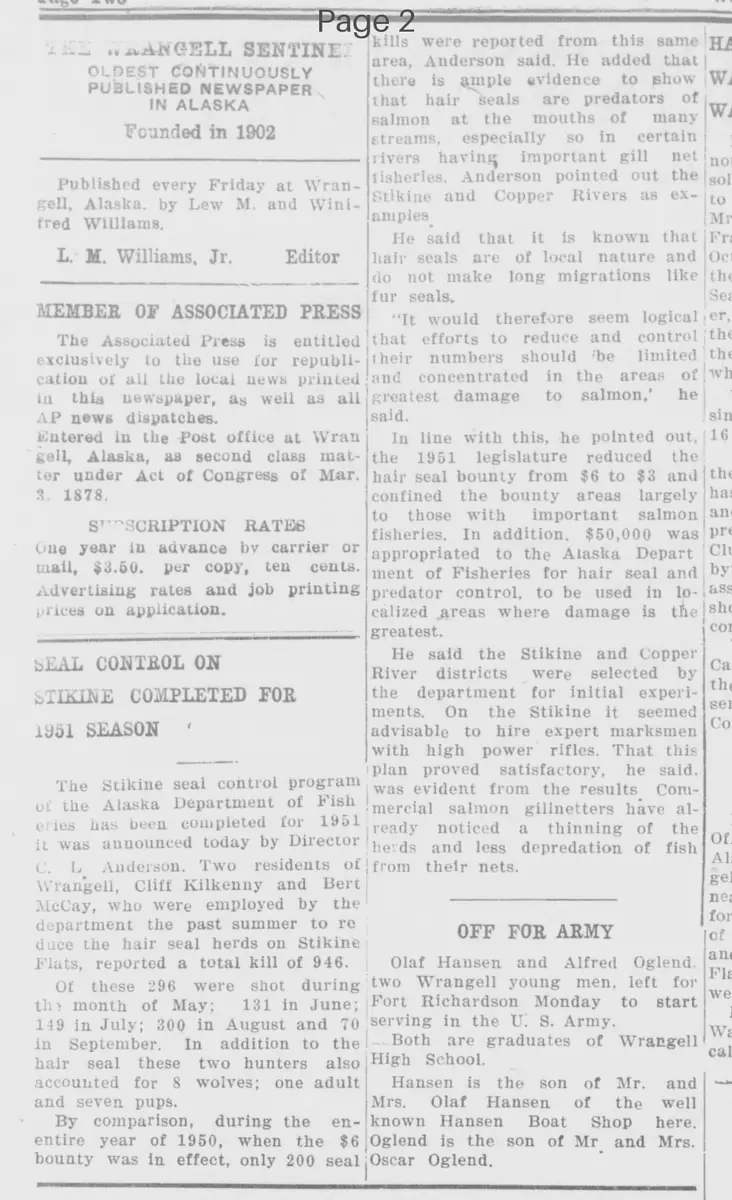
Alaska Department of Fisheries completed 1951 Stikine seal control program, employing two Wrangell hunters who killed 946 hair seals and 8 wolves from May to September to reduce predation on salmon in key river areas like Stikine and Copper Rivers, following legislative bounty reductions and targeted funding.
Clipping
OCR Quality
Full Text
STIKINE COMPLETED FOR
1951 SEASON
The Stikine seal control program of the Alaska Department of Fisheries has been completed for 1951 it was announced today by Director C. L. Anderson. Two residents of Wrangell, Cliff Kilkenny and Bert McCay, who were employed by the department the past summer to reduce the hair seal herds on Stikine Flats, reported a total kill of 946. Of these 296 were shot during the month of May; 131 in June; 149 in July; 300 in August and 70 in September. In addition to the hair seals these two hunters also accounted for 8 wolves: one adult and seven pups.
By comparison, during the entire year of 1950, when the $6 bounty was in effect, only 200 seals kills were reported from this same area, Anderson said. He added that there is ample evidence to show that hair seals are predators of salmon at the mouths of many streams, especially so in certain rivers having important gill net fisheries. Anderson pointed out the Stikine and Copper Rivers as examples.
He said that it is known that hair seals are of local nature and do not make long migrations like fur seals.
"It would therefore seem logical that efforts to reduce and control their numbers should be limited and concentrated in the areas of greatest damage to salmon," he said.
In line with this, he pointed out, the 1951 legislature reduced the hair seal bounty from $6 to $3 and confined the bounty areas largely to those with important salmon fisheries. In addition, $50,000 was appropriated to the Alaska Department of Fisheries for hair seal and predator control, to be used in localized areas where damage is the greatest.
He said the Stikine and Copper River districts were selected by the department for initial experiments. On the Stikine it seemed advisable to hire expert marksmen with high power rifles. That this plan proved satisfactory, he said, was evident from the results. Commercial salmon gillnetters have already noticed a thinning of the herds and less depredation of fish from their nets.
What sub-type of article is it?
What keywords are associated?
What entities or persons were involved?
Where did it happen?
Domestic News Details
Primary Location
Stikine Flats, Alaska
Event Date
1951
Key Persons
Outcome
946 hair seals killed (296 in may, 131 in june, 149 in july, 300 in august, 70 in september); 8 wolves (1 adult, 7 pups); compared to 200 seals in 1950; thinning of herds and reduced depredation on salmon nets
Event Details
Alaska Department of Fisheries employed two Wrangell residents to reduce hair seal herds on Stikine Flats using high power rifles; program targeted local seal populations preying on salmon in rivers like Stikine and Copper; followed 1951 legislative changes reducing bounty to $3 and appropriating $50,000 for localized control