Thank you for visiting SNEWPapers!
Sign up free
Morning Star
Limerick, York County, Maine
What is this article about?
John Hardy disputes evangelical ministers' and Universalists' interpretation of Matthew 24 as fulfilled at Jerusalem's destruction in 70 AD, arguing it describes Christ's second coming with events like the gospel preached worldwide, lightning-like rapidity, cosmic signs, and the trumpet gathering the elect. He warns against false doctrines of 'peace and safety.' Boston, April 15, 1841.
Clipping
OCR Quality
Full Text
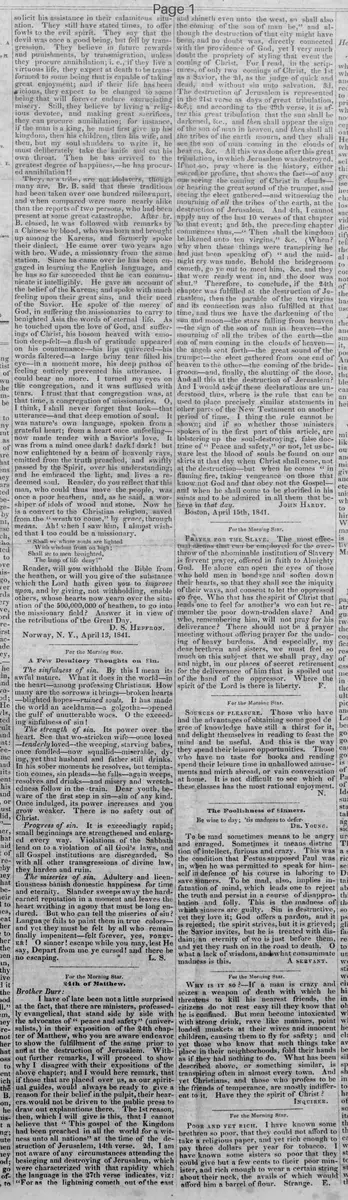
24th of Matthew
Brother Burr:
I have of late been not a little surprised at the fact, that there are ministers, professedly evangelical, that stand side by side with the advocates of "peace and safety" (universalists,) in their exposition of the 24th chapter of Matthew, who you are aware endeavor to show the fulfillment of the same prior to and at the destruction of Jerusalem. Without further remarks, I will proceed to show why I disagree with their expositions of the above chapter; and I would here remark, that if those that are placed over us, as our spiritual guides, would always be ready to give a reason for their belief in the pulpit, their hearers would not be driven to the public press to draw out explanations there. The 1st reason, then, which I will give is this, that I cannot believe that "This gospel of the Kingdom had been preached in all the world for a witness unto all nations" at the time of the destruction of Jerusalem, 14th verse. 2d, I am not aware of any circumstances attending the besieging and destroying of Jerusalem, which were characterized with that rapidity which the language in the 27th verse indicates, viz: "For as the lightning cometh out of the east and shineth even unto the west, so shall also the coming of the son of man be," and although the destruction of that city might have been, and no doubt was, directly connected with the providence of God, yet I very much doubt the propriety of styling that event the coming of Christ. For I read, in the scriptures, of only two comings of Christ, the 1st as a Savior, the 2d, as the judge of quick and dead, and without sin unto salvation. 3d. The destruction of Jerusalem is represented in the 21st verse as days of great tribulation. &c.; and according to the 29th verse, it is after this great tribulation that the sun shall be darkened, &c., and then shall appear the sign of the son of man in heaven, and then shall all the tribes of the earth mourn, and they shall see the son of man coming in the clouds of heaven, &c. All this was done after this great tribulation, in which Jerusalem was destroyed. If not so, pray where is the history, either sacred or profane, that shows the fact--of any one seeing the coming of Christ in clouds--or hearing the great sound of the trumpet, and seeing the elect gathered--and witnessing the mourning of all the tribes of the earth, at the destruction of Jerusalem. And 4th, I cannot apply any of the last 10 verses of that chapter to that event; and 5th, the preceding chapter commences thus,--"Then shall the kingdom be likened unto ten virgins," &c. (When? why when these things were transpiring he had just been speaking of) "and the midnight cry was made. Behold the bridegroom cometh, go ye out to meet him, &c. and they that were ready went in, and the door was shut." Therefore, to conclude, if the 24th chapter was fulfilled at the destruction of Jerusalem, then the parable of the ten virgins and its connection was also fulfilled at that time, and thus we have the darkening of the sun and moon--the stars falling from heaven--the sign of the son of man in heaven--the mourning of all the tribes of the earth--the son of man coming in the clouds of heaven--the angels sent forth--the great sound of the trumpet--the elect gathered from one end of heaven to the other--the coming of the bridegroom--and, finally, the shutting of the door. And all this at the destruction of Jerusalem? And I would ask if these declarations are understood thus, where is the rule that can be used to place precisely similar statements in other parts of the New Testament on another period of time. I think the rule cannot be shown; and if so whether those ministers spoken of in the first part of this article, are bolstering up the soul-destroying, false doctrine of "Peace and safety," or not, let us beware lest the blood of souls be found on our skirts at that day when Christ shall come, not at the destruction--but when he comes "in flaming fire, taking vengeance on those that know not God and that obey not the Gospel--and when he shall come to be glorified in his saints and to be admired in all them that believe in that day.
JOHN HARDY.
Boston, April 15th, 1841.
What sub-type of article is it?
What themes does it cover?
What keywords are associated?
What entities or persons were involved?
Letter to Editor Details
Author
John Hardy
Recipient
Brother Burr
Main Argument
the 24th chapter of matthew describes christ's second coming, not the destruction of jerusalem, as evidenced by unfulfilled prophecies like the gospel preached worldwide, cosmic signs, the trumpet, and gathering of the elect, which did not occur in 70 ad.
Notable Details