Thank you for visiting SNEWPapers!
Sign up free
Virginia Argus
Richmond, Virginia
What is this article about?
In the New York House of Assembly, during debate on the militia bill, Mr. Warner proposed taxing Quakers $10 annually for exemption from duty, opposed by Mr. Williams who argued it was persecution. The motion failed, as did a follow-up for $5. A separate motion to tax other exempt able-bodied men similarly failed, per Mr. Van Rensselaer.
Clipping
OCR Quality
Full Text
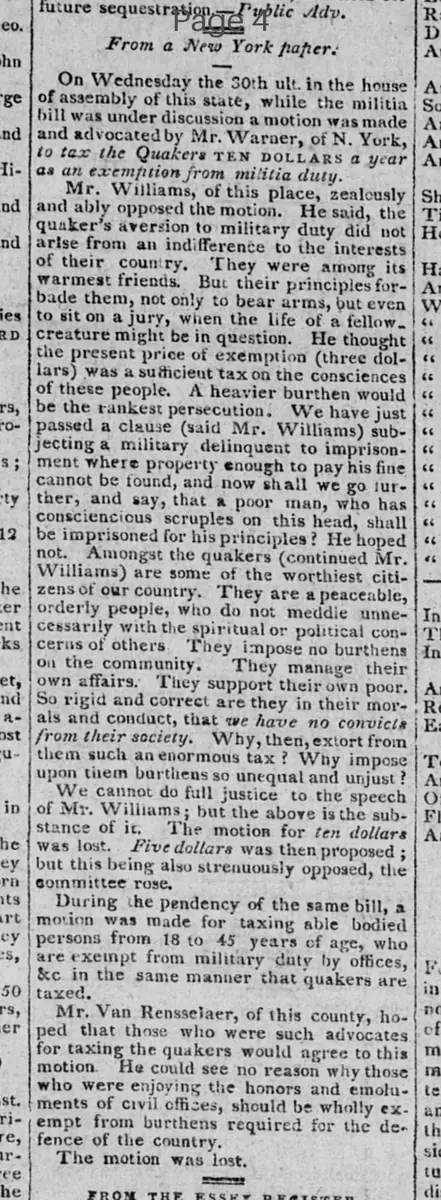
On Wednesday the 30th ult. in the house of assembly of this state, while the militia bill was under discussion a motion was made and advocated by Mr. Warner, of N. York, to tax the Quakers TEN DOLLARS a year as an exemption from militia duty.
Mr. Williams, of this place, zealously and ably opposed the motion. He said, the quaker's aversion to military duty did not arise from an indifference to the interests of their country. They were among its warmest friends. But their principles forbade them, not only to bear arms, but even to sit on a jury, when the life of a fellow-creature might be in question. He thought the present price of exemption (three dollars) was a sufficient tax on the consciences of these people. A heavier burthen would be the rankest persecution. We have just passed a clause (said Mr. Williams) subjecting a military delinquent to imprisonment where property enough to pay his fine cannot be found, and now shall we go further, and say, that a poor man, who has conscientious scruples on this head, shall be imprisoned for his principles? He hoped not. Amongst the quakers (continued Mr. Williams) are some of the worthiest citizens of our country. They are a peaceable, orderly people, who do not meddle unnecessarily with the spiritual or political concerns of others They impose no burthens on the community. They manage their own affairs. They support their own poor. So rigid and correct are they in their morals and conduct, that we have no convicts from their society. Why, then, extort from them such an enormous tax? Why impose upon them burthens so unequal and unjust?
We cannot do full justice to the speech of Mr. Williams; but the above is the substance of it. The motion for ten dollars was lost. Five dollars was then proposed; but this being also strenuously opposed, the Committee rose.
During the pendency of the same bill, a motion was made for taxing able bodied persons from 18 to 45 years of age, who are exempt from military duty by offices, &c. in the same manner that quakers are taxed.
Mr. Van Rensselaer, of this county, hoped that those who were such advocates for taxing the quakers would agree to this motion. He could see no reason why those who were enjoying the honors and emoluments of civil offices, should be wholly exempt from burthens required for the defence of the country.
The motion was lost.
What sub-type of article is it?
What keywords are associated?
What entities or persons were involved?
Where did it happen?
Domestic News Details
Primary Location
New York
Event Date
Wednesday The 30th Ult.
Key Persons
Outcome
motion to tax quakers ten dollars lost; motion to tax quakers five dollars opposed and committee rose; motion to tax able-bodied persons exempt by offices lost.
Event Details
During discussion of the militia bill in the New York House of Assembly, Mr. Warner moved to tax Quakers ten dollars yearly for exemption from militia duty. Mr. Williams opposed, arguing Quakers' principles against bearing arms and jury service in capital cases, that three dollars was sufficient, and heavier tax would be persecution, highlighting Quakers as peaceable citizens supporting their own poor with no convicts from their society. The motion lost; five dollars proposed but opposed, Committee rose. Separately, motion to tax able-bodied persons 18-45 exempt by offices like Quakers; Mr. Van Rensselaer supported, questioning exemption for civil office holders from defense burdens. Motion lost.