Thank you for visiting SNEWPapers!
Sign up free
New Hampshire Statesman And State Journal
Concord, Merrimack County, New Hampshire
What is this article about?
Daniel Webster's speech in the U.S. Senate on March 12, 1838, opposing the Sub-Treasury Bill. He analyzes the U.S. banking and currency system, compares it to England's, critiques past expansions under Jackson, argues against excess circulation claims, and warns of the bill's harmful effects on commerce and resumption of specie payments.
Merged-components note: Continuation of Webster's speech on the Sub-Treasury Bill across columns and pages, based on sequential reading order and content flow.
Clippings
1 of 2
OCR Quality
Full Text
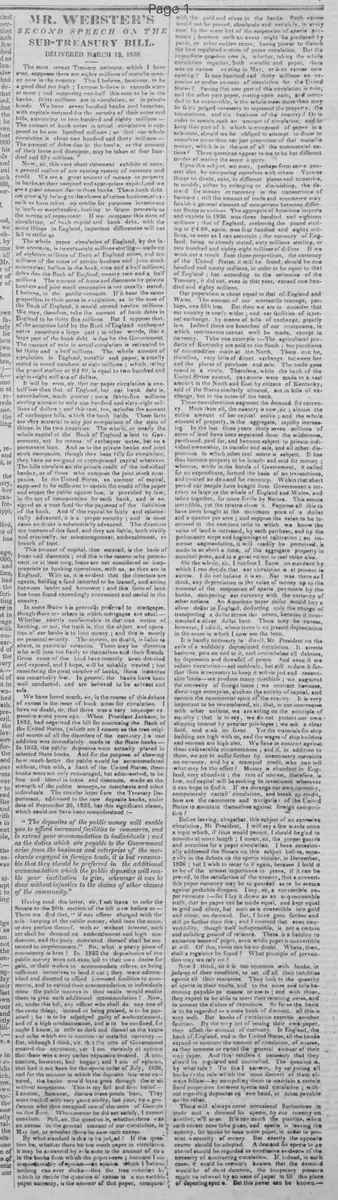
SECOND SPEECH ON THE
SUB-TREASURY BILL.
DELIVERED MARCH 12, 1838.
The most recent Treasury estimate, which I have seen, supposes there are eighty millions of metallic money now in the country. This I believe, however, to be a good deal too high; I cannot believe it exceeds sixty at most; and supposing one-half this sum to be in the banks, thirty millions are in circulation, or in private hands. We have seven hundred banks and branches, with capitals assigned for the security of their notes and bills, amounting to two hundred and eighty millions—The amount of bank notes in actual circulation is supposed to be one hundred millions: so that our whole circulation is about one hundred and thirty millions—The amount of debts due in the banks, or the amount of their loans and discounts, may be taken at four hundred and fifty millions.
Now, sir, this very short statement exhibits at once, a general outline of our existing system of currency and credit. We see a great amount of money or property in banks, as their assigned and appropriate capital, and we see a great amount due to these banks. These bank debtors generally belong to the classes of active business, or such as have taken up credits for purposes investment in lands or merchandize, looking to future proceeds as the means of repayment. If we compare this state of circulation, of bank capital and bank debt, with the same things in England, important differences will not fail to strike us.
The whole paper circulation of England, by the latest accounts, is twenty-eight millions sterling—made up of eighteen millions of Bank of England notes, and ten millions of the notes of private bankers and joint stock companies; bullion in the bank, nine and a half millions; debts due the Bank of England, twenty two and a half millions. The amount of loans and discounts by private bankers and joint stock companies is not usually stated, I believe, in the public accounts. If it bear the same proportion to their notes in circulation, as in the case of the Bank of England, it would exceed twelve millions. We may, therefore, take the amount of bank debts in England to be thirty five millions. But I suppose that, of the securities held by the Bank of England exchequer notes constitute a large part; in other words, that a large part of the bank debt is due by the Government. The amount of coin in actual circulation is estimated to be thirty and a half millions. The whole amount of circulation in England, metallic and paper, is usually stated in round numbers, at sixty millions; which, rating the pound sterling at 4 80, is equal to two hundred and eighty-eight millions of dollars.
It will be seen, sir, that our paper circulation is one-half less than that of England, but our bank debt is, nevertheless, much greater; since thirty-five millions sterling amount to only one hundred and sixty-eight millions of dollars; and this sum, too, includes the amount of exchequer bills, which the bank holds. These facts are very material to any just comparison of the state of things, in the two countries. The whole, or nearly the whole capital of the Bank of England is lent to Government, not by means of exchequer notes, but on a permanent loan. And as to the private banks and joint stock companies, though they issue bills for circulation, they have no assigned or appropriated capital whatever. The bills circulate on the private credit of the individual banker, or of those who compose the joint stock companies. In the United States, an amount of capital, supposed to be sufficient to sustain the credit of the paper and secure the public against loss, is provided by law, in the act of incorporation for each bank, and is assigned as a trust fund for the payment of the liabilities of the bank. And if this capital be fairly and substantially advanced, it is a proper security; and in most cases no doubt is substantially advanced. The directors are trustees of this fund, and they are liable, both civilly and criminally, for mismanagement, embezzlement, or breach of trust.
This amount of capital, thus secured, is the basis of loans and discounts; and this is the reason why permanent, or at least long, loans are not considered so inappropriate to banking operations, with us, as they are in England. With us, it is evident that the directors are agents, holding a fund intended to be loaned, and acting between lender and borrower; and this form of loan has been found exceedingly convenient and useful in the country. In some States it is generally preferred to mortgages, though there are others in which mortgages are usual.—Whether exactly conformable to the true notion of banking, or not, the truth is, that the object and operation of our banks is to loan money; and this is mostly on personal security. The system, no doubt, is liable to abuse, in particular instances. There may be directors who will loan too freely to themselves and their friends. Gross cases of this kind have recently been detected and exposed, and I hope, will be suitably treated; but considering the great number of banks, these instances are remarkably few. In general, the banks have been well conducted, and are believed to be solvent and safe.
We have heard much, sir, in the course of this debate of excess in the issue of bank notes for circulation. I have no doubt, sir, that there was a very improper expansion some years ago. When President Jackson, in 1832, had negatived the bill for continuing the Bank of the United States, (which act I esteem as the true original source of all the disorders of the currency.) a vast addition was immediately made to the State banks.—In 1833, the public deposits were actually placed in selected State banks. And for the purpose of showing how much better the public would be accommodated without, than with, a bank of the United States, these banks were not only encouraged, but admonished, to be free and liberal in loans and discounts, made on the strength of the public moneys, to merchants and other individuals. The circular letter from the Treasury Department, addressed to the new deposit banks, under date of September 26, 1833, has this significant clause, which could not have been misunderstood:-
"The deposits of the public money will enable you to afford increased facilities to commerce, and to extend your accommodation to individuals; and as the duties which are payable to the Government arise from the business and enterprise of the merchants engaged in foreign trade, it is but reasonable that they should be preferred in the additional accommodation which the public deposits will enable your institution to give, whenever it can be done without injustice to the claims of other classes of the community."
Having read this letter, sir, I ask leave to refer the Senate to the 20th section of the bill now before us.—There we find that, "if any officer charged with the safe keeping of the public money, shall loan the same, or any portion thereof, with or without interest, such act shall be deemed an embezzlement and high misdemeanor, and the party convicted thereof shall be sentenced to imprisonment." Sir, what a pretty piece of consistency is here! In 1833 the depositories of the public money were not even left to their own desire for gain, or their wishes to accommodate others, as being sufficient incentives to lend it out; they were admonished and directed to afford increased facilities to commerce, and to extend their accommodation to individuals since the public moneys in their vaults would enable them to give such additional accommodation! Now, sir, under this bill, any officer who shall do any one of the same things, instead of being praised, is to be punished; he is to be adjudged guilty of embezzlement, and of a high misdemeanor, and is to be confined, for aught I know, in a cell as dark and dismal as the vaults and safes which are to contain our metallic currency—But, although I think, sir, that the acts of Government created the expansion, yet I am certainly of opinion that there was a very undue expansion created. A contraction, however, had begun; and I am of opinion, that had it not been for the specie order of July, 1836, and for the manner in which the deposit law was executed, the banks would have gone through the crisis without suspension. This is my full and firm belief.—I cannot, however, discuss these points here. They were treated with very great ability, last year, by a gentleman who then occupied one of the seats of Georgia on this floor. Whomsoever he did not satisfy, I cannot convince. Still, sir, the question is, whether there was an excess in the general amount of our circulation, in May last, or whether there be now such excess.
By what standard is this to be judged? If the question be, whether there be too much paper in circulation it may be answered by reference to the amount of coin in the banks from which the paper issues; because I am unquestionably of opinion—an opinion which I believe nothing can ever shake—that the true criterion by which to decide the question of excess in a convertible paper currency, is the amount of that paper, compared with the gold and silver in the banks. Such excess would not be proved, absolutely and certainly, in every case, by the mere fact of the suspension of specie payments; because such an event might be produced by panic, or other sudden cause, having power to disturb the best regulated system of paper circulation. But the immediate question now, whether, taking the whole circulation together, both metallic and paper, there was an excess existing in May, or is an excess now existing? Is one hundred and thirty millions an excessive or undue amount of circulation for the United States? Seeing that one part of this circulation is coin, and the other part paper, resting upon coin, and intended to be convertible, is the whole mass more than may be fairly judged necessary to represent the property, the transactions, and the business of the country? Or in order to sustain such an amount of circulation, and to keep that part of it which is composed of paper in a safe state, should we be obliged to attempt to draw to ourselves more than our just proportion of that metallic money, which is in the use of all the commercial nations? These questions appear to me to be but different modes of stating the same inquiry.
Upon this subject, we may, perhaps form some general idea, by comparing ourselves with others. Various things no doubt, exist, in different places and countries, to modify, either by enlarging or diminishing, the demand for money or currency in the transactions of business; still the amount of trade and commerce may furnish a general element of comparison between different States or nations. The aggregate of American imports and exports in 1836 was three hundred and eighteen millions; that of England, reckoning the pound sterling at 4 80, again, was four hundred and eighty millions, as near as I can ascertain; the currency of England, being, as already stated, sixty millions sterling, or two hundred and eighty-eight millions of dollars. If we work out a result from these proportions, the currency of the United States, it will be found, should be one hundred and ninety millions, in order to be equal to that of England: but according to the estimates of the Treasury, it did not, even in that year, exceed one hundred and eighty millions.
Our population is about equal to that of England and Wales. The amount of our mercantile tonnage, perhaps, one fifth less. But then we are to consider that our country is vastly wider; and our facilities of internal exchange, by means of bills of exchange, greatly less. Indeed there are branches of our intercourse, in which remittances cannot well be made, except in currency. Take one example: The agricultural products of Kentucky are sold to the South: her purchases of commodities made at the North. There can be, therefore, very little of direct exchange between her and the places of purchase and sale. The trade goes round in a circle. Therefore, while the bank of the United States existed, payments were made to a vast amount in the North and East by citizens of Kentucky, and of the States similarly situated, not in bills of exchange, but in the notes of the bank.
These considerations augment the demand for currency. More than all, the country is new, sir; almost the entire amount of her capital active: and the whole amount of property, in the aggregate, rapidly increasing. In the last three years thirty seven millions of acres of land have been separated from the wilderness, purchased, paid for, and become subject to private individual ownership, to transfer and sale, and all other dispositions to which other real estate is subject. It has thus become property to be bought and sold for money; whereas, while in the hand of Government, it called for no expenditure, formed the basis of no transactions, and created no demand for currency. Within that short period our people have bought from Government a territory as large as the whole of England and Wales taken together, far more fertile by Nature. This seems incredible, yet the returns show it. Suppose all this to have been bought at the minimum price of a dollar and a quarter per acre; and suppose the value to be increased in the common ratio in which we know the value of land is increased, by such purchase, and by the preliminary steps and beginnings of cultivation; an immense augmentation, it will readily be perceived, is made in so short a time, of the aggregate property in the country, both in nominal price, and to a great extent in real value also.
On the whole, sir, I confess I know no standard by which I can decide that our circulation is at present in excess. I do not believe it is so. Nor was there as I think, any depreciation in the value of money up to the moment of the suspension of specie payments by the banks, comparing our currency with the currency of other nations. An American paper dollar would buy a silver dollar in England, deducting only the charge of transporting a dollar across the ocean, because it commanded a silver dollar here. There may be excess, however, I admit, where there is no present depreciation in the sense in which I now use the term.
It is hardly necessary to dwell, Mr. President, on the evils of a suddenly depreciated circulation. It arrests business, puts an end to it, and overwhelms all debtors, by depression and downfall of prices. And even if we reduce circulation—not suddenly, but still reduce it farther than is necessary to keep it within just and reasonable limits—we produce many mischiefs; we augment the necessity of foreign loans; we contract business, discourage enterprise, slacken the activity of capital, and restrain the commercial spirit of the country. It is very important to be remembered, sir, that, in our intercourse with other nations, we are acting on the principle of equality; that is to say, we do not protect our own shipping interest by peculiar privileges; we ask a clear field, and seek no favor. Yet the materials for ship building are high with us, and the wages of ship builders and seamen are high also. We have to contend against these unfavorable circumstances, and if, in addition to these, we are to suffer further by unnecessary restraints on currency, and by a cramped credit, who can tell what may be the effect? Money is abundant in England, very abundant; the rate of interest, therefore, is low, and capital will be seeking its investment wherever it can hope to find it. If we derange our own currency, compulsively curtail circulation, and break up credit, how are the commerce and navigation of the United States to maintain themselves against foreign competition?
Before leaving, altogether, this subject of an excessive circulation, Mr. President, I will say a few words upon a topic which, if time would permit, I should be glad to consider at more length; I mean, sir, the proper guards and securities for a paper circulation. I have occasionally addressed the Senate on this subject before, especially in the debate on the specie circular, in December, 1836; but I wish to recur to it again, because I hold it to be of the utmost importance to prove, if it can be proved, to the satisfaction of the country, that a convertible paper currency may be so guarded as to be secure against probable dangers. I say, sir, a convertible paper currency:—for I lay it down as an unquestionable truth, that no paper can be made equal, and kept equal to gold and silver, but such as is convertible into gold and silver, on demand. But, I have gone farther and still go farther than this, and I contend that even convertibility, though itself indispensable, is not a certain and unfailing ground of reliance. There is a liability to excessive issues of paper, even while paper is convertible at will. Of this, there can be no doubt. Where, then, shall a regulator be found? What principle of prevention may we rely on?
Now I think, sir, it is too common with banks, in judging of their condition, to set off all their liabilities against all their resources. They look to the quantity of specie in their vaults, and to the notes and bills becoming payable as means or assets; and with these, they expect to be able to meet their returning notes, and to answer the claims of depositors. So far as the bank is to be regarded as a mere bank of discount, all this is very well. But banks of circulation exercise another function. By the very act of issuing their own paper, they affect the amount of currency. In England, the bank of England, and in the United States, all the banks expand or contract the amount of circulation, of course, as they increase or curtail the general amount of their own paper. And this renders it necessary that they should be regulated and controlled. The question is, by what rule? To this I answer, by subjecting all banks to the rule which the most discreet of them always follow—by compelling them to maintain a certain fixed proportion between specie and circulation: without regarding deposits on one hand, or notes payable on the other.
There will always occur occasional fluctuations in trade and a demand for specie, by one country on another, will arise. It is too much the practice, when such occurrences take place, and specie is leaving the country, for banks to issue more paper, in order to prevent a scarcity of money. But exactly the opposite course should be adopted. A demand for specie to go abroad should be regarded as conclusive evidence of the necessity of contracting circulation. If, indeed, in such cases, it could be certainly known that the demand would be of short duration, the temporary pressure might be relieved by an issue of paper to fill the place of departing specie. But this never can be known.—
There is no safety, therefore, but in meeting the case at the moment, and in conforming to the infallible index of the exchanges. Circulating paper is thus kept always nearer to the character, and to the circumstances of that of which it is designed to be the representative—the metallic money. This subject might be pursued, I think, and clearly illustrated: but, for the present, I only express my belief that, with experience before us, and with the lights which recent discussions, both in Europe and America, hold out, a national bank might be established, with more regard to its function of regulating currency, than its function of discount, on principles, and subject to regulations, such as should render its operations extremely useful; and I should hope that, with an example before them of plain and eminent advantage, State Institutions would conform to the same rules and principles; and that, in this way all the advantages of convertible paper might be enjoyed with a just security against its dangers.
I have detained the Senate too long, sir, with these observations upon the state of the country, and its pecuniary system and condition. And now, when the banks have suspended payments universally; when the internal exchanges are all deranged, and the business of the country most seriously interrupted, the questions are—Whether the measure before us is suitable to our condition? and, Whether it is a just and proper exercise and fulfilment of the powers and duties of Congress?
What then, sir, will be the practical operation and effect of this measure if it should become a law? Like its predecessor of the last session, the bill proposes nothing for the general currency of the country; nothing to restore exchanges; nothing to bring about a speedy resumption of specie payments by the banks.—Its whole professed object is the collection and disbursement of the public revenue. Some of its friends, indeed say, that when it shall go into operation, it will, incidentally, produce a favorable effect on the currency, by restraining the issue of bank paper. But others press it, as if its effect was to be the final overthrow of all banks, and the introduction of an exclusive metallic currency for all uses of the country.
Are we to understand, then, that it is intended, by means of which this is the first, to rid the country of all banks, as being but so many nuisances, and to abolish all paper currency whatever? Or is it expected, on the contrary, that after this system shall be adopted for the use of Government, there will still be a paper currency in the country for the use of the People? And if there shall still be a paper currency, will that currency consist of irredeemable Government paper, or of convertible bank notes, such as have circulated heretofore? These questions must be answered, before we can judge accurately of the operation of this bill.
As to an exclusive metallic currency, sir, the administration on this point is regularly Janus-faced. Out doors, and among the People, it shows itself "all clinquant, all in gold." There every thing is to be hard money—no paper rag—no delusive credits—no bank monopolies—no trust in paper of any kind. But in the Treasury Department, and in the Houses of Congress, we see another aspect—a mixed appearance, partly gold and partly paper; gold for Government and paper for the People. The small voice which is heard here, allows the absolute necessity of paper of some sort, and to some extent. But the shouts in the community demand the destruction of all banks, and the final extermination of all paper circulation.
To the People, the lion roars against paper money in all the loudness and terror of his voice; but to Members of Congress he is more discreet; lest he should frighten them out of their wits, he here restrains and modulates, were, any nightingale." The impracticability of an exclusive metallic currency, the absurdity of attempting any such a thing in a country like this, are so manifest, oning or argument. All that is said in its favor, is general depunciation of paper, general outcry against the banks, and declamation against existing institutions, full of sound and fury, signifying nothing.
The moment any one considers it, he sees how ridiculous any such attempt would be. An exclusive metallic circulation for the second commercial country on earth, in the nineteenth century! Sir you might as well propose to abolish commerce altogether. The currency of England is estimated at sixty millions sterling; and it is Mr. McCulloch's calculation, that if this currency were all gold, allowing only one-quarter of one per cent. for wear of metals, the annual expense attending such a currency, would be three millions and a quarter a year, or nearly five per cent. upon the whole. With us this charge would be much greater. The loss of capital would be more, owing to the higher rates of interest; and besides all this, is the cost of transportation, which, in a country so extensive as ours, would be vast and not easily calculated. We should also require, proportionally, more specie than is requisite in England, because our system of exchange, by means of bills of exchange, is, at present, and would be, under such a system as is proposed, much less perfect and convenient than that of England. Besides, the English metallic circulation is mostly gold, and being in England the standard metal. With us, silver and gold both are made standards, at a fixed relation; and if we should succeed to keep this relation so true as to preserve both the precious metals among us, (which, indeed, is not very probable,) our circulation would be still more expensive and cumbrous, from the quantity of silver it would contain. The silver in the world is estimated to be fifty times that of gold in amount, and consequently something more than three times in value. If both should circulate, therefore, equally in proportion to value, the currency would be three parts silver, and one gold.
Now, sir, the annual expense of such a circulation, upon the basis of Mr. McCulloch's estimate, would exceed the whole annual expenditure made for our army and navy. Consider, sir, the amount of actual daily payments made in the country. It is difficult to estimate it, and quite impossible to ascertain it, with any accuracy. But we can form some notion of it, by the daily amount of payments in the banks in some of the cities. In times of prosperous business and commerce, the daily amount of payments in the banks of New York alone has been equal to eight millions. Whether we call this a tenth, a twentieth, or a fiftieth part of all the payments and receipts made daily in the country, we see to what aggregate result the whole would rise. And how is it possible that such amount of receipt and payment could be performed by an actual passing of gold and silver from hand to hand?
Such notions, sir, hardly require serious refutation. Mr. President, an entire metallic currency would necessarily create Banks immediately. Where would the money be kept, or how could it be remitted? Banks of deposit must and would be instantly provided for it. Would the merchants of the cities be seen, in their daily walks of business, with servants behind them, with bags of gold and kegs of silver on their wheelbarrows? What folly is great enough to imagine this? If there were not now a bank note, nor a bank in the country, and if there should be an exclusive specie currency tomorrow morning at nine o'clock, there would be fifty banks before sunset. From necessity, there would be created at once places of deposit; and persons having money in such depositories would draw checks for it, and pass these checks as money, and from one hand they would pass to another; or the depository himself would issue certificates of deposit, and these would pass as currency. And all this would do no more than just carry us back two or three hundred years, to the infancy of banks. We should then have done nothing but reject the experience of the most civilized nations, for some centuries, as well as all our own experience, and have returned to the rude conceptions of former times. These certificates of deposit would soon be found to be often issued without any solid capital, or actual deposit. Abuses arising from this source would call for legislative interference, and the legislature would find it necessary to restrain the issue of paper intended for circulation, by enacting that such issue should only be made on the strength of competent capital, actually provided and assigned, placed under proper regulation, and managed by persons responsible to the laws. And this would bring us again exactly to the state of things in which we now are; that is to say, to the use of the paper of banks, established, regulated, and controlled by law. In the mean time, before this process could be carried through, half of the community would be made bankrupt by the ruin of their business, and by the violent and revolutionary changes of property which the process would create. The whole class of debtors, all that live more by industry than on capital, would be overwhelmed with undistinguishing destruction.
There will then, sir, be no such thing as an exclusive metallic currency. The country will not be guilty of the folly of attempting it. I should have felt that I had occupied too much time with such a senseless and preposterous suggestion, were it not the manifest object of partisans to press such notions upon the attention of the People, in aid of the war against the banks.
We shall then, sir, have paper of some sort, forming a part of our currency. What will that paper be?—The honorable gentleman from South Carolina, admitting that paper is necessary as a part of the currency, or circulation, has contended that that paper ought to be Government paper—Government paper not convertible nor redeemable, only so far as by being receivable for debts and dues to Government. My colleague has endeavored to satisfy the Senate, that the aim of the whole system, of which he regards this bill as but Part, is to establish a circulation of Government paper and a Government bank. Other gentlemen have taken the same view of it. But, as the bill itself does not profess any such purpose, I am willing to discuss it in the character in which it presents itself. I take it for what its friends say it is—a bill making further provision for collecting the revenues.
We are then, sir, still to have paper as a general medium of circulation; that paper is to be the paper of banks; but Government is to be divorced from these banks, altogether. It is to have nothing to do with them, but is to collect and disburse its revenues by its own means, and its own officers. The receipt of the notes of specie paying banks is to be partially allowed for some time, but it is to be gradually discontinued; and six years hence, we are to arrive at the maturity and the perfection of the system. When that auspicious day comes, Government is to receive and to pay out gold and silver, and nothing but gold and silver.
Now, Mr. President, let us anticipate this joyous epoch; let us suppose the six years to have expired; and let us imagine this bill, with its specie payments and all, to be in full operation at the present hour. What will that operation be? In the first place, disregarding all question of public convenience, or the general interests of the People, how will this system work as a mere mode of collecting and paying out revenue? Let us see.
Our receipts and expenditures may be estimated, each, at thirty millions a year. Those who think this estimate either too high or too low, may make the necessary allowance. Here, then, is the sum of thirty millions, to be collected and paid out every year; and it is all to be counted, actually told over, dollar after dollar, and gold piece after gold piece; and how many times counted? Let us inquire into that. The importing merchant, whose ship has arrived, and who has cash duties to pay, goes to the bank for his money, and the teller counts it out: that is once. He carries it to the custom house, pays it, and the clerks count it over: that is twice. Some days afterwards, the collector takes it out of his bags and chests, carries it to the receiver general's office, and there it is counted again, and poured into bags and chests of that office: that is the third time. Presently a warrant comes from the Treasury, in favor of some disbursing officer, and the boxes are opened, and the necessary sums counted out: this is the fourth counting. And fifthly and lastly, the disbursing officer pays it to persons entitled to receive it on contracts, or for pensions, salaries, or other claims. Thirty millions of hard money are thus to be handled and told over five times in the course of the year; and if there be transfers from place to place, then of course it is to be counted so much oftener. Government officers, therefore, are to count over one hundred and fifty millions of dollars a year; which, allowing three hundred working days in the year, gives five hundred thousand dollars a day. But this is not all. Once a quarter, the naval officer is to count the collector's money, and the register in the land office is to count the receiver's money. And moreover, sir, every now and then the Secretary of the Treasury is to authorize unexpected and impromptu countings, in his discretion, and just to satisfy his own mind?
Sir, what a money-counting, tinkling, jingling generation we shall be! All the money-changers in Solomon's temple will be as nothing to us. Our sound will go forth unto all lands. We shall all be like the king in the ditty of the nursery:-
"There sat the king a counting his money."
You will observe, sir, that these receipts and payments cannot be made in parcels, without the actual handling of each piece of coin. The marks on kegs of dollars, and the labels on bags of gold, are not to be trusted. They are a part of credit—and all credit, all trust, all confidence is to be done away with. When the surveyor, for instance, at the custom house, is to examine the money on hand, in possession of the collector, or receiver general, he is, of course, to count the money. No other examination can come to anything. He cannot tell, from external appearance, nor from the weight, whether the collector has loaned out the money, and filled the bags and boxes up with sand and lead, or not. Nor can counterfeit pieces be otherwise detected than by actual handling. He must open, he must examine, he must count. And so at the land offices, the mints, and elsewhere. If these officers shall have a taste for silver sounds, they are likely to be gratified.
Mr. President, in all soberness, is not this whole operation preposterous? It begins by proposing to keep the public moneys. This, itself, in the sense of the word here used, is a perfect novelty, especially in the United States. Why keep the public moneys? that is to say, why hoard them, why keep them out of use? The use of money is in the exchange. It is designed to circulate, not to be hoarded. All that Government should have to do with it, is to receive it today, that it may pay it away tomorrow. It should not receive it, before it needs it; and it should part with it as soon as it owes it—To keep it—that is, to detain it, to hold it back from general use, to hoard it, is a conception belonging to barbarous times and barbarous Governments. How would it strike us, if we should see other great Commercial nations acting upon such a system? If England, with a revenue of fifty millions sterling a year, were found to be collecting and disbursing every shilling of it in hard money, through all the ramifications of her vast expenditure, should we not think her mad? But the system is worse here, because it withdraws just so much active capital from the uses of a country that requires capital, and is paying interest for capital whenever it can obtain it.
But now, sir, allow me to examine the operation of this measure upon the general interest of commerce, and upon the general currency of the country. And in this point of view the first great question is, what amount of gold and silver will this operation abstract from the circulation of the country, and from the use of the banks?
In regard to this important inquiry we are not without the means of forming some judgment. An official report from the Treasury, made to the other House, shows that, for the last ten years, there has been, at the end of each year, on an average, fifteen millions and four hundred thousand dollars in the Treasury.—And this sum is exclusive of all that had been collected of the people, but had not yet reached the Treasury; and also of all that had been drawn from the Treasury by disbursing officers, but which had not yet been by them paid to individuals. Adding these sums together, sir, and the result is, that on an average for the last ten years, there have been at least twenty millions of dollars in the Treasury. I do not mean, of course, that this sum is, the whole of it, unappropriated. I mean that this amount has in fact been in the Treasury, either not appropriated, or not called for under appropriations; so that if this sub-treasury scheme had been in operation, in times past, of the specie in the currency, twenty millions would have been constantly locked up in the safes and vaults. Now, sir, I do not believe that for these ten years, the whole amount of silver and gold in the country has exceeded, on the average, fifty or sixty millions. I do not believe it exceeds sixty millions at the present moment; and if we had now the whole system in complete operation, it would lock up, and keep locked up, one full third of all the specie in the country. Locked up I say—hoarded—rendered as useless to all purposes of commerce and business, as if it were carried back to its native mines. Sir, is it not inconceivable that any man should call upon such a scheme as this? Is it possible that any one can fail to see the destructive effects of such a policy on the commerce and the currency of the country?
It is true the system does not come into operation all at once. But it begins its demands on specie immediately; it calls upon the banks, and it calls upon individuals, for their hard dollars, that they may be put away and locked up in the Treasury, at the very moment when the country is suffering for the want of specie in the circulation, all the banks are suffering for the means to enable them to resume their payments. And this it is expected will improve the currency, and facilitate resumption!
It has heretofore been asserted, that the general currency of the country needed to be strengthened, by the introduction of more specie into the circulation. This has been insisted on, for years. Let it be conceded. I have admitted it, and, indeed, contended for the proposition heretofore, and endeavored to prove it. But it must be plain to every body, that any addition of specie, in order to be useful, must either go into circulation, as a part of the circulation or else it must go into the banks, to enable them the better to sustain and redeem their paper. But this bill is calculated to promote neither of those ends, but exactly the reverse. It withdraws specie from the circulation, and from the banks, and piles it up in useless heaps in the Treasury. It weakens the general circulation by making the portion of specie, which is part of it, so much the less; it weakens the banks, by reducing the amount of coin which supports their circulation.—The general evil imputed to our currency, for some years past, is, that paper has formed too great a portion of it. The operation of this measure must be to increase that very evil. I have admitted the evil, and have concurred in measures to remedy it. I have favored the withdrawing of small bills from circulation, to the end that specie might take their place. I discussed this policy, and supported it, as early as 1832. My colleague, who shortly after that period, was placed in the chair of the chief magistracy of Massachusetts, pressed its consideration, at length, upon the attention of the Legislature of that State. I still think it was a right policy. Some of the States had begun to adopt it. But the measures of the Administration, and especially this proposed measure, threw this policy all aback. They undo at once all that we have been laboring for. Such, and so pertinacious has been the demand of Government for specie, and such new demand does this bill promise to create, that the States have found themselves compelled again to issue small bills for the use of the people. It was a day of rejoicing, as we have lately seen, among the people of New York, when the Legislature of that State suspended the small-bill restraining law, and furnished the people with some medium for small payments, better than the miserable trash, which now annoys the community.
The government, therefore, I insist, is evidently breaking down its own declared policy; it is defeating, openly; and manifestly defeating, its own professed object.
And yet, theory, imagination, presumptuous generalization, the application of military movements to questions of commerce and finance, and the abstractions of metaphysics, offer us, in such a state of things, their panacea. And what is it? What is it? What is to cure or mitigate these evils, or what is to ward off future calamities? Why, sir, the most agreeable remedy imaginable; and kindest, tenderest, most soothing, and solacing application in the whole world! Nothing, sir, nothing upon earth, but a smart, delightful, perpetual, and irreconcilable warfare, between the Government of the United States and the State banks. All will be well, we are assured, when the Government and the banks become antagonistical! Yes, sir, "antagonistical!" that is the word. What a stroke of policy, sir, is this! It is as delicate a stratagem as poor old King Lear's and a good deal like it. It proposes that we should tread lightly along, in felt or on velvet, till we get the banks within our power, and then, "kill, kill, kill!"
Sir, we may talk as much as we please about the resumption of specie payments, but I tell you that, with Government thus warring upon the banks, if resumption should take place, another suspension I fear would follow. It is not war, successful or unsuccessful, between Government and the banks; it is only peace, trust, confidence, that can restore the prosperity of the country. This system of perpetual annoyance to the banks, this hoarding up of money which the country demands for its own necessary uses, this bringing of the whole revenue to act, not in aid and furtherance, but direct hindrance and embarrassment of commerce and business, is utterly irreconcilable with the public interest. We shall see no return of former times till it be abandoned—altogether abandoned. The passage of this bill will create new alarm and new distress.
What sub-type of article is it?
What themes does it cover?
What keywords are associated?
What entities or persons were involved?
Where did it happen?
Story Details
Key Persons
Location
United States Senate
Event Date
1838 03 12
Story Details
Webster critiques the U.S. banking system, compares it to England's, attributes currency disorders to Jackson's veto of the Bank of the United States, argues against claims of excess circulation, proposes safeguards for paper currency, and opposes the Sub-Treasury Bill for hoarding specie and harming commerce.