Thank you for visiting SNEWPapers!
Sign up free
Literary
September 8, 1738
The Virginia Gazette
Richmond, Williamsburg, Richmond County, Virginia
What is this article about?
An 18th-century essay from Gentleman's Magazine critiques immoderate drinking, arguing it dulls wit, fosters vice, and harms health, while praising sobriety for mental serenity, bodily well-being, and rational pursuits. References Propertius and classical anecdotes to advocate temperance over excess.
Clipping
OCR Quality
95%
Excellent
Full Text
From the Gentleman's Magazine for March, 1738.
Reflections on Immoderate Drinking:
Vino forma perit, Vino corrumpitur aetas. Proper.
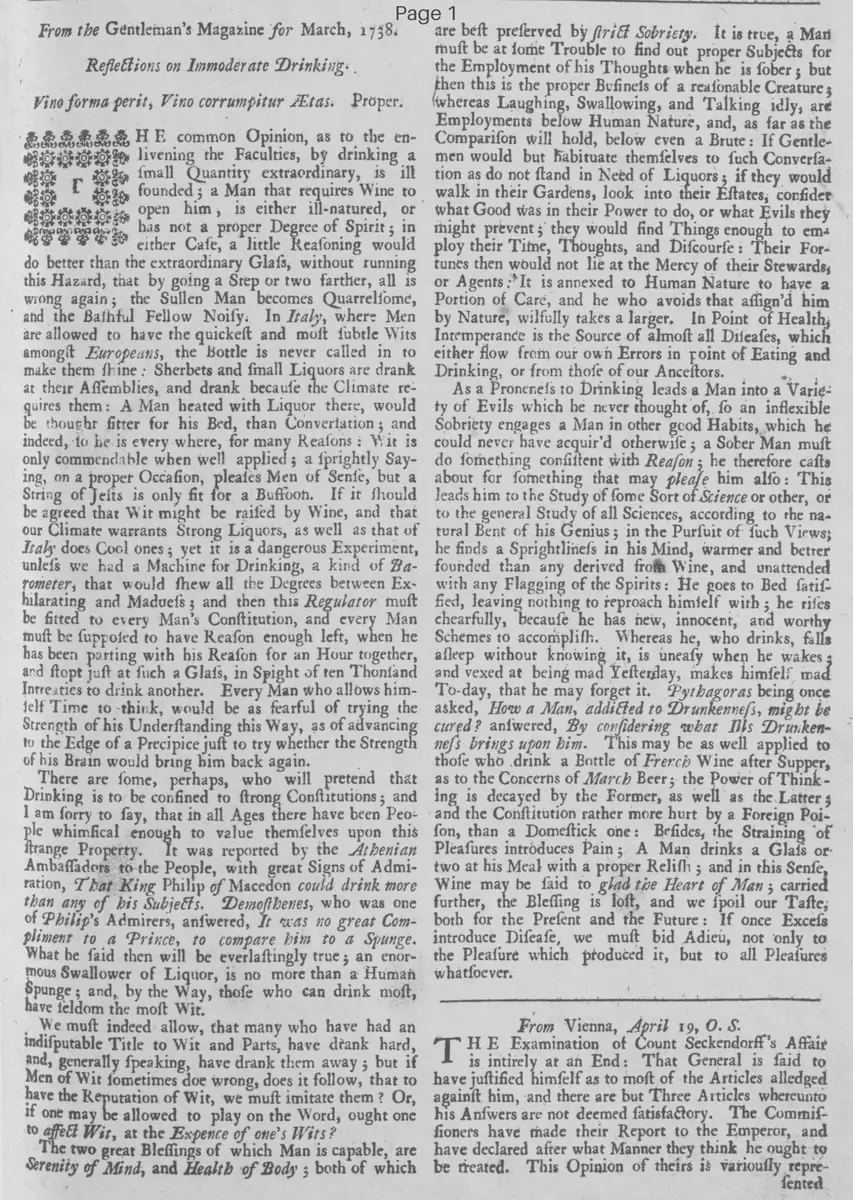
The common Opinion, as to the enlivening the Faculties, by drinking a small Quantity extraordinary, is ill founded; a Man that requires Wine to open him, is either ill-natured, or has not a proper Degree of Spirit; in either Case, a little Reasoning would do better than the extraordinary Glass, without running this Hazard, that by going a Step or two farther, all is wrong again; the Sullen Man becomes Quarrelsome, and the Bashful Fellow Noisy: In Italy, where Men are allowed to have the quickest and most subtle Wits amongst Europeans, the Bottle is never called in to make them shine: Sherbets and small Liquors are drank at their Assemblies, and drank because the Climate requires them: A Man heated with Liquor there, would be thought fitter for his Bed, than Conversation; and indeed, so he is every where, for many Reasons: Wit is only commendable when well applied; a sprightly Saying, on a proper Occasion, pleases Men of Sense, but a String of Jests is only fit for a Buffoon. If it should be agreed that Wit might be raised by Wine, and that our Climate warrants Strong Liquors, as well as that of Italy does Cool ones; yet it is a dangerous Experiment, unless we had a Machine for Drinking, a kind of Barometer, that would show all the Degrees between Exhilarating and Madness; and then this Regulator must be fitted to every Man's Constitution, and every Man must be supposed to have Reason enough left, when he has been parting with his Reason for an Hour together, and stopt just at such a Glass, in Spight of ten Thousand Intreaties to drink another. Every Man who allows himself Time to think, would be as fearful of trying the Strength of his Understanding this Way, as of advancing to the Edge of a Precipice just to try whether the Strength of his Brain would bring him back again.
There are some, perhaps, who will pretend that Drinking is to be confined to strong Constitutions; and I am sorry to say, that in all Ages there have been People whimsical enough to value themselves upon this strange Property. It was reported by the Athenian Ambassadors to the People, with great Signs of Admiration, That King Philip of Macedon could drink more than any of his Subjects. Demosthenes, who was one of Philip's Admirers, answered, It was no great Compliment to a Prince, to compare him to a Spunge.
What he said then will be everlastingly true; an enormous Swallower of Liquor, is no more than a Human Spunge; and, by the Way, those who can drink most, have seldom the most Wit.
We must indeed allow, that many who have had an indisputable Title to Wit and Parts, have drank hard, and, generally speaking, have drank them away; but if Men of Wit sometimes do wrong, does it follow, that to have the Reputation of Wit, we must imitate them? Or, if one may be allowed to play on the Word, ought one to affect Wit, at the Expence of one's Wits?
The two great Blessings of which Man is capable, are Serenity of Mind, and Health of Body; both of which are best preserved by strict Sobriety. It is true, a Man must be at some Trouble to find out proper Subjects for the Employment of his Thoughts when he is sober; but then this is the proper Business of a reasonable Creature; whereas Laughing, Swallowing, and Talking idly, are Employments below Human Nature, and, as far as the Comparison will hold, below even a Brute: If Gentlemen would but habituate themselves to such Conversation as do not stand in Need of Liquors; if they would walk in their Gardens, look into their Estates, consider what Good was in their Power to do, or what Evils they might prevent; they would find Things enough to employ their Time, Thoughts, and Discourse: Their Fortunes then would not lie at the Mercy of their Stewards or Agents: It is annexed to Human Nature to have a Portion of Care, and he who avoids that assign'd him by Nature, wilfully takes a larger. In Point of Health Intemperance is the Source of almost all Diseases, which either flow from our own Errors in point of Eating and Drinking, or from those of our Ancestors.
As a Proneness to Drinking leads a Man into a Variety of Evils which he never thought of, so an inflexible Sobriety engages a Man in other good Habits, which he could never have acquir'd otherwise; a Sober Man must do something consistent with Reason; he therefore casts about for something that may please him also: This leads him to the Study of some Sort of Science or other, or to the general Study of all Sciences, according to the natural Bent of his Genius; in the Pursuit of such Views; he finds a Sprightliness in his Mind, warmer and better founded than any derived from Wine, and unattended with any Flagging of the Spirits: He goes to Bed satisfied, leaving nothing to reproach himself with; he rises cheerfully, because he has new, innocent, and worthy Schemes to accomplish. Whereas he, who drinks, falls asleep without knowing it, is uneasy when he wakes; and vexed at being mad Yesterday, makes himself mad To-day, that he may forget it. Pythagoras being once asked, How a Man, addicted to Drunkenness, might be cured? answered, By considering what Ills Drunkenness brings upon him. This may be as well applied to those who drink a Bottle of French Wine after Supper, as to the Concerns of March Beer; the Power of Thinking is decayed by the Former, as well as the Latter and the Constitution rather more hurt by a Foreign Poison, than a Domestick one: Besides, the Straining of Pleasures introduces Pain; A Man drinks a Glass or two at his Meal with a proper Relish; and in this Sense, Wine may be said to glad the Heart of Man; carried further, the Blessing is lost, and we spoil our Taste, both for the Present and the Future: If once Excess introduce Disease, we must bid Adieu, not only to the Pleasure which produced it, but to all Pleasures whatsoever.
Reflections on Immoderate Drinking:
Vino forma perit, Vino corrumpitur aetas. Proper.
The common Opinion, as to the enlivening the Faculties, by drinking a small Quantity extraordinary, is ill founded; a Man that requires Wine to open him, is either ill-natured, or has not a proper Degree of Spirit; in either Case, a little Reasoning would do better than the extraordinary Glass, without running this Hazard, that by going a Step or two farther, all is wrong again; the Sullen Man becomes Quarrelsome, and the Bashful Fellow Noisy: In Italy, where Men are allowed to have the quickest and most subtle Wits amongst Europeans, the Bottle is never called in to make them shine: Sherbets and small Liquors are drank at their Assemblies, and drank because the Climate requires them: A Man heated with Liquor there, would be thought fitter for his Bed, than Conversation; and indeed, so he is every where, for many Reasons: Wit is only commendable when well applied; a sprightly Saying, on a proper Occasion, pleases Men of Sense, but a String of Jests is only fit for a Buffoon. If it should be agreed that Wit might be raised by Wine, and that our Climate warrants Strong Liquors, as well as that of Italy does Cool ones; yet it is a dangerous Experiment, unless we had a Machine for Drinking, a kind of Barometer, that would show all the Degrees between Exhilarating and Madness; and then this Regulator must be fitted to every Man's Constitution, and every Man must be supposed to have Reason enough left, when he has been parting with his Reason for an Hour together, and stopt just at such a Glass, in Spight of ten Thousand Intreaties to drink another. Every Man who allows himself Time to think, would be as fearful of trying the Strength of his Understanding this Way, as of advancing to the Edge of a Precipice just to try whether the Strength of his Brain would bring him back again.
There are some, perhaps, who will pretend that Drinking is to be confined to strong Constitutions; and I am sorry to say, that in all Ages there have been People whimsical enough to value themselves upon this strange Property. It was reported by the Athenian Ambassadors to the People, with great Signs of Admiration, That King Philip of Macedon could drink more than any of his Subjects. Demosthenes, who was one of Philip's Admirers, answered, It was no great Compliment to a Prince, to compare him to a Spunge.
What he said then will be everlastingly true; an enormous Swallower of Liquor, is no more than a Human Spunge; and, by the Way, those who can drink most, have seldom the most Wit.
We must indeed allow, that many who have had an indisputable Title to Wit and Parts, have drank hard, and, generally speaking, have drank them away; but if Men of Wit sometimes do wrong, does it follow, that to have the Reputation of Wit, we must imitate them? Or, if one may be allowed to play on the Word, ought one to affect Wit, at the Expence of one's Wits?
The two great Blessings of which Man is capable, are Serenity of Mind, and Health of Body; both of which are best preserved by strict Sobriety. It is true, a Man must be at some Trouble to find out proper Subjects for the Employment of his Thoughts when he is sober; but then this is the proper Business of a reasonable Creature; whereas Laughing, Swallowing, and Talking idly, are Employments below Human Nature, and, as far as the Comparison will hold, below even a Brute: If Gentlemen would but habituate themselves to such Conversation as do not stand in Need of Liquors; if they would walk in their Gardens, look into their Estates, consider what Good was in their Power to do, or what Evils they might prevent; they would find Things enough to employ their Time, Thoughts, and Discourse: Their Fortunes then would not lie at the Mercy of their Stewards or Agents: It is annexed to Human Nature to have a Portion of Care, and he who avoids that assign'd him by Nature, wilfully takes a larger. In Point of Health Intemperance is the Source of almost all Diseases, which either flow from our own Errors in point of Eating and Drinking, or from those of our Ancestors.
As a Proneness to Drinking leads a Man into a Variety of Evils which he never thought of, so an inflexible Sobriety engages a Man in other good Habits, which he could never have acquir'd otherwise; a Sober Man must do something consistent with Reason; he therefore casts about for something that may please him also: This leads him to the Study of some Sort of Science or other, or to the general Study of all Sciences, according to the natural Bent of his Genius; in the Pursuit of such Views; he finds a Sprightliness in his Mind, warmer and better founded than any derived from Wine, and unattended with any Flagging of the Spirits: He goes to Bed satisfied, leaving nothing to reproach himself with; he rises cheerfully, because he has new, innocent, and worthy Schemes to accomplish. Whereas he, who drinks, falls asleep without knowing it, is uneasy when he wakes; and vexed at being mad Yesterday, makes himself mad To-day, that he may forget it. Pythagoras being once asked, How a Man, addicted to Drunkenness, might be cured? answered, By considering what Ills Drunkenness brings upon him. This may be as well applied to those who drink a Bottle of French Wine after Supper, as to the Concerns of March Beer; the Power of Thinking is decayed by the Former, as well as the Latter and the Constitution rather more hurt by a Foreign Poison, than a Domestick one: Besides, the Straining of Pleasures introduces Pain; A Man drinks a Glass or two at his Meal with a proper Relish; and in this Sense, Wine may be said to glad the Heart of Man; carried further, the Blessing is lost, and we spoil our Taste, both for the Present and the Future: If once Excess introduce Disease, we must bid Adieu, not only to the Pleasure which produced it, but to all Pleasures whatsoever.
What sub-type of article is it?
Essay
What themes does it cover?
Temperance
Moral Virtue
What keywords are associated?
Immoderate Drinking
Sobriety
Temperance
Wit
Health
Intemperance
Moral Reflection
Classical Anecdote
Literary Details
Title
Reflections On Immoderate Drinking
Subject
On Immoderate Drinking And The Benefits Of Sobriety
Key Lines
Vino Forma Perit, Vino Corrumpitur Aetas. Proper.
Wit Is Only Commendable When Well Applied; A Sprightly Saying, On A Proper Occasion, Pleases Men Of Sense, But A String Of Jests Is Only Fit For A Buffoon.
The Two Great Blessings Of Which Man Is Capable, Are Serenity Of Mind, And Health Of Body; Both Of Which Are Best Preserved By Strict Sobriety.
An Enormous Swallower Of Liquor, Is No More Than A Human Spunge; And, By The Way, Those Who Can Drink Most, Have Seldom The Most Wit.
Pythagoras Being Once Asked, How A Man, Addicted To Drunkenness, Might Be Cured? Answered, By Considering What Ills Drunkenness Brings Upon Him.