Thank you for visiting SNEWPapers!
Sign up free
Editorial
September 6, 1805
Norfolk Gazette And Publick Ledger
Norfolk, Virginia
What is this article about?
This editorial republishes a response from the Evening Post critiquing the Spanish ambassador's defense against US claims for spoliations on American commerce by French privateers in Spanish ports. It argues Spain, as neutral, bears responsibility for violations in its jurisdiction, unaffected by the US-France peace convention.
Clipping
OCR Quality
98%
Excellent
Full Text
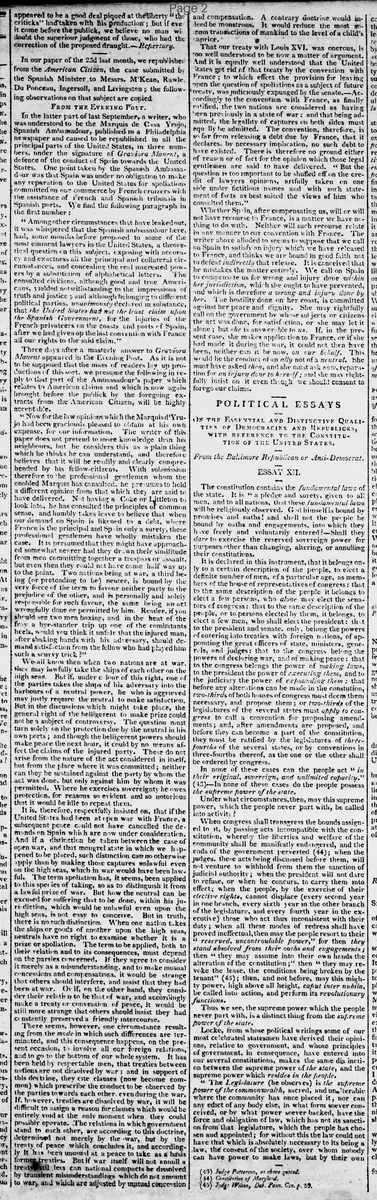
In our paper of the 23d last month, we republished from the American Citizen, the case submitted by the Spanish Minister to Messrs. M'Kean, Rawle, Du Ponceau, Ingersoll, and Livingston; the following observations on that subject are copied from the Evening Post.
In the latter part of last September— a writer, who was understood to be the Marquis de Casa Yrujo, Spanish Ambassadour, published in a Philadelphia newspaper and caused to be republished in all the principal parts of the United States, in three numbers, under the signature of Graviora Manent, a defence of the conduct of Spain towards the United States. One point taken by the Spanish Ambassadour was that Spain was under no obligation to make any reparation to the United States for spoliations committed on our commerce by French cruizers with the assistance of French and Spanish tribunais in Spanish ports. We find the following paragraph in the first number:
"Among other circumstances that have leaked out, it was whispered that the Spanish ambassadour here, had, some months before proposed to some of the most eminent lawyers in the United States, a theoretical question on this subject, exposing with accuracy and exactness all the principal and collateral circumstances, and concealing the real interested powers by a substitution of alphabetical letters. The consulted civilians, although good and true Americans, yielded notwithstanding to the impressions of truth and justice; and although belonging to different political parties, unanimously declared in substance, that the United States had not the least claim upon the Spanish Government for the injuries of the French privateers on the coasts and ports of Spain, after we had given up the last convention with France all our rights to the said claim."
Three days after a masterly answer to Graviora Manent appeared in the Evening Post. As it is not to be supposed that the mass of readers lay up productions of this sort, we presume the following in reply to that part of the Ambassadour's paper which relates to American claims and which is now again brought before the publick by the foregoing extracts from the American Citizen, will be highly acceptable.
"Now for the law opinions which the Marquis d'Yrujo had been graciously pleased to obtain at his own expense, for our information. The writer of this paper does not pretend to more knowledge than his neighbours, but he considers this as a plain thing which he thinks he can understand, and therefore believes that it will be readily and clearly comprehended by his fellow-citizens. With submission therefore to the professional gentlemen whom the enobled Marquis has consulted, he presumes to hold a different opinion from that which they are said to have delivered. Not having a Coke or Littleton to look into, he has consulted the principles of common sense, and humbly takes leave to believe that when our demand on Spain is likened to a debt, where France is the principal and Spain only a surety, these professional gentlemen have wholly mistaken the case. It is presumed that they might have approached somewhat nearer had they drawn their similitude from men committing together a trespass or assault, but even then they could not have come half way up to the point. Two nations being at war, a third being (or pretending to be) neuter, is bound by the very force of the term to favour neither party to the prejudice of the other, and is personally and solely responsible for such favour, the same being an act wrongfully done or permitted by him. Reader, if you should see two men boxing, and in the heat of the fray a bye-stander trip up one of the combatants heels, would you think it unfair that the injured man, after shaking hands with his adversary, should demand satisfaction from the fellow who had played him such a scurvy trick?"
We all know then when two nations are at war, they may lawfully take the ships of each other on the high seas. But if, under colour of this right, one of the parties takes the ships of his adversary into the harbours of a neutral power, he who is aggrieved may justly require the neutral to make satisfaction. But in the discussions which might take place, the general right of the belligerent to make prize could not be a subject of controversy. The question must turn solely on the protection due by the neutral in his own ports; and though the belligerent powers should make peace the next hour, it could by no means affect the claims of the injured party. These do not arise from the nature of the act considered in itself, but from the place where it was committed: neither can they be sustained against the party by whom the act was done, but only against him by whom it was permitted. Where he exercises sovereignty he owes protection, for reasons so evident and so notorious that it would be idle to repeat them.
It is, therefore, respectfully insisted on, that if the United States had been at open war with France, a subsequent peace could not have cancelled the demands on Spain which are now under consideration. And if a distinction be taken between the case of open war, and that mongrel state in which we happened to be placed, such distinction can no otherwise apply than by making those captures unlawful even on the high seas, which in war would have been lawful. The term spoliation has, it seems, been applied to this species of taking, so as to distinguish it from a lawful prize of war. "But how the neutral can be excused for suffering that to be done, within his jurisdiction, which would be unlawful even upon the high seas, is not easy to conceive. But in truth, there is no such distinction. When one nation takes the ships or goods of another upon the high seas, neutrals have no right to examine whether it is a prize or spoliation. The term to be applied, both to their relation and to its consequences, must depend on the parties concerned. If they agree to consider it merely as a misunderstanding, and to make mutual concessions and compensations, it would be strange that others should interfere, and insist that they had been at war. Or if, on the other hand, they consider their relation to be that of war, and accordingly make a treaty or convention of peace, it would be still more strange that others should insist they had constantly preserved a friendly intercourse.
There seems, however, one circumstance resulting from the mode in which such differences are terminated, and this consequence happens, on the present occasion, to involve all our foreign relations, and to go to the bottom of our whole system. It has been held by respectable men, that treaties between nations are not dissolved by war: and in support of this doctrine, they cite clauses (now become common) which prescribe the conduct to be observed by the parties towards each other, even during the war. If, however, treaties are dissolved by war, it will be difficult to assign a reason for clauses which would be entirely void at the only moment when they could possibly operate. The relations in which governments stand to each other, are according to this doctrine, determined not merely by the war, but by the treaty of peace which concludes it, and accordingly it has been unusual at a peace to take as a basis former treaties. But if war itself will not annul a treaty still less can national compacts be dissolved by transient misunderstandings which do not amount to war, and which are adjusted by mutual concession and compensation. A contrary doctrine would indeed be monstrous. It would reduce the most solemn transactions of mankind to the level of a child's a price.
That our treaty with Louis XVI. was onerous, is too well understood to be now a matter of argument. And it is equally well understood that the United States got rid of that treaty by the convention with France; to which effect the provision for leaving open the question of spoliations as a subject of future treaty, was judiciously expunged by the senate.—Accordingly to the convention with France, as finally ratified, the two nations are considered as having been previously in a state of war: and that being admitted, the legality of captures on both sides must equally be admitted. The convention, therefore, is so far from releasing a debt due by France, that it declares, by necessary implication, no such debt to have existed. There is therefore no ground either of reason or of fact for the opinion which those legal gentlemen are said to have delivered." But the question is too important to be shuffled off on the credit of lawyers opinions, artfully taken on one side under fictitious names and with such statement of facts as best suited the views of him who consulted them.
Whether Spain, after compensating us, will or will not have recourse to France, is a matter we have nothing to do with. Neither will such recourse relate in any manner to our convention with France. The writer above alluded to seems to suppose that we call on Spain to satisfy an injury which we have released to France, and thinks we are bound in good faith not to defeat indirectly that release. It is conceived that he mistakes the matter entirely. We call on Spain to compensate us for wrong and injury done within her jurisdiction, which she ought to have prevented, and which is therefore a wrong and injury done by her. The hostility done on her coast, is committed against her peace and dignity. She may rightfully call on the government by whose subjects or citizens the act was done, for satisfaction, or she may let it alone: but she is answerable to us. If, in the present case, she makes application to France, or if she had made it during the war, it could not then have been, neither can it be now, on our behalf. This would be the conduct of an ally not of a neutral. She must have asked then, and she must ask now, reparation for an injury done to herself; and she may rightfully insist on it even though we should consent to forego our claims.
In the latter part of last September— a writer, who was understood to be the Marquis de Casa Yrujo, Spanish Ambassadour, published in a Philadelphia newspaper and caused to be republished in all the principal parts of the United States, in three numbers, under the signature of Graviora Manent, a defence of the conduct of Spain towards the United States. One point taken by the Spanish Ambassadour was that Spain was under no obligation to make any reparation to the United States for spoliations committed on our commerce by French cruizers with the assistance of French and Spanish tribunais in Spanish ports. We find the following paragraph in the first number:
"Among other circumstances that have leaked out, it was whispered that the Spanish ambassadour here, had, some months before proposed to some of the most eminent lawyers in the United States, a theoretical question on this subject, exposing with accuracy and exactness all the principal and collateral circumstances, and concealing the real interested powers by a substitution of alphabetical letters. The consulted civilians, although good and true Americans, yielded notwithstanding to the impressions of truth and justice; and although belonging to different political parties, unanimously declared in substance, that the United States had not the least claim upon the Spanish Government for the injuries of the French privateers on the coasts and ports of Spain, after we had given up the last convention with France all our rights to the said claim."
Three days after a masterly answer to Graviora Manent appeared in the Evening Post. As it is not to be supposed that the mass of readers lay up productions of this sort, we presume the following in reply to that part of the Ambassadour's paper which relates to American claims and which is now again brought before the publick by the foregoing extracts from the American Citizen, will be highly acceptable.
"Now for the law opinions which the Marquis d'Yrujo had been graciously pleased to obtain at his own expense, for our information. The writer of this paper does not pretend to more knowledge than his neighbours, but he considers this as a plain thing which he thinks he can understand, and therefore believes that it will be readily and clearly comprehended by his fellow-citizens. With submission therefore to the professional gentlemen whom the enobled Marquis has consulted, he presumes to hold a different opinion from that which they are said to have delivered. Not having a Coke or Littleton to look into, he has consulted the principles of common sense, and humbly takes leave to believe that when our demand on Spain is likened to a debt, where France is the principal and Spain only a surety, these professional gentlemen have wholly mistaken the case. It is presumed that they might have approached somewhat nearer had they drawn their similitude from men committing together a trespass or assault, but even then they could not have come half way up to the point. Two nations being at war, a third being (or pretending to be) neuter, is bound by the very force of the term to favour neither party to the prejudice of the other, and is personally and solely responsible for such favour, the same being an act wrongfully done or permitted by him. Reader, if you should see two men boxing, and in the heat of the fray a bye-stander trip up one of the combatants heels, would you think it unfair that the injured man, after shaking hands with his adversary, should demand satisfaction from the fellow who had played him such a scurvy trick?"
We all know then when two nations are at war, they may lawfully take the ships of each other on the high seas. But if, under colour of this right, one of the parties takes the ships of his adversary into the harbours of a neutral power, he who is aggrieved may justly require the neutral to make satisfaction. But in the discussions which might take place, the general right of the belligerent to make prize could not be a subject of controversy. The question must turn solely on the protection due by the neutral in his own ports; and though the belligerent powers should make peace the next hour, it could by no means affect the claims of the injured party. These do not arise from the nature of the act considered in itself, but from the place where it was committed: neither can they be sustained against the party by whom the act was done, but only against him by whom it was permitted. Where he exercises sovereignty he owes protection, for reasons so evident and so notorious that it would be idle to repeat them.
It is, therefore, respectfully insisted on, that if the United States had been at open war with France, a subsequent peace could not have cancelled the demands on Spain which are now under consideration. And if a distinction be taken between the case of open war, and that mongrel state in which we happened to be placed, such distinction can no otherwise apply than by making those captures unlawful even on the high seas, which in war would have been lawful. The term spoliation has, it seems, been applied to this species of taking, so as to distinguish it from a lawful prize of war. "But how the neutral can be excused for suffering that to be done, within his jurisdiction, which would be unlawful even upon the high seas, is not easy to conceive. But in truth, there is no such distinction. When one nation takes the ships or goods of another upon the high seas, neutrals have no right to examine whether it is a prize or spoliation. The term to be applied, both to their relation and to its consequences, must depend on the parties concerned. If they agree to consider it merely as a misunderstanding, and to make mutual concessions and compensations, it would be strange that others should interfere, and insist that they had been at war. Or if, on the other hand, they consider their relation to be that of war, and accordingly make a treaty or convention of peace, it would be still more strange that others should insist they had constantly preserved a friendly intercourse.
There seems, however, one circumstance resulting from the mode in which such differences are terminated, and this consequence happens, on the present occasion, to involve all our foreign relations, and to go to the bottom of our whole system. It has been held by respectable men, that treaties between nations are not dissolved by war: and in support of this doctrine, they cite clauses (now become common) which prescribe the conduct to be observed by the parties towards each other, even during the war. If, however, treaties are dissolved by war, it will be difficult to assign a reason for clauses which would be entirely void at the only moment when they could possibly operate. The relations in which governments stand to each other, are according to this doctrine, determined not merely by the war, but by the treaty of peace which concludes it, and accordingly it has been unusual at a peace to take as a basis former treaties. But if war itself will not annul a treaty still less can national compacts be dissolved by transient misunderstandings which do not amount to war, and which are adjusted by mutual concession and compensation. A contrary doctrine would indeed be monstrous. It would reduce the most solemn transactions of mankind to the level of a child's a price.
That our treaty with Louis XVI. was onerous, is too well understood to be now a matter of argument. And it is equally well understood that the United States got rid of that treaty by the convention with France; to which effect the provision for leaving open the question of spoliations as a subject of future treaty, was judiciously expunged by the senate.—Accordingly to the convention with France, as finally ratified, the two nations are considered as having been previously in a state of war: and that being admitted, the legality of captures on both sides must equally be admitted. The convention, therefore, is so far from releasing a debt due by France, that it declares, by necessary implication, no such debt to have existed. There is therefore no ground either of reason or of fact for the opinion which those legal gentlemen are said to have delivered." But the question is too important to be shuffled off on the credit of lawyers opinions, artfully taken on one side under fictitious names and with such statement of facts as best suited the views of him who consulted them.
Whether Spain, after compensating us, will or will not have recourse to France, is a matter we have nothing to do with. Neither will such recourse relate in any manner to our convention with France. The writer above alluded to seems to suppose that we call on Spain to satisfy an injury which we have released to France, and thinks we are bound in good faith not to defeat indirectly that release. It is conceived that he mistakes the matter entirely. We call on Spain to compensate us for wrong and injury done within her jurisdiction, which she ought to have prevented, and which is therefore a wrong and injury done by her. The hostility done on her coast, is committed against her peace and dignity. She may rightfully call on the government by whose subjects or citizens the act was done, for satisfaction, or she may let it alone: but she is answerable to us. If, in the present case, she makes application to France, or if she had made it during the war, it could not then have been, neither can it be now, on our behalf. This would be the conduct of an ally not of a neutral. She must have asked then, and she must ask now, reparation for an injury done to herself; and she may rightfully insist on it even though we should consent to forego our claims.
What sub-type of article is it?
Foreign Affairs
Legal Reform
What keywords are associated?
Spanish Spoliations
French Privateers
Neutral Responsibility
Us Claims
International Law
Treaty Obligations
Quasi War France
What entities or persons were involved?
Marquis De Casa Yrujo
M'kean
Rawle
Du Ponceau
Ingersoll
Livingston
Spain
France
United States
Editorial Details
Primary Topic
Us Claims Against Spain For Spoliations By French Privateers In Spanish Ports
Stance / Tone
Defense Of Us Claims And Critique Of Spanish Position
Key Figures
Marquis De Casa Yrujo
M'kean
Rawle
Du Ponceau
Ingersoll
Livingston
Spain
France
United States
Key Arguments
Spain As Neutral Is Responsible For Injuries In Its Ports Regardless Of Us France Relations
Legal Opinions Solicited By Spanish Ambassador Misrepresent The Case
Treaties Are Not Dissolved By War Or Misunderstandings
Us France Convention Does Not Release Spain's Liability
Neutral Powers Owe Protection In Their Jurisdiction