Thank you for visiting SNEWPapers!
Sign up free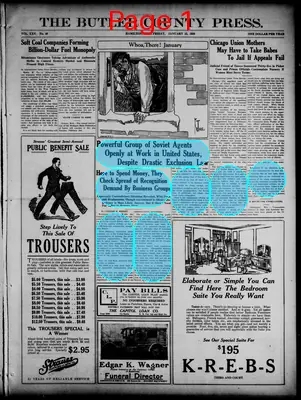
The Butler County Press
Hamilton, Butler County, Ohio
What is this article about?
Article reveals presence of up to 200 Soviet communist agents in the US as Amtorg representatives, spending money on imports despite exclusion laws barring others like Countess Karolyi and Saklatvala. Explains policy as expediency to appease business interests and prevent push for Soviet recognition, urging labor vigilance.
Merged-components note: Continuation of the story about Soviet agents working in the United States, with sequential reading order and adjacent bounding boxes.
Clipping
OCR Quality
Full Text
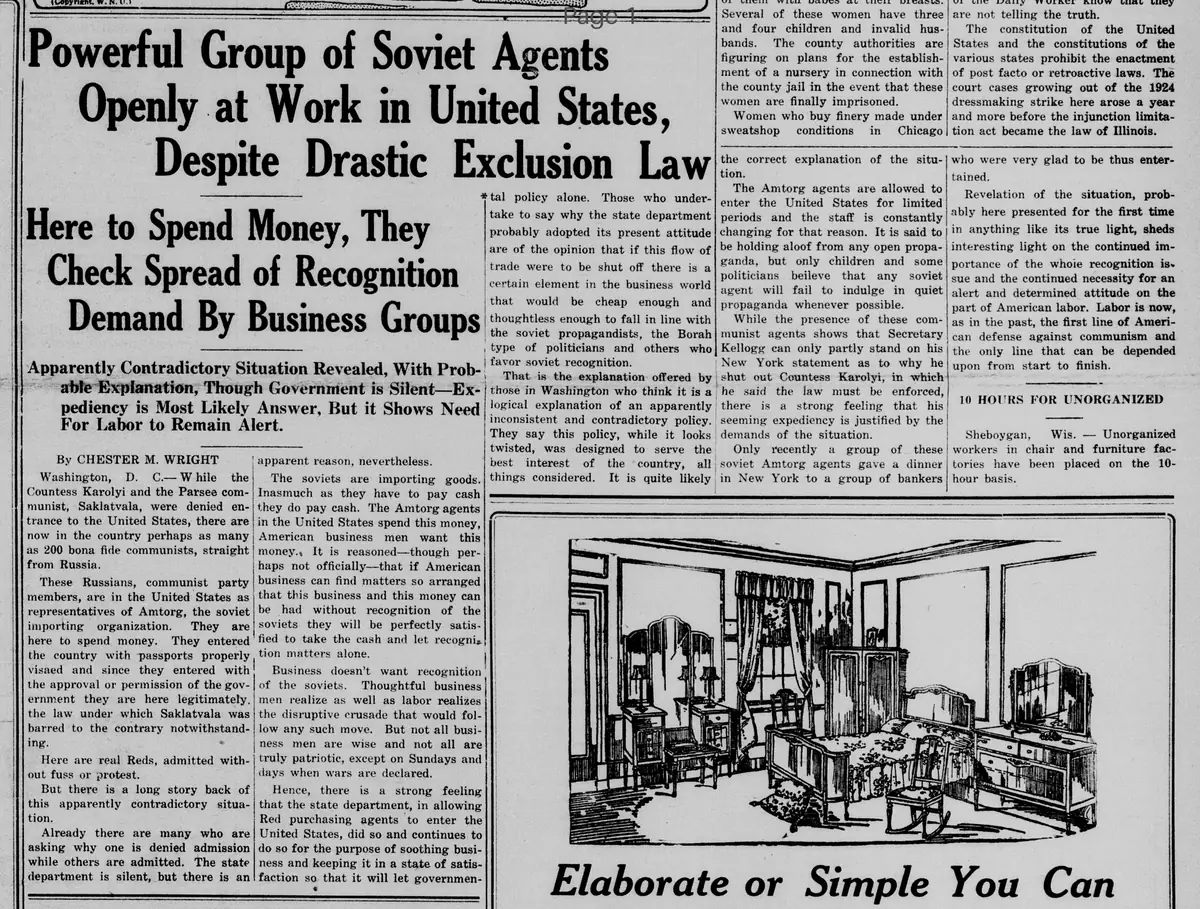
Agents
Openly at Work in United States,
Despite
Drastic Exclusion
Law
Here to Spend Money, They
Check Spread of Recognition
Demand By Business Groups
Apparently Contradictory Situation Revealed, With Prob-
able Explanation. Though Government is Silent--Ex-
pediency is Most Likely Answer, But it Shows Need
For Labor to Remain Alert.
Washington, D. C.- While the
Countess Karolyi and the Parsee com-
munist, Saklatvala, were denied en-
trance to the United States, there are
now in the country perhaps as many
as 200 bona fide communists, straight
from Russia.
These Russians, communist party
members, are in the United States as
representatives of Amtorg, the soviet
importing organization. They are
here to spend money. They entered
the country with passports properly
visaed and since they entered with
the approval or permission of the gov-
ernment they are here legitimately.
the law under which Saklatvala was
barred to the contrary notwithstand-
ing.
Here are real Reds, admitted with-
out fuss or protest.
But there is a long story back of
this apparently contradictory situa-
tion.
Already there are many who are
asking why one is denied admission
while others are admitted. The state
department is silent, but there is an
The soviets are importing goods.
Inasmuch as they have to pay cash
they do pay cash. The Amtorg agents
in the United States spend this money,
American business men want this
money. It is reasoned-though per-
haps not officially--that if American
business can find matters so arranged
that this business and this money can
be had without recognition of the
soviets they will be perfectly satis-
fied to take the cash and let recogni-
tion matters alone.
Business doesn't want recognition
of the soviets. Thoughtful business
men realize as well as labor realizes
the disruptive crusade that would fol-
low any such move. But not all busi-
ness men are wise and not all are
truly patriotic, except on Sundays and
days when wars are declared.
Hence, there is a strong feeling
that the state department, in allowing
Red purchasing agents to enter the
United States, did so and continues to
do so for the purpose of soothing busi-
ness and keeping it in a state of satis-
faction so that it will let governmen-
tal policy alone. Those who under-
take to say why the state department
probably adopted its present attitude
are of the opinion that if this flow of
trade were to be shut off there is a
certain element in the business world
that would be cheap enough and
thoughtless enough to fall in line with
the soviet propagandists. the Borah
type of politicians and others who
favor soviet recognition.
That is the explanation offered by
those in Washington who think it is a
logical explanation of an apparently
inconsistent and contradictory policy.
They say this policy, while it looks
twisted, was designed to serve the
best interest of the country, all
things considered. It is quite likely
The Amtorg agents are allowed to
enter the United States for limited
periods and the staff is constantly
changing for that reason. It is said to
be holding aloof from any open propa-
ganda. but only children and some
politicians believe that any soviet
agent will fail to indulge in quiet
propaganda whenever possible.
While the presence of these com-
munist agents shows that Secretary
Kellogg can only partly stand on his
New York statement as to why he
shut out Countess Karolyi, in which
he said the law must be enforced,
there is a strong feeling that his
seeming expediency is justified by the
demands of the situation.
Only recently a group of these
soviet Amtorg agents gave a dinner
in New York to a group of bankers
who were very glad to be thus enter-
tained.
Revelation of the situation, prob-
ably here presented for the first time
in anything like its true light, sheds
interesting light on the continued im-
portance of the whoie recognition is-
sue and the continued necessity for an
alert and determined attitude on the
part of American labor. Labor is now.
as in the past, the first line of Ameri-
can defense against communism and
the only line that can be depended
upon from start to finish.
What sub-type of article is it?
What keywords are associated?
What entities or persons were involved?
Where did it happen?
Story Details
Key Persons
Location
Washington, D. C., United States, New York
Story Details
Up to 200 Soviet communist agents operate in the US as Amtorg representatives, spending cash on imports despite laws barring others; policy explained as expediency to satisfy business and avoid recognition demands, with labor urged to stay alert against propaganda.