Thank you for visiting SNEWPapers!
Sign up free
Editorial
August 10, 1805
Virginia Argus
Richmond, Virginia
What is this article about?
Editorial from Baltimore Evening Post defends Thomas Jefferson against Federalist calumnies, recounting his composed response to Tarleton's 1781 raid on Charlottesville while governor of Virginia, emphasizing his security measures and the lack of damage to Monticello.
Clipping
OCR Quality
98%
Excellent
Full Text
From the Baltimore Evening Post.
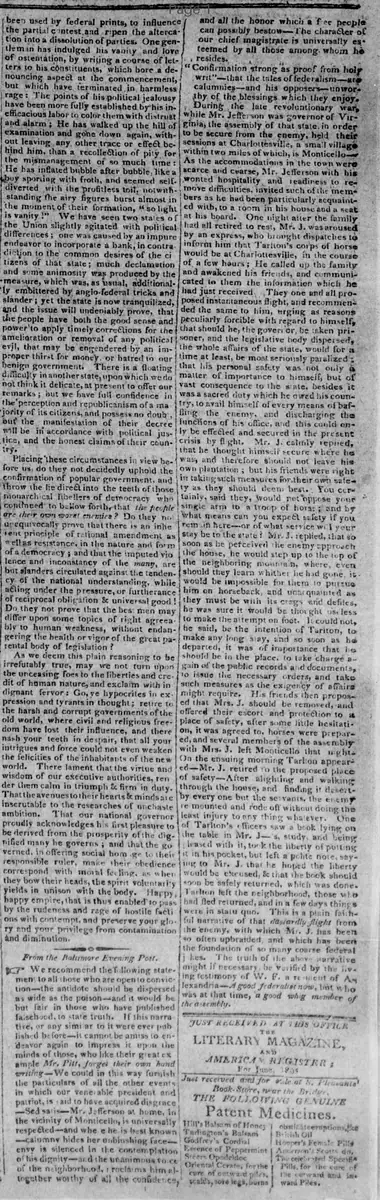
We recommend the following statement to all those who are open to conviction--the antidote should be dispersed as wide as the poison--and it would be but fair in those who have published falsehood, to state truth. If this narrative, or any similar to it were ever published before--it cannot be amiss to endeavor again to impress it upon the minds of those, who like their great example Mr. Pitt, forge their own hand writing--We could in this way furnish the particulars of all the other events in which our venerable president and patriot, is said to have acquired disgrace. Sed satis--Mr. Jefferson at home, in the vicinity of Monticello, is universally respected--and where he is best known--calumny hides her blushing face--envy is silenced in the contemplation of his dignity--and the unanimous voice of the neighborhood, proclaims him altogether worthy of all the confidence, and all the honor which a free people can possibly bestow--The character of our chief magistrate is universally esteemed by all those among whom he resides.
"Confirmation strong as proof from holy writ" that the tales of federalism--are calumnies--and his opposers--unworthy of the blessings which they enjoy.
During the late revolutionary war while Mr. Jefferson was governor of Virginia, the assembly of that state, in order to be secure from the enemy, held their sessions at Charlottesville, a small village within two miles of which, is Monticello--As the accommodations in the town were scarce and coarse, Mr. Jefferson with his wonted hospitality, and readiness to remove difficulties, invited such of the members as he had been particularly acquainted with, to a room in his house and a seat at his board. One night after the family had all retired to rest, Mr. J. was aroused by an express, who brought dispatches to inform him that Tarlton's corps of horse would be at Charlottesville, in the course of a few hours; He called up the family and awakened his friends, and communicated to them the information which he had just received. They one and all proposed instantaneous flight, and recommended the same to him, urging as reasons peculiarly forcible with regard to himself, that should he, the governor, be taken prisoner, and the legislative body dispersed, the whole affairs of the state, would for a time at least, be most seriously paralyzed; that his personal safety was not only a matter of importance to himself, but of vast consequence to the state, besides it was a sacred duty which he owed his country, to avail himself of every means of baffling the enemy, and discharging the functions of his office, and this could only be effected and secured in the present crisis by flight. Mr. J. calmly replied, that he thought himself secure where he was, and therefore should not leave his own plantation; but his friends were right in taking such measures for their own safety as they should deem best.: You certainly, said they, would not oppose your single arm to a troop of horse; and by what means can you expect safety if you remain here--or of what service will your stay be to the state? Mr- J. replied, that so soon as he perceived the enemy approach the house, he would step up to the top of the neighboring mountain, where, even should they learn whither he had gone, it would be impossible for them to pursue him on horseback, and unacquainted as they must be with its crags and defiles, he was sure it would be thought useless to make the attempt on foot. It could not, he said, be the intention of Tarlton, to make any long stay, and so soon as he departed, it was of importance that he should be in the place, to take charge again of the public records and documents, to issue the necessary orders, and take such measures as the exigency of affairs might require. His friends then proposed that Mrs. J. should be removed,--and offered their escort and protection to a place of safety, after some little hesitation, it was agreed to, horses were prepared, and several members of the assembly with Mrs. J. left Monticello that night--On the ensuing morning Tarlton appeared Mr. J. retired to the proposed place of safety--After alighting and walking through the house, and finding it deserted by every one but the servants. the enemy remounted and rode off without doing the least injury to any thing whatever. One of Tarlton's officers saw a book lying on the table in Mr. J-'s study, and being pleased with it, took the liberty of putting it in his pocket, but left a polite note, saying to Mr. J. that he hoped the liberty would be excused, & that the book should soon be safely returned, which was done. Tarlton left the neighborhood, those who had fled returned, and in a few days things were in statu quo. This is a plain faithful narrative of that dastardly flight from the enemy, with which Mr. J. has been so often upbraided, and which has been the foundation of so many coarse federal jokes. The truth of the above narrative might if necessary, be verified by the living testimony of W. F. a resident of Alexandria--A good federalist now, but who was at that time, a good whig member of the assembly.
We recommend the following statement to all those who are open to conviction--the antidote should be dispersed as wide as the poison--and it would be but fair in those who have published falsehood, to state truth. If this narrative, or any similar to it were ever published before--it cannot be amiss to endeavor again to impress it upon the minds of those, who like their great example Mr. Pitt, forge their own hand writing--We could in this way furnish the particulars of all the other events in which our venerable president and patriot, is said to have acquired disgrace. Sed satis--Mr. Jefferson at home, in the vicinity of Monticello, is universally respected--and where he is best known--calumny hides her blushing face--envy is silenced in the contemplation of his dignity--and the unanimous voice of the neighborhood, proclaims him altogether worthy of all the confidence, and all the honor which a free people can possibly bestow--The character of our chief magistrate is universally esteemed by all those among whom he resides.
"Confirmation strong as proof from holy writ" that the tales of federalism--are calumnies--and his opposers--unworthy of the blessings which they enjoy.
During the late revolutionary war while Mr. Jefferson was governor of Virginia, the assembly of that state, in order to be secure from the enemy, held their sessions at Charlottesville, a small village within two miles of which, is Monticello--As the accommodations in the town were scarce and coarse, Mr. Jefferson with his wonted hospitality, and readiness to remove difficulties, invited such of the members as he had been particularly acquainted with, to a room in his house and a seat at his board. One night after the family had all retired to rest, Mr. J. was aroused by an express, who brought dispatches to inform him that Tarlton's corps of horse would be at Charlottesville, in the course of a few hours; He called up the family and awakened his friends, and communicated to them the information which he had just received. They one and all proposed instantaneous flight, and recommended the same to him, urging as reasons peculiarly forcible with regard to himself, that should he, the governor, be taken prisoner, and the legislative body dispersed, the whole affairs of the state, would for a time at least, be most seriously paralyzed; that his personal safety was not only a matter of importance to himself, but of vast consequence to the state, besides it was a sacred duty which he owed his country, to avail himself of every means of baffling the enemy, and discharging the functions of his office, and this could only be effected and secured in the present crisis by flight. Mr. J. calmly replied, that he thought himself secure where he was, and therefore should not leave his own plantation; but his friends were right in taking such measures for their own safety as they should deem best.: You certainly, said they, would not oppose your single arm to a troop of horse; and by what means can you expect safety if you remain here--or of what service will your stay be to the state? Mr- J. replied, that so soon as he perceived the enemy approach the house, he would step up to the top of the neighboring mountain, where, even should they learn whither he had gone, it would be impossible for them to pursue him on horseback, and unacquainted as they must be with its crags and defiles, he was sure it would be thought useless to make the attempt on foot. It could not, he said, be the intention of Tarlton, to make any long stay, and so soon as he departed, it was of importance that he should be in the place, to take charge again of the public records and documents, to issue the necessary orders, and take such measures as the exigency of affairs might require. His friends then proposed that Mrs. J. should be removed,--and offered their escort and protection to a place of safety, after some little hesitation, it was agreed to, horses were prepared, and several members of the assembly with Mrs. J. left Monticello that night--On the ensuing morning Tarlton appeared Mr. J. retired to the proposed place of safety--After alighting and walking through the house, and finding it deserted by every one but the servants. the enemy remounted and rode off without doing the least injury to any thing whatever. One of Tarlton's officers saw a book lying on the table in Mr. J-'s study, and being pleased with it, took the liberty of putting it in his pocket, but left a polite note, saying to Mr. J. that he hoped the liberty would be excused, & that the book should soon be safely returned, which was done. Tarlton left the neighborhood, those who had fled returned, and in a few days things were in statu quo. This is a plain faithful narrative of that dastardly flight from the enemy, with which Mr. J. has been so often upbraided, and which has been the foundation of so many coarse federal jokes. The truth of the above narrative might if necessary, be verified by the living testimony of W. F. a resident of Alexandria--A good federalist now, but who was at that time, a good whig member of the assembly.
What sub-type of article is it?
Partisan Politics
Moral Or Religious
What keywords are associated?
Jefferson Defense
Tarleton Raid
Monticello
Revolutionary War
Federalist Calumnies
Virginia Governor
Charlottesville
What entities or persons were involved?
Thomas Jefferson
Tarlton
Mr. Pitt
W. F.
Federalists
Editorial Details
Primary Topic
Defense Of Jefferson Against Calumnies Over Tarleton Raid
Stance / Tone
Strongly Pro Jefferson, Refuting Federalist Accusations
Key Figures
Thomas Jefferson
Tarlton
Mr. Pitt
W. F.
Federalists
Key Arguments
Jefferson Hosted Assembly Members At Monticello During War
He Calmly Planned Escape To Mountain Top For Safety While Ensuring Records Protected
Tarleton's Forces Left Without Damage After Brief Visit
Mrs. Jefferson And Members Escorted Away Safely
Narrative Verifies No Cowardice, Book Returned Politely
Jefferson Universally Respected Locally