Thank you for visiting SNEWPapers!
Sign up free
The Weekly Iberian
New Iberia, Iberia County, Louisiana
What is this article about?
Pessimistic Americans can take comfort in comparing US finances to Germany's: US has $250B resources, $50B earnings, $12B debt, and $1B post-war costs, versus Germany's $80B pre-war resources, $30B debt, and $4B annual war burdens, with US holding $2.5B gold.
Clipping
OCR Quality
Full Text
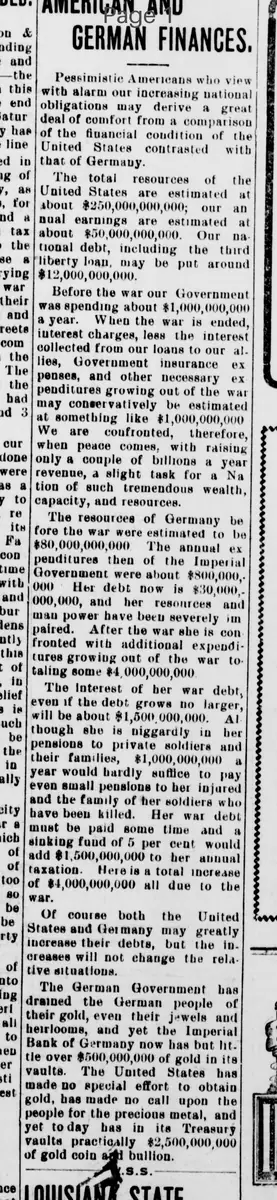
Pessimistic Americans who view with alarm our increasing national obligations may derive a great deal of comfort from a comparison of the financial condition of the United States contrasted with that of Germany.
The total resources of the United States are estimated at about $250,000,000,000; our annual earnings are estimated at about $50,000,000,000. Our national debt, including the third liberty loan, may be put around $12,000,000,000. Before the war our Government was spending about $1,000,000,000 a year. When the war is ended, interest charges, less the interest collected from our loans to our allies, Government insurance expenses, and other necessary expenditures growing out of the war may conservatively be estimated at something like $1,000,000,000. We are confronted, therefore, when peace comes, with raising only a couple of billions a year revenue, a slight task for a Nation of such tremendous wealth, capacity, and resources.
The resources of Germany before the war were estimated to be $80,000,000,000. The annual expenditures then of the Imperial Government were about $500,000,000. Her debt now is $30,000,000,000, and her resources and man power have been severely impaired. After the war she is confronted with additional expenditures growing out of the war totaling some $4,000,000,000. The interest of her war debt, even if the debt grows no larger, will be about $1,500,000,000. Although she is niggardly in her pensions to private soldiers and their families, $1,000,000,000 a year would hardly suffice to pay even small pensions to her injured and the family of her soldiers who have been killed. Her war debt must be paid some time and a sinking fund of 5 per cent would add $1,500,000,000 to her annual taxation. Here is a total increase of $4,000,000,000 all due to the war.
Of course both the United States and Germany may greatly increase their debts, but the increases will not change the relative situations.
The German Government has drained the German people of their gold, even their jewels and heirloom, and yet the Imperial Bank of Germany now has but little over $500,000,000 of gold in its vaults. The United States has made no special effort to obtain gold, has made no call upon the people for the precious metal, and yet today has in its Treasury vaults practically $2,500,000,000 of gold coin and bullion.
.s.s.
What sub-type of article is it?
What themes does it cover?
What keywords are associated?
Where did it happen?
Story Details
Location
United States And Germany
Event Date
World War I Era
Story Details
The article compares the financial conditions of the United States and Germany, noting the US's vast resources ($250B), annual earnings ($50B), and manageable debt ($12B) with post-war expenditures around $1B, contrasting with Germany's pre-war resources ($80B), current debt ($30B), and projected annual war-related costs of $4B, emphasizing the US's superior position and gold reserves.