Thank you for visiting SNEWPapers!
Sign up free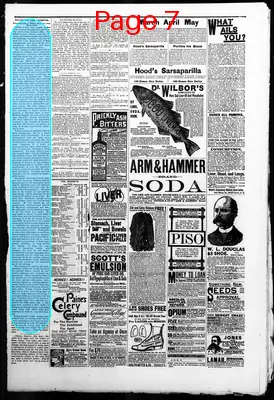
Story
March 3, 1888
St. Landry Democrat
Opelousas, Saint Landry County, Louisiana
What is this article about?
An essay analogizing railroad operations to farming, highlighting shared risks of neglect leading to decay and loss, and advocating constant vigilance, maintenance, and adoption of modern tools for success in agriculture.
Clipping

OCR Quality
98%
Excellent
Full Text
RAILROADS AND FARMING
Some Respects in Which They Are Very Much Alike.
Unlike as they may appear at first view, railroad management and farming are in some respects alike. The former is more distinct, bold and obvious, and requires heavy expenditure. Its teachings, therefore, may well extend into some departments of farm management, and prove all the more instructive. Its defects and drawbacks present their instruction.
The question is often asked why accidents on railways are so much more frequent than formerly, and why human life has of late years been more abundantly sacrificed than many years ago. There are three reasons: The first and greatest is that they have rapidly increased in length and business. The present 140,000 miles give six thousand times greater length than in 1830, and even as late as 1840 there was only about one-fortieth as much as at the present time. There are now ten thousand trains running every day, and among the great multitude which pass safely over them year in and year out, the scattered accidents are published in all the papers.
The second reason of the many disasters is natural decay. A large part of the railways some years ago were new and strong and never gave out; at the present time the bridges and other structures are beginning to rot, often unseen till a destructive accident occurs. The third reason is a gradually increasing carelessness in men who have a certain service to perform a thousand times a year. Nothing happens for some years, and they naturally become inattentive.
All these influences are continually working in the creation of disaster, and they will continue to operate so long as human imperfection continues to exist.
Various points of similarity exist in farm management, but on a much smaller scale individually. It is not accompanied with the same occasional destruction of human life, but its victims in a smaller way are much more numerous. It is liable to great pecuniary losses under neglect, and to numerous discomforts from inattention. The farm, which is once put in good order, with fine buildings and excellent fences, will fall into decay unless watched and kept in repair; perennial weeds will make destructive progress if allowed to run; fertility will gradually pass to sterility under carelessness; as with the neglected railway, continued disasters of many kinds will follow. Constant care and vigilance will be required to accomplish success.
The farmer who keeps even in progress with the many improvements in farm machinery, will accomplish more than by adhering to old and awkward tools, avoiding at the same time the loss for useless expenditure. He must save in his outlays for new and untried things, and he must save by the economy of raising heavy crops. He must have machinery enough to do work cheaply, and to do it in the best manner. He will discard the old square-tooth, three-cornered harrow for the newer, spring-tooth and disc. He will prefer a twine-binding reaper to the old sickle and cradle. He may prefer to secure his corn fodder while fresh and uninjured in a silo, to allowing it to rot by storms in the open field; he may choose the various advantages of horse-power appliances; or windmills for pumping, or barb-wire fencing, and sheltering buildings for his domestic animals. If the farmer who is not wide awake to avail himself of substantial and wise improvements, will keep a record of all his delays and disasters from old or worn-out tools and machines, or from unrepaired buildings, or from defective fences, or from the neglect of spreading weeds, and estimate the loss, he will doubtless discover a greater aggregate than he expected; and the whole loss thus sustained by the five million farmers of the United States would doubtless exceed the pecuniary loss sustained by all the railways.
The leading and guiding principle, therefore, which he should lay down for constant action, should be continued vigilance and continued improvement. There was much truth in the remark of a wise philosopher, that we have greater enjoyment, while actively engaged in making improvements, than in setting down when they are completed and looking at what we have done. Young farmers should bear this in mind, and acting upon it will soon make vigilance and energy a continued habit, in which there will be more happiness than in idle pastimes.
One great reason why some men succeed in life while others fail, is that they have acquired a fixed habit of doing every thing promptly, and doing every thing well, while others procrastinate or work in a slip-shod manner.
Young farmers might occupy some of their time in laying plans for an active campaign in farm improvement, and in keeping up with the best work for the season, acting with wisdom and avoiding what might be classed with mere chimeras. - Country Gentleman.
Some Respects in Which They Are Very Much Alike.
Unlike as they may appear at first view, railroad management and farming are in some respects alike. The former is more distinct, bold and obvious, and requires heavy expenditure. Its teachings, therefore, may well extend into some departments of farm management, and prove all the more instructive. Its defects and drawbacks present their instruction.
The question is often asked why accidents on railways are so much more frequent than formerly, and why human life has of late years been more abundantly sacrificed than many years ago. There are three reasons: The first and greatest is that they have rapidly increased in length and business. The present 140,000 miles give six thousand times greater length than in 1830, and even as late as 1840 there was only about one-fortieth as much as at the present time. There are now ten thousand trains running every day, and among the great multitude which pass safely over them year in and year out, the scattered accidents are published in all the papers.
The second reason of the many disasters is natural decay. A large part of the railways some years ago were new and strong and never gave out; at the present time the bridges and other structures are beginning to rot, often unseen till a destructive accident occurs. The third reason is a gradually increasing carelessness in men who have a certain service to perform a thousand times a year. Nothing happens for some years, and they naturally become inattentive.
All these influences are continually working in the creation of disaster, and they will continue to operate so long as human imperfection continues to exist.
Various points of similarity exist in farm management, but on a much smaller scale individually. It is not accompanied with the same occasional destruction of human life, but its victims in a smaller way are much more numerous. It is liable to great pecuniary losses under neglect, and to numerous discomforts from inattention. The farm, which is once put in good order, with fine buildings and excellent fences, will fall into decay unless watched and kept in repair; perennial weeds will make destructive progress if allowed to run; fertility will gradually pass to sterility under carelessness; as with the neglected railway, continued disasters of many kinds will follow. Constant care and vigilance will be required to accomplish success.
The farmer who keeps even in progress with the many improvements in farm machinery, will accomplish more than by adhering to old and awkward tools, avoiding at the same time the loss for useless expenditure. He must save in his outlays for new and untried things, and he must save by the economy of raising heavy crops. He must have machinery enough to do work cheaply, and to do it in the best manner. He will discard the old square-tooth, three-cornered harrow for the newer, spring-tooth and disc. He will prefer a twine-binding reaper to the old sickle and cradle. He may prefer to secure his corn fodder while fresh and uninjured in a silo, to allowing it to rot by storms in the open field; he may choose the various advantages of horse-power appliances; or windmills for pumping, or barb-wire fencing, and sheltering buildings for his domestic animals. If the farmer who is not wide awake to avail himself of substantial and wise improvements, will keep a record of all his delays and disasters from old or worn-out tools and machines, or from unrepaired buildings, or from defective fences, or from the neglect of spreading weeds, and estimate the loss, he will doubtless discover a greater aggregate than he expected; and the whole loss thus sustained by the five million farmers of the United States would doubtless exceed the pecuniary loss sustained by all the railways.
The leading and guiding principle, therefore, which he should lay down for constant action, should be continued vigilance and continued improvement. There was much truth in the remark of a wise philosopher, that we have greater enjoyment, while actively engaged in making improvements, than in setting down when they are completed and looking at what we have done. Young farmers should bear this in mind, and acting upon it will soon make vigilance and energy a continued habit, in which there will be more happiness than in idle pastimes.
One great reason why some men succeed in life while others fail, is that they have acquired a fixed habit of doing every thing promptly, and doing every thing well, while others procrastinate or work in a slip-shod manner.
Young farmers might occupy some of their time in laying plans for an active campaign in farm improvement, and in keeping up with the best work for the season, acting with wisdom and avoiding what might be classed with mere chimeras. - Country Gentleman.
What sub-type of article is it?
Curiosity
What themes does it cover?
Moral Virtue
Triumph
What keywords are associated?
Railroad Farming Comparison
Vigilance Maintenance
Farm Improvements
Agricultural Advice
Decay Prevention
Story Details
Story Details
The article compares railroad management and farming, noting similarities in the need for constant vigilance to prevent decay, accidents, and losses; it advises farmers to adopt improvements in machinery and practices for success and happiness.