Thank you for visiting SNEWPapers!
Sign up free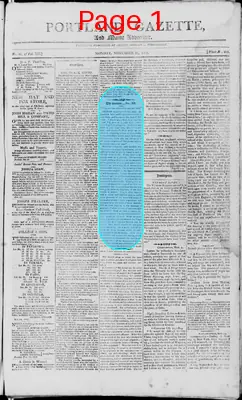
Editorial
November 27, 1809
Portland Gazette, And Maine Advertiser
Portland, Cumberland County, Maine
What is this article about?
Moral reflection on ingratitude in public and private life, drawing from a biblical story in Ecclesiastes about a poor wise man forgotten after saving a city. Urges acting with duty and conscience despite uncertain favor or neglect in old age.
Clipping
OCR Quality
95%
Excellent
Full Text
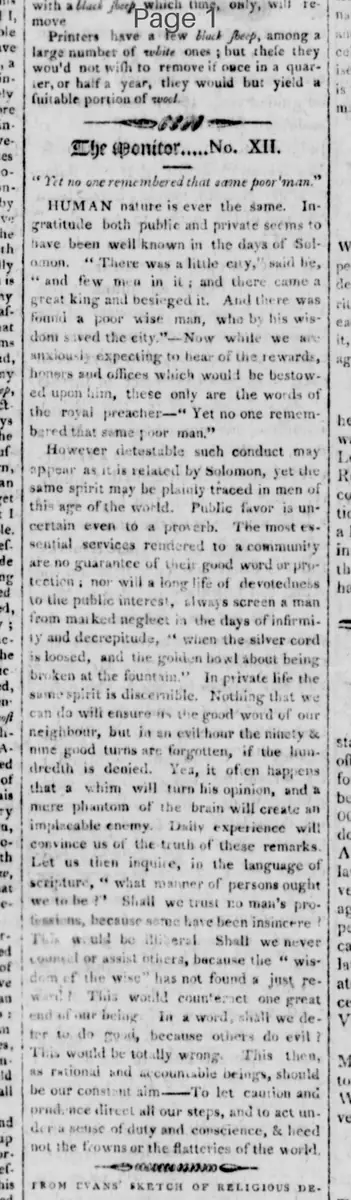
Printers have a few black sheep, among a large number of white ones; but these they would not wish to remove if once in a quarter, or half a year, they would but yield a suitable portion of wool.
The Monitor.....No. XII.
"Yet no one remembered that same poor man."
HUMAN nature is ever the same. Ingratitude both public and private seems to have been well known in the days of Solomon. "There was a little city," said he, "and few men in it; and there came a great king and besieged it. And there was found a poor wise man, who by his wisdom saved the city." Now while we are anxiously expecting to hear of the rewards, honors and offices which would be bestowed upon him, these only are the words of the royal preacher- "Yet no one remembered that same poor man."
However detestable such conduct may appear as it is related by Solomon, yet the same spirit may be plainly traced in men of this age of the world. Public favor is uncertain even to a proverb. The most essential services rendered to a community are no guarantee of their good word or protection; nor will a long life of devotedness to the public interest, always screen a man from marked neglect in the days of infirmity and decrepitude, "when the silver cord is loosed, and the golden bowl about being broken at the fountain." In private life the same spirit is discernible. Nothing that we can do will ensure the good word of our neighbour, but in an evil hour the ninety & nine good turns are forgotten, if the hundredth is denied. Yea, it often happens that a whim will turn his opinion, and a mere phantom of the brain will create an implacable enemy. Daily experience will convince us of the truth of these remarks.
Let us then inquire, in the language of scripture, "what manner of persons ought we to be?" Shall we trust no man's professions, because some have been insincere? That would be ill, even. Shall we never condescend or assist others, because the "wisdom of the wise" has not found a just reward? This would counteract one great end of our being. In a word, shall we deter to do good, because others do evil? This would be totally wrong. This then, as rational and accountable beings, should be our constant aim—To let caution and prudence direct all our steps, and to act under a sense of duty and conscience, heed not the frowns or the flatteries of the world.
The Monitor.....No. XII.
"Yet no one remembered that same poor man."
HUMAN nature is ever the same. Ingratitude both public and private seems to have been well known in the days of Solomon. "There was a little city," said he, "and few men in it; and there came a great king and besieged it. And there was found a poor wise man, who by his wisdom saved the city." Now while we are anxiously expecting to hear of the rewards, honors and offices which would be bestowed upon him, these only are the words of the royal preacher- "Yet no one remembered that same poor man."
However detestable such conduct may appear as it is related by Solomon, yet the same spirit may be plainly traced in men of this age of the world. Public favor is uncertain even to a proverb. The most essential services rendered to a community are no guarantee of their good word or protection; nor will a long life of devotedness to the public interest, always screen a man from marked neglect in the days of infirmity and decrepitude, "when the silver cord is loosed, and the golden bowl about being broken at the fountain." In private life the same spirit is discernible. Nothing that we can do will ensure the good word of our neighbour, but in an evil hour the ninety & nine good turns are forgotten, if the hundredth is denied. Yea, it often happens that a whim will turn his opinion, and a mere phantom of the brain will create an implacable enemy. Daily experience will convince us of the truth of these remarks.
Let us then inquire, in the language of scripture, "what manner of persons ought we to be?" Shall we trust no man's professions, because some have been insincere? That would be ill, even. Shall we never condescend or assist others, because the "wisdom of the wise" has not found a just reward? This would counteract one great end of our being. In a word, shall we deter to do good, because others do evil? This would be totally wrong. This then, as rational and accountable beings, should be our constant aim—To let caution and prudence direct all our steps, and to act under a sense of duty and conscience, heed not the frowns or the flatteries of the world.
What sub-type of article is it?
Moral Or Religious
What keywords are associated?
Ingratitude
Human Nature
Public Service
Private Relations
Moral Duty
Biblical Wisdom
What entities or persons were involved?
Solomon
Poor Wise Man
Editorial Details
Primary Topic
Ingratitude In Public And Private Life
Stance / Tone
Moral Exhortation To Act Dutifully Despite Ingratitude
Key Figures
Solomon
Poor Wise Man
Key Arguments
Human Nature Shows Ingratitude As In Solomon's Story Of The Forgotten Savior
Public Services Do Not Guarantee Favor Or Protection
Private Good Turns Are Forgotten In Moments Of Denial
Act With Caution, Prudence, Duty, And Conscience Regardless Of Others' Responses