Thank you for visiting SNEWPapers!
Sign up free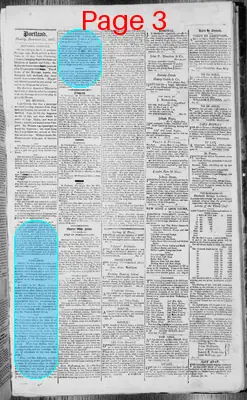
Editorial
December 21, 1807
Portland Gazette, And Maine Advertiser
Portland, Cumberland County, Maine
What is this article about?
Editorial criticizes the Nonimportation Act as risking war with Britain, praises peace efforts like sending envoy Rose, quotes advocacy for peace among Federalists and others, attacks Jefferson's hypocrisy on commerce and war, and mocks war advocates Orchard Cook and General Chandler.
Clipping
OCR Quality
98%
Excellent
Full Text
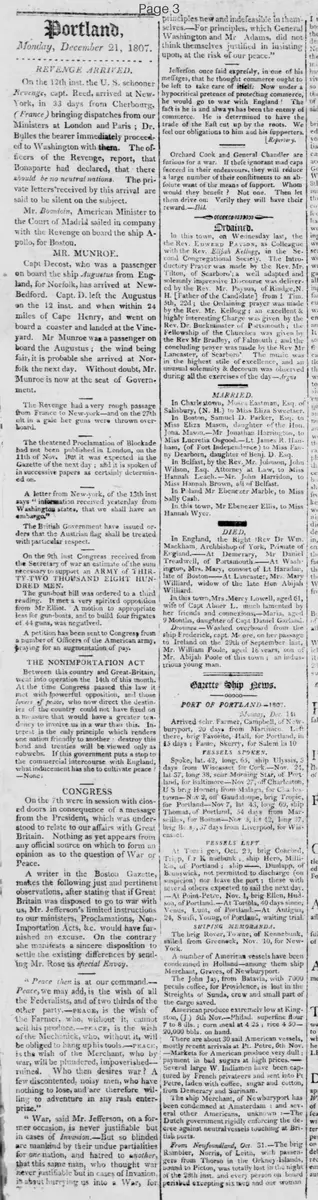
THE NONIMPORTATION ACT
Between this country and Great-Britain, went into operation the 14th of this month. At the time Congress passed this law it met with powerful opposition, and those lovers of peace, who now direct the destinies of the country could not have fixed on a measure that would have a greater tendency to involve us in a war than this. Interest is the only principle which renders one nation friendly to another: destroy this bond and treaties will be viewed only as cobwebs. If this government puts a stop to the commercial intercourse with England, what inducement has she to cultivate peace: -None:
CONGRESS
On the 7th were in session with closed doors in consequence of a message from the President, which was understood to relate to our affairs with Great Britain. Nothing as yet appears from any official source on which to form an opinion as to the question of War or Peace.
A writer in the Boston Gazette, makes the following just and pertinent observations, after stating that if Great Britain was disposed to go to war with us, Mr. Jefferson's limited instructions to our ministers, Proclamations, Non Importation Acts, &c. would have furnished an excuse. On the contrary she manifests a sincere disposition to settle the existing differences by sending Mr. Rose as special Envoy.
"Peace then is at our command.- Peace, we may add, is the wish of all the Federalists, and of two thirds of the other party.-Peace, is the wish of the Farmer, who, without it, cannot sell his produce,--PEACE, is the wish of the Mechanick, who, without it, will be obliged to hang up his tools.--PEACE, is the wish of the Merchant, who by war, will be plundered, impoverished- ruined. Who then desires war? A few discontented, noisy men, who have nothing to lose, and are therefore willing to adventure in any rash enterprize."
"War, said Mr. Jefferson, on a former occasion, is never justifiable but in cases of Invasion.-But so blinded are mankind by their undue partialities for one nation, and hatred to another, that this same man, who thought war never justifiable but in cases of Invasion, is about hurrying us into a War, for principles new and indefeasible in themselves.-For principles, which General Washington and Mr Adams, did not think themselves justified in insisting upon, at the risk of our peace."
Jefferson once said expressly, in one of his messages, that he thought commerce ought to be left to take care of itself: Now under a hypocritical pretence of protecting commerce, he would go to war with England! The fact is he is and always has been the enemy of commerce. He is determined to have the trade of the East cut up by the roots. We feel our obligations to him and his supporters.
[Repertory.]
Orchard Cook and General Chandler are furious for a war. If these ignorant mad caps succeed in their endeavours, they will reduce a large number of their constituents to an absolute want of the means of support. Whom would they benefit? Not one. Then let them drive on: Verily they will have their reward.-Ibid.
Between this country and Great-Britain, went into operation the 14th of this month. At the time Congress passed this law it met with powerful opposition, and those lovers of peace, who now direct the destinies of the country could not have fixed on a measure that would have a greater tendency to involve us in a war than this. Interest is the only principle which renders one nation friendly to another: destroy this bond and treaties will be viewed only as cobwebs. If this government puts a stop to the commercial intercourse with England, what inducement has she to cultivate peace: -None:
CONGRESS
On the 7th were in session with closed doors in consequence of a message from the President, which was understood to relate to our affairs with Great Britain. Nothing as yet appears from any official source on which to form an opinion as to the question of War or Peace.
A writer in the Boston Gazette, makes the following just and pertinent observations, after stating that if Great Britain was disposed to go to war with us, Mr. Jefferson's limited instructions to our ministers, Proclamations, Non Importation Acts, &c. would have furnished an excuse. On the contrary she manifests a sincere disposition to settle the existing differences by sending Mr. Rose as special Envoy.
"Peace then is at our command.- Peace, we may add, is the wish of all the Federalists, and of two thirds of the other party.-Peace, is the wish of the Farmer, who, without it, cannot sell his produce,--PEACE, is the wish of the Mechanick, who, without it, will be obliged to hang up his tools.--PEACE, is the wish of the Merchant, who by war, will be plundered, impoverished- ruined. Who then desires war? A few discontented, noisy men, who have nothing to lose, and are therefore willing to adventure in any rash enterprize."
"War, said Mr. Jefferson, on a former occasion, is never justifiable but in cases of Invasion.-But so blinded are mankind by their undue partialities for one nation, and hatred to another, that this same man, who thought war never justifiable but in cases of Invasion, is about hurrying us into a War, for principles new and indefeasible in themselves.-For principles, which General Washington and Mr Adams, did not think themselves justified in insisting upon, at the risk of our peace."
Jefferson once said expressly, in one of his messages, that he thought commerce ought to be left to take care of itself: Now under a hypocritical pretence of protecting commerce, he would go to war with England! The fact is he is and always has been the enemy of commerce. He is determined to have the trade of the East cut up by the roots. We feel our obligations to him and his supporters.
[Repertory.]
Orchard Cook and General Chandler are furious for a war. If these ignorant mad caps succeed in their endeavours, they will reduce a large number of their constituents to an absolute want of the means of support. Whom would they benefit? Not one. Then let them drive on: Verily they will have their reward.-Ibid.
What sub-type of article is it?
War Or Peace
Foreign Affairs
Economic Policy
What keywords are associated?
Nonimportation Act
War With Britain
Peace Advocacy
Jefferson Criticism
Commerce Protection
Federalists
Envoy Rose
What entities or persons were involved?
Great Britain
Congress
President
Mr. Jefferson
Mr. Rose
Federalists
General Washington
Mr. Adams
Orchard Cook
General Chandler
Editorial Details
Primary Topic
Criticism Of Nonimportation Act Risking War With Britain
Stance / Tone
Strongly Pro Peace And Anti War, Critical Of Jefferson
Key Figures
Great Britain
Congress
President
Mr. Jefferson
Mr. Rose
Federalists
General Washington
Mr. Adams
Orchard Cook
General Chandler
Key Arguments
Nonimportation Act Destroys Commercial Bonds And Risks War With Britain
Peace Is Wished By Federalists, Farmers, Mechanics, And Merchants
War Desired Only By Noisy Men With Nothing To Lose
Jefferson Hypocritical On War Justification And Commerce Protection
Britain Shows Disposition For Peace By Sending Envoy Rose
Washington And Adams Did Not Risk Peace For Similar Principles
Jefferson Enemy Of Commerce, Aims To Cut East Trade
War Advocates Like Cook And Chandler Will Harm Constituents Without Benefit