Thank you for visiting SNEWPapers!
Sign up free
Editorial
October 11, 1765
The New Hampshire Gazette And Historical Chronicle
Portsmouth, Greenland, Rockingham County, New Hampshire
What is this article about?
An editorial essay emphasizing the need for prudent, deliberate law-making to ensure good governance, drawing on Roman practices and historical examples from China, Russia, and Sparta to illustrate the dangers of hasty legislation and the importance of considering context, people, past, and future.
Clipping
OCR Quality
98%
Excellent
Full Text
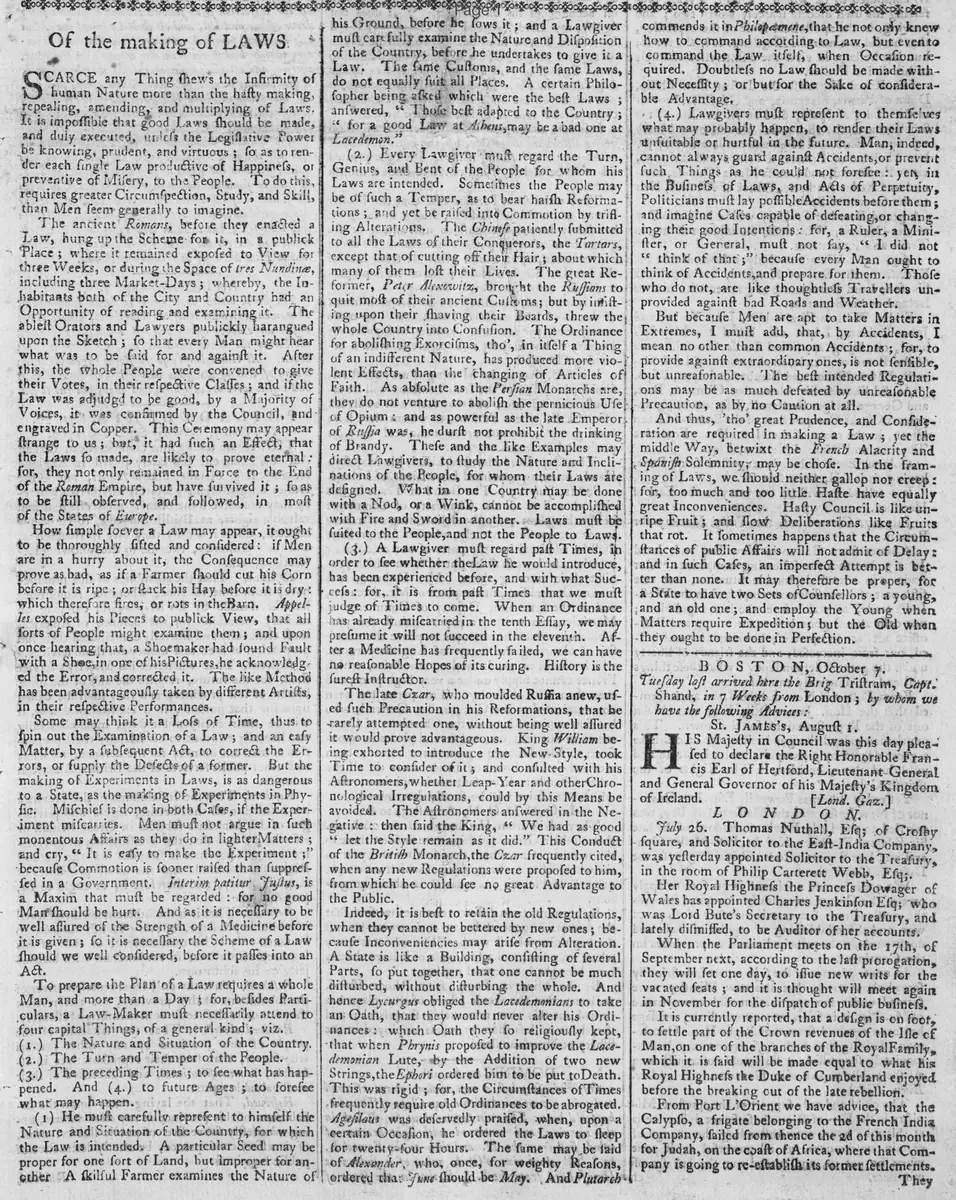
Of the making of LAWS
Because any Thing shows the Infirmity of human Nature more than the hasty making, repealing, amending, and multiplying of Laws. It is impossible that good Laws should be made, and duly executed, unless the Legislative Power be knowing, prudent, and virtuous; so as to render each single Law productive of Happiness, or preventive of Misery, to the People. To do this, requires greater Circumspection, Study, and Skill, than Men seem generally to imagine.
The ancient Romans, before they enacted a Law, hung up the Scheme for it, in a publick Place: where it remained exposed to View for three Weeks, or during the Space of tres Nundinæ, including three Market-Days; whereby, the Inhabitants both of the City and Country had an Opportunity of reading and examining it. The ablest Orators and Lawyers publickly harangued upon the Sketch; so that every Man might hear what was to be said for and against it. After this, the whole People were convened to give their Votes, in their respective Classes: and if the Law was adjudged to be good, by a Majority of Voices, it was confirmed by the Council, and engraved in Copper. This Ceremony may appear strange to us; but, it had such an Effect, that the Laws so made, are likely to prove eternal: for, they not only remained in Force to the End of the Roman Empire, but have survived it; so as to be still observed, and followed, in most of the States of Europe.
How simple soever a Law may appear, it ought to be thoroughly sifted and considered: if Men are in a hurry about it; the Consequence may prove as bad, as if a Farmer should cut his Corn before it is ripe: or stack his Hay before it is dry: which therefore shines; or rots in the Barn. Apelles exposed his Pictures to publick View, that all sorts of People might examine them; and upon once hearing that, a Shoemaker had found Fault with a Shoe in one of his Pictures, he acknowledged the Error, and corrected it. The like Method has been advantageously taken by different Artiffs, in their respective Performances.
Some may think it a Loss of Time, thus to spin out the Examination of a Law; and an easy Matter, by a subsequent Act, to correct the Errors, or supply the Defects of a former. But the making of Experiments in Laws, is as dangerous to a State, as the making of Experiments in Physic. Mischief is done in both Cases, if the Experiment miscarries. Men must not argue in such momentous Affairs as they do in lighter Matters: and cry, "It is easy to make the Experiment:" because Commotion is sooner raised than suppressed in a Government. Interrim batitur, nullus, is a Maxim that must be regarded: for no good Man should be hurt. And as it is necessary to be well assured of the Strength of a Medicine before it is given; so it is necessary the Scheme of a Law should be well considered, before it passes into an Act.
To prepare the Plan of a Law requires a whole Man, and more than a Day; for, besides Particulars, a Law-Maker must necessarily attend to four capital Things, of a general kind: viz. (1.) The Nature and Situation of the Country. (2.) The Turn and Temper of the People. (3.) The preceding Times; to see what has happened. And (4.) to future Ages; to foresee what may happen.
(1) He must carefully represent to himself the Nature and Situation of the Country, for which the Law is intended. A particular Seed may be proper for one sort of Land, but improper for another. A skilful Farmer examines the Nature of his Ground, before he sows it; and a Lawgiver must carefully examine the Nature and Disposition of the Country, before he undertakes to give it a Law. The same Customs, and the same Laws, do not equally suit all Places. A certain Philosopher being asked which were the best Laws; answered, "Those best adapted to the Country; for a good Law at Athens, may be a bad one at Lacedemon."
(2.) Every Lawgiver must regard the Turn, Genius, and Bent of the People for whom his Laws are intended. Sometimes the People may be of such a Temper, as to bear harsh Reformations; and yet be raised into Commotion by trifling Alterations. The Chinese patiently submitted to all the Laws of their Conquerors, the Tartars, except that of cutting off their Hair; about which many of them lost their Lives. The great Reformer, Peter Alexowitz, brought the Russians to quit most of their ancient Customs; but by insisting upon their having their Beards, threw the whole Country into Confusion. The Ordinance for abolishing Exorcisms, tho', in itself a Thing of an indifferent Nature, has produced more violent Effects, than the changing of Articles of Faith. As absolute as the Persian Monarchs are, they do not venture to abolish the pernicious Use of Opium: and as powerful as the late Emperor of Russia was, he durst not prohibit the drinking of Brandy. These and the like Examples may direct Lawgivers, to study the Nature and Inclinations of the People, for whom their Laws are designed. What in one Country may be done with a Nod, or a Wink, cannot be accomplished with Fire and Sword in another. Laws must be suited to the People, and not the People to Laws.
(3.) A Lawgiver must regard past Times, in order to see whether the Law he would introduce, has been experienced before, and with what Success: for, it is from past Times that we must judge of Times to come. When an Ordinance has already miscarried in the tenth Essay, we may presume it will not succeed in the eleventh. After a Medicine has frequently failed, we can have no reasonable Hopes of its curing. History is the surest Instructor.
The late Czar, who moulded Russia anew, used such Precaution in his Reformations, that he rarely attempted one, without being well assured it would prove advantageous. King William being exhorted to introduce the New-Style, took Time to consider of it; and consulted with his Astronomers, whether Leap-Year and other Chronological Irregularities, could by this Means be avoided. The Astronomers answered in the Negative: then said the King, "We had as good let the Style remain as it did." This Conduct of the British Monarch, the Czar frequently cited, when any new Regulations were proposed to him, from which he could see no great Advantage to the Public.
Indeed, it is best to retain the old Regulations, when they cannot be bettered by new ones: because Inconveniencies may arise from Alteration. A State is like a Building, consisting of several Parts, so put together, that one cannot be much disturbed, without disturbing the whole. And hence Lycurgus obliged the Lacedemonians to take an Oath, that they would never alter his Ordinances: which Oath they so religiously kept, that when Phrynis proposed to improve the Lacedemonian Lute, by the Addition of two new Strings, the Ephori ordered him to be put to Death. This was rigid: for, the Circumstances of Times frequently require old Ordinances to be abrogated. Agesilaus was deservedly praised, when, upon a certain Occasion, he ordered the Laws to sleep for twenty-four Hours. The same may be said of Alexander, who, once, for weighty Reasons, ordered that June should be May. And Plutarch commends it in Philopœmen, that he not only knew how to command according to Law, but even to command the Law itself, when Occasion required. Doubtless no Law should be made without Necessity: or but for the Sake of considerable Advantage.
(4.) Lawgivers must represent to themselves what may probably happen, to render their Laws unsuitable or hurtful in the future. Man, indeed, cannot always guard against Accidents, or prevent such Things as he could not foresee: yet in the Business of Laws, and Acts of Perpetuity, Politicians must lay possible Accidents before them; and imagine Cases capable of defeating or changing their good Intentions: for, a Ruler, a Minister, or General, must not say, "I did not think of that:" because every Man ought to think of Accidents, and prepare for them. Those who do not, are like thoughtless Travellers unprovided against bad Roads and Weather.
But because Men are apt to take Matters in Extremes, I must add, that, by Accidents, I mean no other than common Accidents: for, to provide against extraordinary ones, is not sensible, but unreasonable. The best intended Regulations may be as much defeated by unreasonable Precaution, as by no Caution at all.
And thus, tho' great Prudence, and Consideration are required in making a Law; yet the middle Way, betwixt the French Alacrity and Spanish Solemnity, may be chose. In the framing of Laws, we should neither gallop nor creep: for, too much and too little Haste have equally great Inconveniences. Hasty Council is like unripe Fruit: and slow Deliberations like Fruits that rot. It sometimes happens that the Circumstances of public Affairs will not admit of Delay: and in such Cases, an imperfect Attempt is better than none. It may therefore be proper, for a State to have two Sets of Counsellors; a young, and an old one; and employ the Young when Matters require Expedition; but the Old when they ought to be done in Perfection.
Because any Thing shows the Infirmity of human Nature more than the hasty making, repealing, amending, and multiplying of Laws. It is impossible that good Laws should be made, and duly executed, unless the Legislative Power be knowing, prudent, and virtuous; so as to render each single Law productive of Happiness, or preventive of Misery, to the People. To do this, requires greater Circumspection, Study, and Skill, than Men seem generally to imagine.
The ancient Romans, before they enacted a Law, hung up the Scheme for it, in a publick Place: where it remained exposed to View for three Weeks, or during the Space of tres Nundinæ, including three Market-Days; whereby, the Inhabitants both of the City and Country had an Opportunity of reading and examining it. The ablest Orators and Lawyers publickly harangued upon the Sketch; so that every Man might hear what was to be said for and against it. After this, the whole People were convened to give their Votes, in their respective Classes: and if the Law was adjudged to be good, by a Majority of Voices, it was confirmed by the Council, and engraved in Copper. This Ceremony may appear strange to us; but, it had such an Effect, that the Laws so made, are likely to prove eternal: for, they not only remained in Force to the End of the Roman Empire, but have survived it; so as to be still observed, and followed, in most of the States of Europe.
How simple soever a Law may appear, it ought to be thoroughly sifted and considered: if Men are in a hurry about it; the Consequence may prove as bad, as if a Farmer should cut his Corn before it is ripe: or stack his Hay before it is dry: which therefore shines; or rots in the Barn. Apelles exposed his Pictures to publick View, that all sorts of People might examine them; and upon once hearing that, a Shoemaker had found Fault with a Shoe in one of his Pictures, he acknowledged the Error, and corrected it. The like Method has been advantageously taken by different Artiffs, in their respective Performances.
Some may think it a Loss of Time, thus to spin out the Examination of a Law; and an easy Matter, by a subsequent Act, to correct the Errors, or supply the Defects of a former. But the making of Experiments in Laws, is as dangerous to a State, as the making of Experiments in Physic. Mischief is done in both Cases, if the Experiment miscarries. Men must not argue in such momentous Affairs as they do in lighter Matters: and cry, "It is easy to make the Experiment:" because Commotion is sooner raised than suppressed in a Government. Interrim batitur, nullus, is a Maxim that must be regarded: for no good Man should be hurt. And as it is necessary to be well assured of the Strength of a Medicine before it is given; so it is necessary the Scheme of a Law should be well considered, before it passes into an Act.
To prepare the Plan of a Law requires a whole Man, and more than a Day; for, besides Particulars, a Law-Maker must necessarily attend to four capital Things, of a general kind: viz. (1.) The Nature and Situation of the Country. (2.) The Turn and Temper of the People. (3.) The preceding Times; to see what has happened. And (4.) to future Ages; to foresee what may happen.
(1) He must carefully represent to himself the Nature and Situation of the Country, for which the Law is intended. A particular Seed may be proper for one sort of Land, but improper for another. A skilful Farmer examines the Nature of his Ground, before he sows it; and a Lawgiver must carefully examine the Nature and Disposition of the Country, before he undertakes to give it a Law. The same Customs, and the same Laws, do not equally suit all Places. A certain Philosopher being asked which were the best Laws; answered, "Those best adapted to the Country; for a good Law at Athens, may be a bad one at Lacedemon."
(2.) Every Lawgiver must regard the Turn, Genius, and Bent of the People for whom his Laws are intended. Sometimes the People may be of such a Temper, as to bear harsh Reformations; and yet be raised into Commotion by trifling Alterations. The Chinese patiently submitted to all the Laws of their Conquerors, the Tartars, except that of cutting off their Hair; about which many of them lost their Lives. The great Reformer, Peter Alexowitz, brought the Russians to quit most of their ancient Customs; but by insisting upon their having their Beards, threw the whole Country into Confusion. The Ordinance for abolishing Exorcisms, tho', in itself a Thing of an indifferent Nature, has produced more violent Effects, than the changing of Articles of Faith. As absolute as the Persian Monarchs are, they do not venture to abolish the pernicious Use of Opium: and as powerful as the late Emperor of Russia was, he durst not prohibit the drinking of Brandy. These and the like Examples may direct Lawgivers, to study the Nature and Inclinations of the People, for whom their Laws are designed. What in one Country may be done with a Nod, or a Wink, cannot be accomplished with Fire and Sword in another. Laws must be suited to the People, and not the People to Laws.
(3.) A Lawgiver must regard past Times, in order to see whether the Law he would introduce, has been experienced before, and with what Success: for, it is from past Times that we must judge of Times to come. When an Ordinance has already miscarried in the tenth Essay, we may presume it will not succeed in the eleventh. After a Medicine has frequently failed, we can have no reasonable Hopes of its curing. History is the surest Instructor.
The late Czar, who moulded Russia anew, used such Precaution in his Reformations, that he rarely attempted one, without being well assured it would prove advantageous. King William being exhorted to introduce the New-Style, took Time to consider of it; and consulted with his Astronomers, whether Leap-Year and other Chronological Irregularities, could by this Means be avoided. The Astronomers answered in the Negative: then said the King, "We had as good let the Style remain as it did." This Conduct of the British Monarch, the Czar frequently cited, when any new Regulations were proposed to him, from which he could see no great Advantage to the Public.
Indeed, it is best to retain the old Regulations, when they cannot be bettered by new ones: because Inconveniencies may arise from Alteration. A State is like a Building, consisting of several Parts, so put together, that one cannot be much disturbed, without disturbing the whole. And hence Lycurgus obliged the Lacedemonians to take an Oath, that they would never alter his Ordinances: which Oath they so religiously kept, that when Phrynis proposed to improve the Lacedemonian Lute, by the Addition of two new Strings, the Ephori ordered him to be put to Death. This was rigid: for, the Circumstances of Times frequently require old Ordinances to be abrogated. Agesilaus was deservedly praised, when, upon a certain Occasion, he ordered the Laws to sleep for twenty-four Hours. The same may be said of Alexander, who, once, for weighty Reasons, ordered that June should be May. And Plutarch commends it in Philopœmen, that he not only knew how to command according to Law, but even to command the Law itself, when Occasion required. Doubtless no Law should be made without Necessity: or but for the Sake of considerable Advantage.
(4.) Lawgivers must represent to themselves what may probably happen, to render their Laws unsuitable or hurtful in the future. Man, indeed, cannot always guard against Accidents, or prevent such Things as he could not foresee: yet in the Business of Laws, and Acts of Perpetuity, Politicians must lay possible Accidents before them; and imagine Cases capable of defeating or changing their good Intentions: for, a Ruler, a Minister, or General, must not say, "I did not think of that:" because every Man ought to think of Accidents, and prepare for them. Those who do not, are like thoughtless Travellers unprovided against bad Roads and Weather.
But because Men are apt to take Matters in Extremes, I must add, that, by Accidents, I mean no other than common Accidents: for, to provide against extraordinary ones, is not sensible, but unreasonable. The best intended Regulations may be as much defeated by unreasonable Precaution, as by no Caution at all.
And thus, tho' great Prudence, and Consideration are required in making a Law; yet the middle Way, betwixt the French Alacrity and Spanish Solemnity, may be chose. In the framing of Laws, we should neither gallop nor creep: for, too much and too little Haste have equally great Inconveniences. Hasty Council is like unripe Fruit: and slow Deliberations like Fruits that rot. It sometimes happens that the Circumstances of public Affairs will not admit of Delay: and in such Cases, an imperfect Attempt is better than none. It may therefore be proper, for a State to have two Sets of Counsellors; a young, and an old one; and employ the Young when Matters require Expedition; but the Old when they ought to be done in Perfection.
What sub-type of article is it?
Legal Reform
Constitutional
What keywords are associated?
Law Making
Legislation
Prudence
Roman Practices
Historical Examples
Lawgiver Considerations
Deliberate Reform
What entities or persons were involved?
Ancient Romans
Lycurgus
Peter Alexowitz
King William
Agesilaus
Alexander
Philopoemen
Editorial Details
Primary Topic
Prudence In Law Making
Stance / Tone
Advocacy For Deliberate And Considered Legislation
Key Figures
Ancient Romans
Lycurgus
Peter Alexowitz
King William
Agesilaus
Alexander
Philopoemen
Key Arguments
Hasty Law Making Reveals Human Infirmity And Leads To Poor Outcomes
Roman Practice Of Public Review Ensured Enduring Laws
Laws Must Be Thoroughly Examined Like Art Or Medicine To Avoid Mischief
Law Makers Must Consider Nature Of Country, Temper Of People, Past Experiences, And Future Possibilities
Laws Should Suit The People, Not Force People To Suit Laws
History Guides Judgment On New Laws
Retain Old Laws Unless Clearly Improved, As Changes Can Disrupt The State
Balance Haste And Delay In Legislation